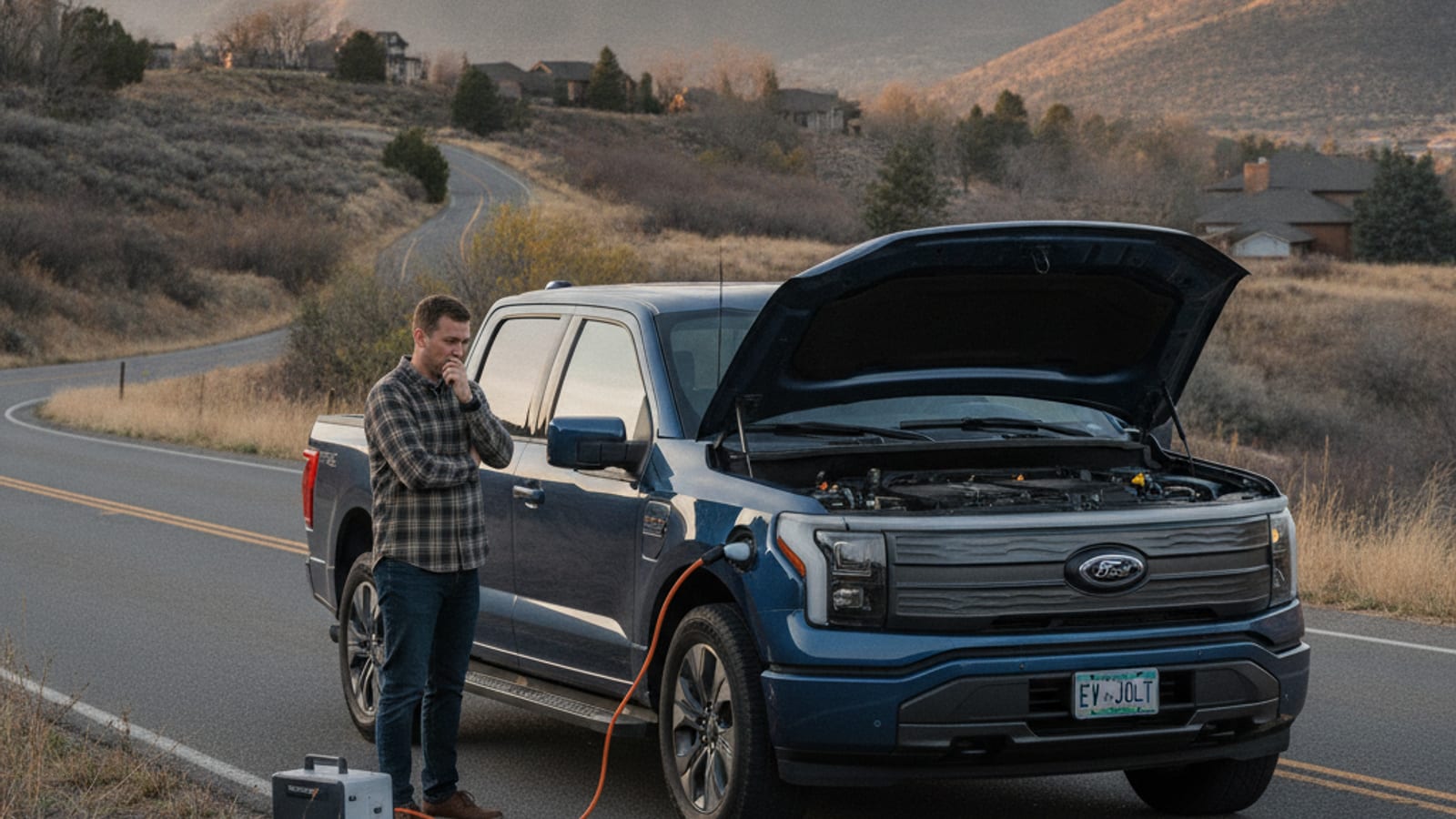
Mobile EV charging in Golden is the right call when your pack reads empty before you commit to the canyon. Golden sits at the mouth of Clear Creek Canyon where US-6 climbs toward Idaho Springs, and it is also where SH-93 runs north toward Boulder along the hogback. If your battery dies in a parking lot on Washington Avenue or beside the Coors brewery, you have not yet lost cell service or shoulder space. You still have a choice. Call (720) 738-6950 and we refer an independent local operator to your bumper. They quote before any cable goes in.
Why Golden is the last flat stop
Golden is wedged against the hogback where the plains end. The city sits around 5,675 feet, tucked between the Colorado School of Mines campus, the Coors brewery, and Lookout Mountain. Every road out of town climbs. US-6 west climbs into Clear Creek Canyon toward Idaho Springs and eventually the Eisenhower-Johnson Memorial Tunnel at 11,158 feet. SH-93 north runs along the hogback to Boulder with its own steady grade. SH-58 drops toward the mountains, and C-470 rings the west edge of the metro. Lookout Mountain Drive adds another climb above town.
That geography is the whole point. Golden is a flat, well-charged staging area for mountain runs. The Supercharger closest to US-6 west sits in Idaho Springs, and Georgetown between Idaho Springs and the tunnel shows no Supercharger in the current inventory. A driver who leaves Golden with a comfortable-looking margin can watch it shrink on the grade, then run out somewhere with fewer services. Charging here, while the road is still flat, is the easier call.
What a Golden stranding looks like
A Golden stranding is rarely a dramatic one. The patterns are quieter than the I-70 mountain rescues.
A student parks near the School of Mines for the day. The car sits through lectures in January, and a marginal 12-volt battery drains below the threshold the car needs to wake. The traction pack may still hold plenty of range, but the doors will not open and the screen will not light up. That is a 12-volt problem, not an empty-pack problem.
A driver from Lakewood or Arvada tops off at a public stall on Washington Avenue, runs a couple of errands, then heads west toward the canyon. The cold plus the start of the grade eats more range than the trip computer predicted. The pack reads 12 percent by the time the driver reaches the canyon mouth.
A cyclist or visitor parks at the Clear Creek whitewater park or up Lookout Mountain Drive, walks the trails for a few hours, and comes back to a car that will not unlock. Phantom drain ran the 12-volt down while the traction pack still shows range.
Each of those scenarios is a mobile EV charging referral, an out of charge recovery, or a Tesla 12V battery jump. Same answer, three different jobs.
What the operators we refer actually bring
Charge Pro DEN is a referral line. We do not own trucks, we do not employ technicians, and we do not carry insurance on the work itself. We match you with an independent local operator who runs a 240-volt Level 2 source. That operator drives to your location, confirms equipment and access, quotes you before any cable goes in, and bills you directly for the work they do.
The kit is a 240-volt Level 2 source on wheels. Tesla drivers get a native NACS plug on the lead. Other EVs use a CCS or J1772 adapter. Typical charging time adds about 10 to 20 miles of range in 15 to 30 minutes of charging once the cable is in. The clock starts when charging starts, not before. It is not an arrival time, and we do not promise one. Those added miles are usually enough to drive under your own power to a public stall, to home, or to a shop.
Operators we refer handle Tesla, Hyundai, Ford, Rivian, Lucid, Polestar, Mercedes, BMW, Volkswagen, and the rest of the major EV brands. A stuck charge port is a latch problem, not a tow problem. Ask the operator about the port before anyone hooks a winch.
Empty pack versus a dead 12-volt
The two problems feel the same from the driver’s seat. The fix is different.
A car that ran the pack down sits dark because there is no energy to power the computers. The 12-volt battery is fine, just like a flashlight with no batteries in it is fine. A Level 2 charge wakes the car.
A car that sat through a cold night can die on the 12-volt while the traction pack still shows plenty of range. The 12-volt runs the contactors, the door locks, and the infotainment. When it goes flat, the whole car looks dead. CDOT Safety Patrol jumps 12-volts on its covered segments, but Golden streets are not on those patrol segments. Independent operators we refer can jump or replace a 12-volt on site. Can roadside jump an EV 12-volt walks that split in detail.
How do you tell which one you have? If the dash showed low range before it died, treat it as an empty pack. If it sat through a freeze and never gave a low-range warning, start with the 12-volt. Recurrent Auto studied more than 30,000 U.S. EVs in winter. At 32 degrees, EVs kept about 78 percent of max range. Cold is why a morning buffer can vanish on a Golden canyon climb. It is not a reason to guess the next charger.
Why Golden is easier than the canyon
A stranding at the mouth of Clear Creek Canyon is still in cell range, still on a paved surface, and still on flat ground. A stranding partway up US-6 or on SH-93 is none of those. The canyon road climbs steadily. Cell coverage gets patchy. Pull-offs are narrow, and winter conditions can close them.
Treat Golden as the place to top off, not the place to gamble. If your range is below 30 percent at the Supercharger east of town, do not point west toward Idaho Springs without a plan. Find a public stall in Golden and add range before you leave the flat ground.
For a longer comparison of who covers what in this metro, read Tesla, AAA, and a local mobile rescue. That post stays on coverage. This one stays on charging at the canyon mouth.
When a tow is still the right tool
A roadside charge does not straighten bent suspension. If the car cannot roll, you need a tow. CRS 42-4-1202 lets a driver sit on the shoulder if the vehicle could not be moved further, with hazard lights on under CRS 42-4-230. That law covers Golden shoulders. It does not change the fact that a tow truck is the right answer for a car with body damage.
CRS 42-4-1803 sets no fixed hour count for an abandoned-vehicle call. No Colorado statute treats a disabled EV as a special class. A stranded EV is governed by the same disabled-vehicle statutes as any other car, and the Colorado Public Utilities Commission regulates towing carriers. Exact tow fee figures were not verified for this page.
If the car is undamaged but the pack will not take a charge, a mobile operator can usually still help on site. They will tell you when the right call is a flatbed instead.
What to do right now if you are stuck in Golden
Turn your hazards on and stay visible to traffic. Stay in the car if that is the safer choice. If you are in a parking lot, set the parking brake and leave the car in park. Do not try to push a disabled EV into a travel lane by yourself.
If the dash showed low range before it died, this is an empty pack. If it sat through a freeze and never warned, this is likely a 12-volt. The operator can tell you which one when they get there.
Call (720) 738-6950. We serve the Denver metro from the plains to the foothills, and we refer operators to Golden. The operator quotes you before they start work. Treat it as a referral number, not a rolling promise.
How to choose before you leave Golden
A few decisions made in a parking lot can save a real problem up the canyon.
Read the dash at the bottom of the hill before you climb. If the pack is below about 30 percent, find a stall in town or call for a mobile EV charging boost before you commit. The same rule applies to SH-93 toward Boulder. The hogback climb plus a winter heater will eat a margin that looked fine on the plain.
Keep your phone charged. A dead phone in Clear Creek Canyon with a dead car is a much harder problem than the same combination in a Golden parking lot. Cell coverage stays reliable on Washington Avenue and along US-6 until you get past the first switchbacks.
Watch the temperature. Recurrent’s data shows about a 30 percent range drop at 20 degrees compared to a mild day, and AAA’s study shows about a 39 percent loss at 20 degrees. A warm-climate estimate of range is not safe in a Denver metro winter. Build a bigger buffer than you think you need.
If the worst happens anyway, the operator quotes first and the cable goes in only after you say yes. You stay in your car, you stay off the shoulder, and you drive out under your own power.
Frequently asked questions
Should I top off in Golden or push on to Idaho Springs?
Top off in Golden. The Idaho Springs Supercharger sits at 7,526 feet, and Georgetown in between shows no Supercharger in the current inventory. The climb plus the heater plus the cold can close the gap between what the dash promises and what the pack delivers. A 240-volt Level 2 boost in Golden is cheaper insurance than a canyon stranding.
Can the operator bring a charge to my School of Mines parking lot?
Yes, in most cases. The operators we refer roll a 240-volt Level 2 source and confirm access before they start. They need a spot near your car and a safe place to park the truck. Call (720) 738-6950 and describe the lot. The operator will tell you whether the space works.
Is a dead 12-volt in Golden the same as an empty pack?
No. A dead 12-volt usually means the car sat cold and the small accessory battery went flat. The traction pack may still have plenty of range. An empty pack means the main battery hit zero. The operator can tell which one you have when they arrive. Both are fixable on site, but the job is different.