A Chevy Bolt that won’t charge at a Front Range stall is usually the stall. Ice, a failed handshake, or a weak 12-volt will stop the session. The pack can still have miles. Run those checks before you call for a boost.
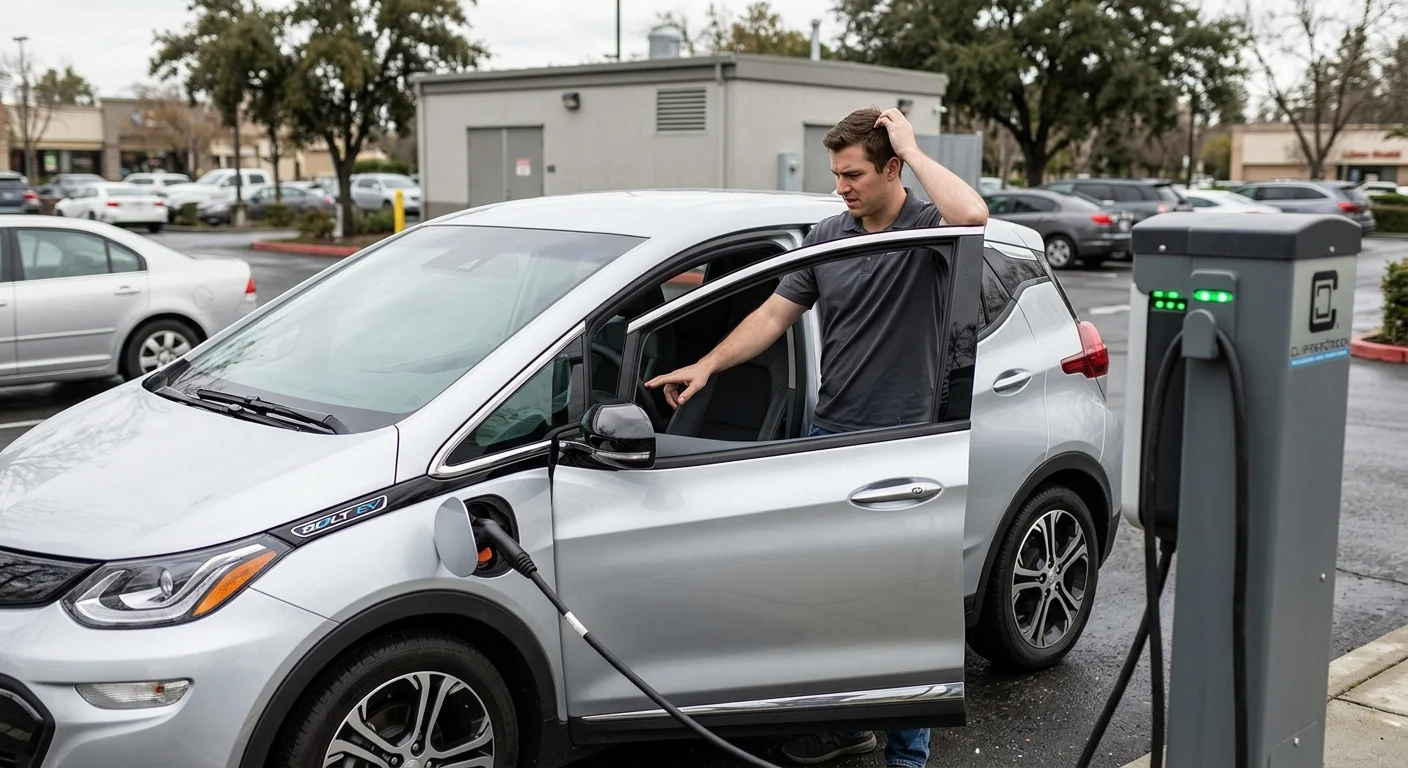
A frozen stall shows up more than an empty pack
January nights around here sit near 18 degrees. That’s the NWS Boulder climate normal. The January 2024 arctic blast dropped Denver from 47 to minus 19. That swing took about two days. A Bolt that sat through a soak like that can refuse a public plug.
Snow melt in the charge port is a local pattern. You plug in after a wet run on I-25 or C-470. The handle looks seated. The car stays quiet. Ice and water interrupt the handshake the Bolt needs. That’s a stall and port problem. It isn’t an empty pack.
Chevy Equinox EV drivers see the same public-stall freeze. Our Chevy Equinox EV public charging notes cover the same stall pattern. The Bolt order is close. You still need a clean port and a live station. You also need a 12-volt that will wake the high-voltage system.
Cold also cuts range, which is why people mix the two problems up. Recurrent Auto’s winter study found EVs keep about 78% of max range at 32 degrees. At 20 degrees they keep about 70% on average. A won’t-charge alert is a different failure than a range miss.
Denver sits at 5,280 feet at the State Capitol’s west steps. None of that is a frozen CCS stall at Park Meadows. The Denver Tech Center produces the same ice on a dwell.
Read the screens before you blame the pack
Look at the range you had when you parked. If you still had tens of miles, you aren’t out of charge. An empty pack and a silent stall feel similar from the seat. They aren’t the same problem.
If the screens are dark and the doors feel slow, think 12-volt. The traction battery can be healthy while the small battery won’t close the contactors. Charging never starts in that state. You need a jump or a 12-volt swap. You don’t need a DC fast stall yet.
If the screens are awake, read the alert. Unable to Charge points at the stall and the port. That message is a handshake or a safety cut. It isn’t a miles-to-empty reading.
Keep the hazards on if you’re on a paved shoulder. Colorado’s disabled-vehicle rule is CRS 42-4-1202. Outside a business or residential district, don’t stop on the traveled lanes. The exception is a car that truly couldn’t go farther. Hazard lighting is required under CRS 42-4-230. A violation is a class B traffic infraction. There’s no EV carve-out in Colorado law. A stranded Bolt is treated like any disabled car.
Work a public stall in a tight order
Stay with the first station for one extra try. Unplug, wait a few seconds, and seat the connector again. If the station screen is dark or frozen, that stall is already the story.
Move one stall over on the same island if you can do it safely. Public hardware fails one port at a time. A dead unit next to a live one is common after a cold garage night.
Then change networks, not just stalls. EVgo lists 24 Colorado sites in the current inventory. Electrify America adds DC fast coverage across the metro. Your Bolt talks CCS or J1772. It doesn’t talk Tesla-only Supercharger hardware. Tesla Superchargers sit across the metro, including Denver and Idaho Springs. That density helps Tesla drivers. It doesn’t mean your Bolt can use those stalls. Confirm the plug and the app before you roll over.
A station that looks open on the map can still refuse a session. If the cable won’t release, stop yanking. Cold locks the latch. Use the stuck charge-port steps for that freeze. Melt and dry the inlet before you force it. Standing water after a Front Range storm is the other quiet killer. Read snow melt in the port before you plug a wet inlet.
A connected-but-idle session has its own pattern. If the app says plugged in and kilowatts sit at zero, keep reading. Use the connected but not charging checks. That’s still stall and handshake. It isn’t proof the pack is empty.
Public charging around the Denver metro is a mix of Level 2 and DC fast. Park Meadows in Lone Tree sees long garage dwells. So does the Tech Center in Greenwood Village. A Bolt that sat through a Red Rocks show can ice in Morrison. The car isn’t unique. The stall and the cold are.
Level 1, Level 2, and DC fast are different conversations. A Bolt that refuses DC fast may still take a quiet J1772 charge.
Home charging here is a utility question
The Denver metro isn’t one electric company. Xcel Energy covers Denver, Aurora, Lakewood, Golden, and Wheat Ridge. It also covers Littleton, Englewood, Sheridan, and Cherry Hills Village. Greenwood Village, Boulder, Louisville, Superior, and Lafayette are Xcel too. So are the Clear Creek towns.
CORE Electric Cooperative owns the Douglas County corridor. That’s Centennial, Highlands Ranch, Lone Tree, Parker, Castle Rock, and Castle Pines.
United Power covers much of the north and northeast, including Brighton. It splits streets with Xcel in Thornton, Northglenn, and Westminster. Arvada, Broomfield, Erie, and Commerce City split too. Longmont Power and Communications is the City of Longmont’s municipal utility.
If the home plug added no miles, start at the breaker. Then confirm the utility. A tripped Level 2 breaker is ordinary after a cold soak. If it trips again, stop. That’s an electrician’s job, not a roadside charge.
Confirm who serves the address in the split cities. Don’t call Xcel from a CORE street in Highlands Ranch. Don’t call Xcel from a United Power house in Brighton. Longmont rebate and public Level 2 questions go to the City. They don’t go to Xcel.
Xcel publishes EV Accelerate At Home, Optimize Your Charge, Charging Perks, RE-TOU, and PCAN. It also lists the EV Home Wiring Rebate and the Residential EV Rebate. CORE publishes COREV Connect, COREV Charge, and COREV Community Charge. CORE’s own page says COREV Charge is at capacity and closed to new applications. United Power publishes United EV, the EV Make-Ready Wiring Rebate, and RTD1. It also lists the EV Home Charge Panel Upgrade Rebate. LPC publishes an EV Charger Rebate plus City Level 2. We don’t publish rebate dollars. Check the current program with the utility that bills you.
A home Level 2 that won’t wake the car is often 12-volt or port ice. It isn’t automatically a failed onboard charger.
What “Unable to Charge” is telling you
“Unable to Charge” is a blanket GM alert. The Bolt and the station negotiate voltage, current, and safety before any kilowatts move. If that talk fails, the car cuts the session. The message doesn’t name the guilty party.
A flaky public station is the usual cause on a winter evening. Unstable supply at a tired lot stall trips the same protection. So does a wet pin or a half-latched handle. A software hiccup after a January sit will do it too.
An onboard charger fault or a high-voltage battery fault is possible. It isn’t the first explanation. Persistent errors after a new stall and a 12-volt check are dealer territory. Roadside help won’t reflash an onboard charger on a shoulder.
Reset the charging brain, then retry
Treat this as a reboot, not a repair. Unplug fully so the session actually ends. Power the Bolt off. Open and close the driver’s door so modules drop. Wait a few minutes. Power back on. Plug in again.
If the station has a safe, labeled second connector, try that after the car reset. Don’t open cabinets. Don’t cycle breakers that aren’t yours.
This clears a lot of ghost handshakes. If it does nothing, you’ve learned something. The fault is still in the stall, the 12-volt, or the port.
Check the 12-volt before you call it a pack problem
The big battery moves the car. The small 12-volt runs the computers, locks, and the relays that allow charging to start. No 12-volt, no charge handshake. That’s true on a Bolt the same way it’s true on every modern EV.
A weak 12-volt after a Denver cold soak looks like a brick. Screens stay dark. The charge port ignores the handle. The traction pack can still hold plenty of range.
On most Bolts the 12-volt sits under the hood on the driver’s side. Look for corrosion on the terminals. A rest voltage near 12.6 volts with the car off is the healthy neighborhood. That’s for a lead-acid 12-volt. A reading well under 12 volts is a problem. If you aren’t set up to measure it, skip the guess and treat the symptoms.
Jumping an EV 12-volt isn’t the same as jumping a gas car. Wrong clamps and a running donor can hurt modules. Recurring 12-volt deaths belong in a maintenance conversation. A 12-volt jump can wake the car so it’ll accept a charge. It doesn’t fill the traction pack. If you’re actually at zero miles, you still need energy into the high-voltage battery.
If you’re already stuck on a metro road
Move to the outside shoulder if you can. I-25 North Express Lanes were built with a minimum 8-foot outside shoulder. US-36 Express Lanes were built the same way. The right shoulder is the breakdown side. Don’t sit in a live lane.
CDOT Safety Patrol helps on covered freeway segments. That includes parts of I-25 South from 120th Ave to Arapahoe Rd. It includes I-70 East from Wadsworth to Airport Blvd. It also covers portions of US-6, C-470, and I-225. The I-70 Mountain Corridor coverage runs Morrison to Vail. Front Range weekday hours are 6:00 to 9:30 a.m. and 2:30 to 7:00 p.m. Weekends run 10:00 a.m. to 7:00 p.m. They’ll jump a 12-volt, change a tire, and handle debris. CDOT’s own pages say nothing about EV charging. The free state program won’t bring a charge to a Bolt.
On E-470, pull to the shoulder and dial *470. You can also dial *CSP (*277) for State Patrol. That help is flats, fluids, jumps, and debris. It isn’t a mobile EV charge.
Abandoned-vehicle rules are CRS 42-4-1803 to 1805. There’s no published 24-hour clock in the statute. Get the car to a legal, safer spot when you can.
COtrip.org and 511 carry I-70 closures and traction-law status. Traction law and chain law activate by signage and COtrip. If you were climbing toward Evergreen or Idaho Springs, check COtrip first.
Peña Boulevard is the only road into Denver International. It’s city-maintained, not an interstate. A week in a cold DEN lot often kills the 12-volt. That isn’t an empty pack.
When a mobile boost is the right call
A tow moves the car. It doesn’t diagnose a handshake. It doesn’t jump a 12-volt. It doesn’t put 240-volt energy into the pack on the spot. For a Bolt that won’t charge, skip the tow for a handshake fault. A crash, a mechanical failure, or a shop-bound high-voltage fault still needs a tow.
Charge Pro DEN works as a referral line. We don’t own trucks, and we don’t do the work. We match you with independent local mobile rescue operators. The operator quotes you before starting and bills you directly. We set no prices and we promise no arrival time.
The operators we connect you with bring a 240-volt Level 2 source to the car. For a Bolt that means CCS or a J1772 adapter, not a Tesla-native plug. They typically add 10 to 20 miles in 15 to 30 minutes of charging. That’s charging time, not an arrival time. They can also jump or replace a dead 12-volt on site. See non-Tesla EV rescue and mobile EV charging for how that referral works.
Call when the stall, the port, the reset, and the 12-volt checks have failed. Call when you can’t reach another charger from where you sit. If you’ve finished the checks and still need a boost, call. The number is (720) 738-6950. We’ll connect you with a local operator who quotes you before any work starts.