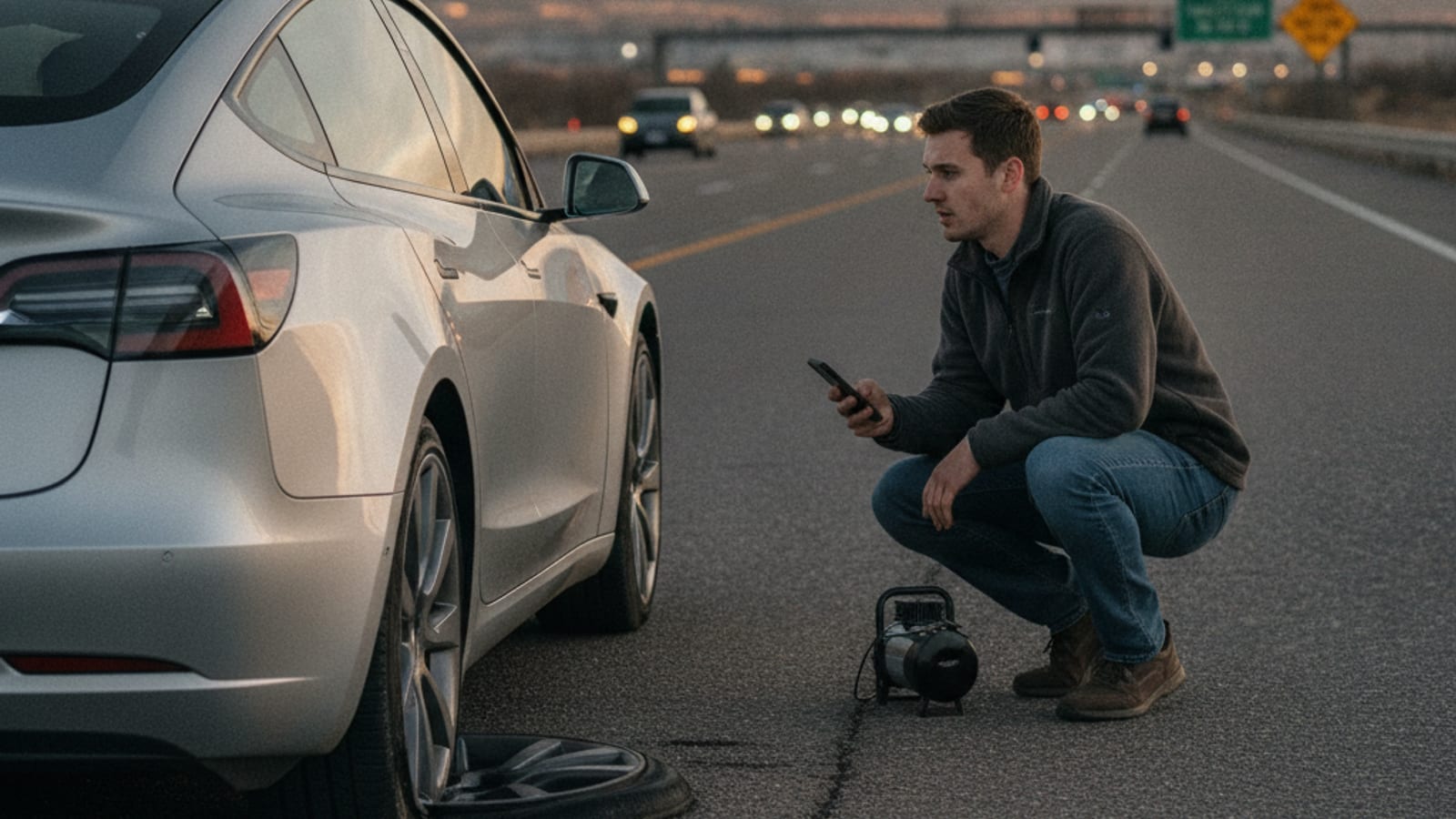
Teslas do not have run-flat tires from the factory. They ship on standard summer, all-season, or dedicated winter tires, depending on the build and the wheel package. Colorado’s traction law does not care whether your tire can run flat. It cares whether the tire has enough grip to move the car up a snowy grade. Run-flats do not solve that. If your Tesla will not move forward under the law, chains or a winter tire with the right markings do.
If you are already stopped on a shoulder somewhere along the metro, call (720) 738-6950. Charge Pro DEN is a referral line. The operators we refer quote you before any work starts.
Teslas ship on ordinary tires
Tesla’s own owner documentation, year by year, lists tire type, recommended pressures, and what to do after a puncture. None of those documents describe run-flat tires. None of them promise that you can keep driving on a flat. A Model 3, Model Y, Model S, Model X, or Cybertruck on its original wheel package uses a conventional tire. Puncture repair and replacement follow the same logic as any other car: stop somewhere safe, change the tire if you have a spare, or call for help.
The newer low-voltage battery in current Model 3 and Model Y is lithium-ion. The hood still opens with the external cable. From there, the standard 12-volt jump process takes over for cars that go dark in a cold lot. That is a separate battery from the traction pack. It has nothing to do with whether the tires are run-flat. They are not.
If you have ever wondered “do Teslas have run flat tires” because you wanted to keep driving home on a flat, the answer is no. Pull off the road. Use your spare if you carry one and the model includes it. Most Teslas do not include a spare at all. The car will not let you roll far on a true flat.
A flat still ends your drive
Run-flat tires are reinforced sidewalls that let you keep driving for a short distance at low speed after losing pressure. They are common on some BMW, Mercedes-Benz, and Mini models. They are not common on Teslas. Tesla’s chosen path is a tire pressure monitoring system plus a tire repair kit in some trims, plus roadside service for the rest.
Here is what that means on a Front Range shoulder:
- A sidewall blowout is a tow, not a slow roll to the next exit.
- A slow leak may let you limp a few miles at low speed. The pressure warning will not stop you, but the tire will.
- A nail in the tread is repairable, but only if you can get the wheel off the road and the car onto a stable surface.
In Colorado, the relevant question is usually not “can I drive home on a flat?” It is “will I get stuck before I get home?” Cold and grade eat your margin fast. A flat tire on top of that is the kind of day that ends with a flatbed.
The traction law is not about your tire being drivable
CDOT’s Passenger Vehicle Traction Law sits in CRS 42-4-106 and on the agency’s traction-law page. The rule is about grip on a snowy or icy road, not about whether a flat tire can carry you another mile. The two questions look similar. They have nothing to do with each other.
Under the standard traction law:
- An AWD or 4WD vehicle must have M+S (mud and snow) tires with at least 3/16 inch of tread depth. All-season tires that carry the M+S marking count.
- A 2WD vehicle must have chains or an approved traction device on the drive axle. M+S tires alone do not satisfy the rule for 2WD cars.
- The law activates by highway signage and is also posted on COtrip.org and the 511 line.
When CDOT escalates to the Passenger Vehicle Chain Law in a severe storm, every vehicle on that segment needs chains or an approved traction device. AWD no longer exempts you. Tread depth no longer exempts you. A run-flat marking, if such a marking existed, would not exempt you either.
The fines are real: $100 plus a $33 surcharge for non-compliance, $500 plus a $157 surcharge if your car blocks a lane. Those are state-set numbers and have not changed in this audit. They are not the same as a service price from Charge Pro DEN. We do not publish service prices, and we do not promise an arrival window.
Run-flats do not satisfy the law
A run-flat tire is still a tire. If it carries the M+S marking, it counts as M+S for the standard traction law. If it does not, it does not. The reinforcement that lets you drive on a flat does not put a snowflake on the sidewall. Tesla does not offer a factory run-flat option, so you do not get to rely on one.
What does satisfy the law:
- A dedicated winter tire with the three-peak mountain snowflake (3PMSF) marking. This is the strictest snow rating for passenger tires in North America.
- An M+S all-season tire with at least 3/16 inch of tread depth on every drive tire.
- Chains or an approved traction device sized to your wheel, installed when the law is active.
For a Tesla on its factory summer or all-season tires, the answer is usually chains for a storm trip, or a fitted winter wheel set for the season. Charge Pro DEN does not sell or install either. We refer drivers to independent local operators for roadside work. Tire shops fit seasonal sets.
How the law actually activates
CDOT does not run the traction law on a calendar. There is no published “season starts on this date” line for the whole state. CDOT imposes the law by posting signs on the affected highway segment. COtrip.org and the 511 line carry the activation status. The radio version is the variable-message signs over the road.
In practice, the metro segments most likely to see a chain law activation sit on the I-70 Mountain Corridor west of Morrison. CDOT’s Safety Patrol covers that corridor Morrison to Vail on posted hours. The corridor is the same stretch that closes during bomb-cyclone weather. The March 2019 storm closed Peña Boulevard, I-70, and I-25 and shut the airport. That is the size of storm the chain law is built for.
If you plan to drive from the metro to a mountain destination on a forecast storm day, check COtrip the night before. Read the chain-law status before you back out of the driveway. Do not assume AWD means you are clear. It is not.
When the sign says chains
Most Tesla drivers do not own chains. Most have never installed chains on any car. Installing chains on a Tesla Model 3 or Model Y in the cold, in a chain-up area, with traffic backing up behind you, is a learned skill. It is not a thing to attempt for the first time at the Eisenhower Tunnel. The clearance between the tire and the inner fender on a Tesla is tighter than on most trucks and SUVs. Some chain sets do not fit at all.
Plan in advance:
- If you are heading into the mountains in winter, carry chains or an approved traction device that fits your wheel and tire size.
- Practice installing them once in a dry garage before you need them in the storm.
- If you do not have chains and the sign says chains, do not drive past the sign. CDOT will turn you around or hold you at a chain-up station. You will lose more time fighting that than you would have lost buying chains.
This is also why many mountain regulars run a winter wheel set from late fall through early spring. The cost is not zero. The convenience is real. Charge Pro DEN does not publish tire costs, because we do not sell tires and we do not set tire prices. Independent tire shops in the metro publish their own pricing.
If you flat on the way up
A flat tire at altitude in a storm is a different kind of problem than a flat tire in a parking lot. You are on a shoulder with snow coming down. The shoulder on the I-70 Mountain Corridor is narrow. The visibility is poor. The next chain-up area may be twenty minutes up the road. You cannot safely change a tire on a tire that is still holding some pressure while traffic passes at highway speed in slush.
For a Tesla with a tire repair kit, the kit can sometimes reinflate a tire with a small puncture and a slow leak. It cannot fix a sidewall failure. It cannot fix a blowout. It cannot fix a tire with a chunk missing from the tread.
For a Tesla with no spare and no usable repair, the only safe path is a tow to a tire shop. Charge Pro DEN’s role on the mountain corridor is the referral line for the operators we work with. We are not a tow company. We do not own trucks. The operator we refer quotes you before they start, and they handle the work. Call (720) 738-6950 if you are stranded. If you are reading this from home, save the number before you leave.
If the car is still drivable but the tire is going flat, drive slowly to the next safe pull-off. Hazard lights on. Stay on the outside shoulder. Get off the road before you stop. A car that is limping is a car that needs a tire shop, not a chain-up station.
Where we fit, and where we don’t
Charge Pro DEN is a referral line for stranded EV drivers. We match you with an independent local operator. The operator brings a 240-volt Level 2 source for an empty pack, or a 12-volt jump box for a dead low-voltage battery. We are not a tire shop. We are not a chain installer. We are not a tow company in the contract sense. The operators we refer may also not be a tire shop, depending on the job.
What we are good for:
- An EV that is out of charge on a metro shoulder, on I-70, or on a side street near Evergreen or Idaho Springs.
- A Tesla that will not wake after a cold night because the 12-volt is dead.
- A non-Tesla EV with a CCS or J1772 port that needs a Level 2 boost to reach the next charger.
- A charge port that is stuck closed after an ice storm.
For a flat tire, your fastest path on a posted highway is usually the CDOT Safety Patrol, which covers listed metro segments on posted hours and changes tires on its menu. For a flat on a city street, a tow to a tire shop is the practical answer. For a Tesla-specific question about roadside coverage, the Tesla app is the primary call. Charge Pro DEN is the referral line when your car needs a charge and you cannot reach one. We are also the second call when the OEM path does not bring a 240-volt source to your shoulder. The first screen on every rescue topic is the phone number.
What Tesla covers and what it does not
Tesla roadside, reached through the Tesla app, handles tire changes on covered cars using the tire repair kit and a standard procedure. It also jumps a 12-volt battery. It does not bring a Level 2 charge to a stranded EV. Out-of-range assistance is offered under certain conditions and is not always free. Read your app screen for the exact coverage that applies to your car. The operator that Tesla sends is a contracted third party, not a Tesla employee.
For the local option when the OEM path runs out, see our Tesla roadside coverage page. For a charge when the pack is empty, see mobile EV charging. For a 12-volt jump on a cold metro morning, see Tesla 12-volt battery jump. For the broader category, see EV roadside assistance.
Frequently asked questions
Do Teslas have run flat tires?
No. Tesla does not fit run-flat tires from the factory. A Tesla on its original wheel package uses a conventional tire, and a true flat will leave the car undrivable. Some trims include a tire repair kit. Most do not include a spare. Tesla roadside through the app is the OEM path for a flat. CDOT Safety Patrol will also change a tire on listed metro and mountain segments during posted hours.
Does a run-flat tire satisfy Colorado’s traction law?
Only if it carries the M+S marking. Run-flat is a sidewall construction, not a snow rating. If the run-flat tire has the M+S marking with at least 3/16 inch of tread depth, it counts toward the standard traction law. If it does not, it does not. The three-peak mountain snowflake marking on a dedicated winter tire is the strongest indicator.
When is the traction law active on I-70?
CDOT posts the activation on highway signs and on COtrip.org. There is no fixed calendar for the whole corridor. Storm events trigger it. The I-70 Mountain Corridor west of Morrison is the segment most likely to see a chain-law activation in a serious storm. Check COtrip before you leave.
Can I install chains on a Tesla Model Y?
Some chains fit. Many do not, because of the inner-fender clearance on Tesla vehicles. Buy chains sized for your wheel and tire combination. Practice installing them in a dry garage before you need them in a storm. Do not attempt a first-time install on the side of I-70 in a chain-up area during a chain-law activation.
What if I flat on the way up to the mountains and I have no spare?
Turn your hazards on, get to the outside shoulder, and get off the road before you stop if you can. CDOT Safety Patrol covers the I-70 Mountain Corridor Morrison to Vail on posted hours and changes tires. Outside those hours, or off the listed segments, a tow to a tire shop is the practical answer. If your Tesla will not start at all because the 12-volt died in the cold, call (720) 738-6950 for a referral to a local operator. That is a separate problem from a flat tire, and the fix is different.