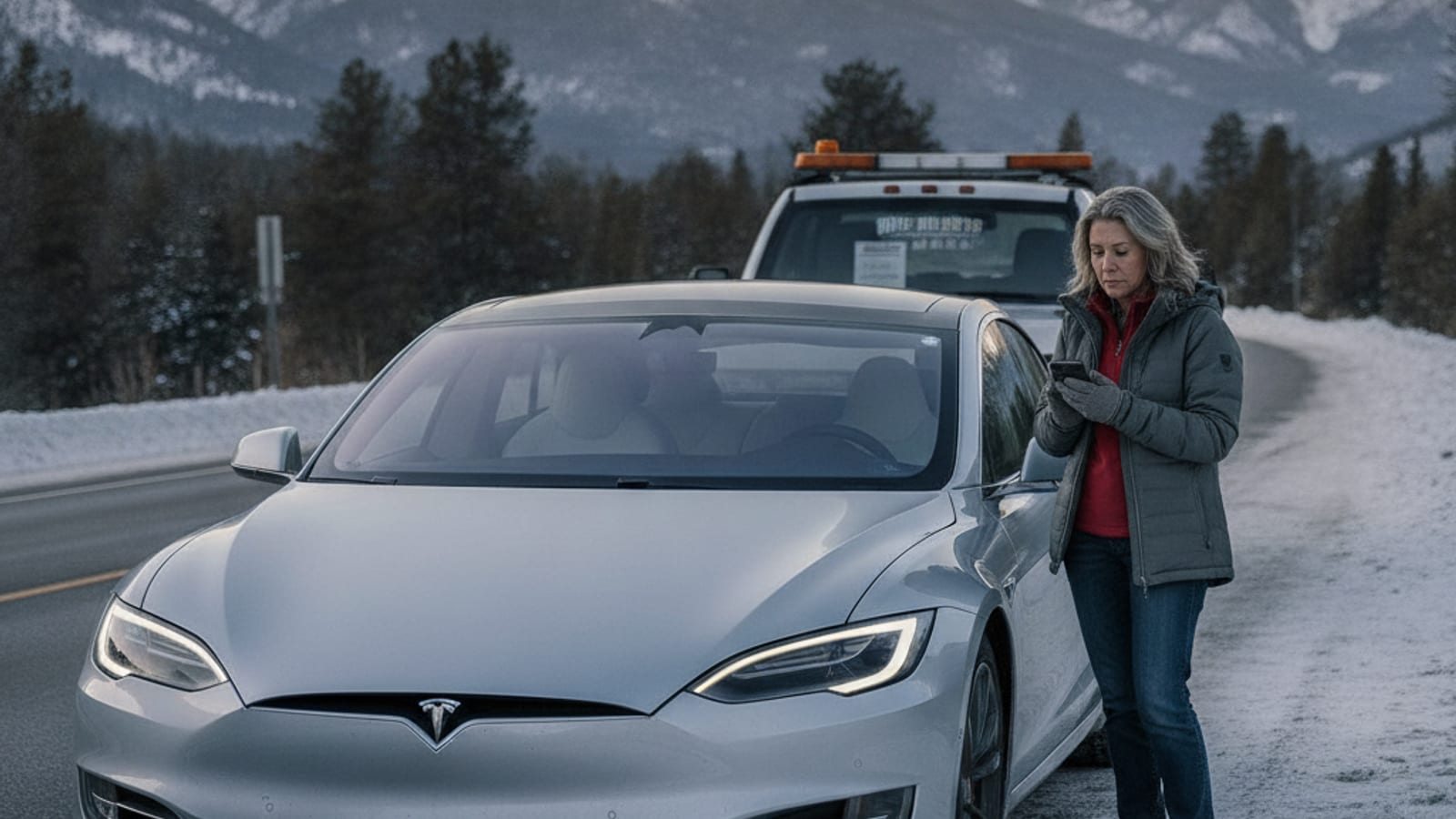
A Tesla Model S that will not start after a cold night in the Denver metro usually needs the 12-volt battery, not a charge for the traction pack. The big pack may still show plenty of range on the dash. The car looks finished because the 12-volt runs the computers, contactors, and door locks. When it fades, the whole vehicle looks dead. Call (720) 738-6950 if your Model S is dark and you want a referral to an independent local operator who can jump or replace the 12-volt on site.
Why the Model S looks dead in the cold
The Model S is the original Tesla sedan, in production for more than a decade, with several battery and 12-volt designs across model years. Earlier cars used a conventional 12-volt lead-acid battery, much like the one in a gas car. Newer Model S builds moved to a lithium-ion low-voltage battery. Either kind can fail in the cold. The reason has less to do with the chemistry than with the job the 12-volt does. It wakes the car. It closes the contactors that connect the traction pack to the motors. It powers the screen, the locks, and the lights. When it dies, the rest of the car cannot come online, even if the pack underneath still has range.
A cold Front Range night at 10 below does two things at once. It thickens the oil inside a lead-acid battery and slows its chemical reaction. It also wakes the battery management system more often to run thermal management on the pack, which drains the 12-volt faster. A Model S that sat through a long freeze at the airport, in a driveway, or on a side street can come back in the morning with a 12-volt that no longer has enough voltage to close the contactors. The screen stays black. The handles do not present. Tow mode will not engage. From the driver’s seat the car looks completely dead.
How to tell a dead 12-volt from an empty pack
A driver can usually tell which system has failed without opening anything. If the gauge showed low range before the car was parked, the pack is probably the problem. If the gauge showed a normal state of charge and the car sat through a cold night, the 12-volt is the likely culprit. The Tesla app sometimes still works even when the dash is dark, and the app state of charge is the single best tell. A real pack at zero is a charging problem. A real 12-volt at zero is a jump problem.
A few other signs point to the 12-volt. The key fob does nothing. The doors do not present. There is no click when you press the brake. The hazard lights may still work because they run off a separate path, but the screen stays off. None of those symptoms mean the traction pack is empty. They mean the small battery that wakes the car is dead.
Recurrent Auto studied more than 30,000 U.S. EVs in winter. EVs keep about 78 percent of their max range at 32 degrees and about 70 percent at 20 degrees on average. That is a real loss, but it is not the same as zero. A driver who parked the car with 80 miles of indicated range did not lose all of it overnight. They lost a slice of it, and the rest is still there in the pack. The reason the car will not move is that the small battery that wakes it is dead. Treat it as a 12-volt job, not a tow-to-a-charger job.
The first three minutes with a dark Model S
If the car is in a travel lane or another dangerous place, call 911. Move to the shoulder with the hazards on if you can do so safely. CRS 42-4-1202 allows a disabled vehicle to sit on the shoulder with hazards on if the car could not be moved further. That is the Colorado law behind sitting safely while you sort the next step.
Once the car is safe, do not try to use the frunk release. The Model S frunk releases electrically on most model years, and a dead 12-volt means the release will not fire. Jumping the 12-volt through the wrong point can damage the pack electronics. The correct low-voltage jump points are not the same as a gas car. Tesla publishes them in the owner’s manual for each model year, and the procedure for a 2014 Model S is not the procedure for a 2024 Model S. Open the book that came with the car before you hook anything up.
If you do not have the manual in the car, do not improvise. A crossed jumper cable on a Model S can take out a body control module and turn a 12-volt problem into a parts problem. The safe move in the Denver metro is to call the operators we refer. They carry the right booster pack and the right procedure for that year.
What the operators we refer actually do
Charge Pro DEN is a referral line for stranded drivers in the Denver metro. We do not own trucks and we do not employ technicians. We match you with an independent local operator. That operator quotes you before any cable goes in. They bill you directly for the work they do. The number to call is (720) 738-6950.
For a dead 12-volt, the operator arrives with a Lithium-iron booster pack and the correct low-voltage jump points for that Model S year. They connect under the hood at the marked positive and the chassis ground, not at random studs. The booster wakes the contactors and the screen comes back. From there the operator can either let the car’s own DC-DC converter recharge the 12-volt from the traction pack, or they can swap the 12-volt on site when the battery is too far gone to recover. They quote the option they recommend before they start.
A few drivers ask whether to use Tesla roadside for the same job. Tesla has its own roadside path in the app. Tesla can dispatch a contractor who knows the jump procedure. Tesla’s path is one valid option. A local operator through the referral line is another, and the local operator often arrives faster inside the metro. Tesla does not bring a Level 2 charge to the shoulder, and a local operator through this line does not either. Both paths end with the car awake and the driver back in motion.
Where the 12-volt lives in a Model S
Model S low-voltage battery location varies by year. Earlier cars hide the 12-volt under the hood in the frunk area, accessed through the frunk itself. Later cars moved the 12-volt into the passenger-side footwell area or behind a panel in the trunk sidewall. The owner’s manual for the model year is the only reliable guide. Do not trust a forum post that does not name the build month.
This matters because the jump points also move. Some Model S years expose jump posts under the hood that the operator can reach without removing panels. Other years require pulling a trim piece or two to reach the 12-volt. A Model S that has been in a fender bender and had front-end work done may have the jump points in a slightly different spot than stock. The operator who shows up reads the manual for that VIN before they touch anything.
Cold-soak spots that repeat the same pattern
A few patterns repeat across the Denver metro. The airport corridor is the largest one. A traveler leaves a Model S in a DEN-area lot for a week in January, walks back to the car, and finds a dark dash. The pack may still show 60 or 70 percent state of charge on the app. The 12-volt is the part that died. The lot has no outlet to plug into. A jump from the operators we refer finishes the job in the parking lot.
The foothills towns see a different version of the same story. A Model S parked in Evergreen at the end of a winding road sits through a cold snap. The 12-volt dies. The nearest Supercharger is back down at the I-70 junction or in the metro. A mobile operator with a booster is closer than a tow to a shop back in Lakewood.
The DTC and Park Meadows corridor sees the dwell pattern. A Model S sits all day at the office or for hours at Park Meadows in Lone Tree. The 12-volt finally gives up on a cold week. The car will not wake in the parking structure. The owner walks down seven levels, opens the car with the app, and nothing happens. A local operator can meet the car in the garage with a booster.
The Model S lithium 12-volt variant
Newer Model S builds use a lithium-ion low-voltage battery. The lithium variant is lighter and lasts longer in mild climates, but it is still a 12-volt that can drop below the voltage the car needs to wake. A lithium 12-volt that sits in a freezing lot for a week can still come back too low to close the contactors. The procedure is the same: confirm state of charge on the app, jump at the marked points, let the DC-DC converter top up the small battery, and watch for repeated warnings. If the same warning shows up three days in a row, the small battery is at end of life and an on-site replacement is the right call.
A lithium 12-volt does not like being charged by a regular lead-acid charger. A booster pack is fine. A trickle charger from an auto-parts store is not. The operators we refer carry the right booster for the lithium variant. That detail matters, because the wrong charging profile on a lithium 12-volt can knock it out for good.
When a tow is still the right tool
A roadside jump does not straighten bent suspension. If the Model S was hit, has a flat, or will not roll, the 12-volt is the smaller problem. The job is a tow. The operators we refer do not replace tow service for cars that cannot move under their own power, but they can recommend a flatbed partner when the need is real. A charge from a Level 2 source cannot fix a car that cannot roll to the cable.
Colorado law under CRS 42-4-1803 leaves abandoned-vehicle status to officer discretion. The statute sets no fixed clock. A dark EV on a shoulder with hazards on is not abandoned. It is a disabled vehicle under 42-4-1202. The state program and the local police do not need to be called until the car genuinely needs to be removed.
How to keep the 12-volt alive through a Denver winter
Three habits help. First, plug the car in at home whenever you can. A Model S on a charger keeps the 12-volt topped up through the DC-DC converter. A car parked outside in the cold without a plug loses the small battery faster. Second, check the Tesla app once a week during cold spells. A 12-volt that is starting to drop will sometimes show warnings before the car goes fully dark. Third, if the car is going to sit for more than a week in a cold lot, ask the operators we refer about a periodic check rather than discovering the failure on the day you return.
For a longer walk on Tesla roadside in the metro, read Tesla, AAA, and a local mobile rescue for a side-by-side. That post covers which program does what. This one stays on the cold-soak no-wake that points almost always to the 12-volt.
When to call
If your Model S is dark in a lot, on a shoulder, or in a garage and the app shows the pack still has range, treat it as a 12-volt job. The operators we refer can jump or replace the 12-volt on site. They quote before they start. They cover the Denver metro from the plains to the foothills. Call (720) 738-6950 and describe the year of the car and the symptoms. The match moves from there.
For an EV that is dark because the traction pack itself is empty, mobile EV charging is the right call. For a Tesla 12-volt replacement on site, see Tesla 12-volt jump and replacement.
Frequently asked questions
How do I know if my Model S has a dead 12-volt or an empty pack?
Check the Tesla app. If the app shows normal state of charge and the dash stays dark, the 12-volt is the likely problem. If the gauge was already low before you parked, the pack may be empty.
Will a Model S lithium 12-volt fail in the cold?
Yes. A lithium low-voltage battery still drops voltage in a deep cold soak. The contactors need a minimum voltage to close. A jump at the marked points brings the car back, but repeated warnings mean the small battery is at end of life.
Can I jump the 12-volt myself?
Use only the marked jump points in the owner’s manual for that model year. The Model S frunk release and the 12-volt access are different across years. A wrong hookup can damage electronics.
Does Tesla roadside send someone for a dead 12-volt?
Tesla has its own roadside path in the app. Tesla can dispatch a contractor with a booster. A local operator through the referral line at (720) 738-6950 is another option, and they can meet the car in the metro without a long wait.
What if the Model S will not roll?
A roadside jump does not fix a car that cannot move under its own power. A flatbed to a shop is the right tool. A Level 2 charge will not help a car that cannot roll to the cable.