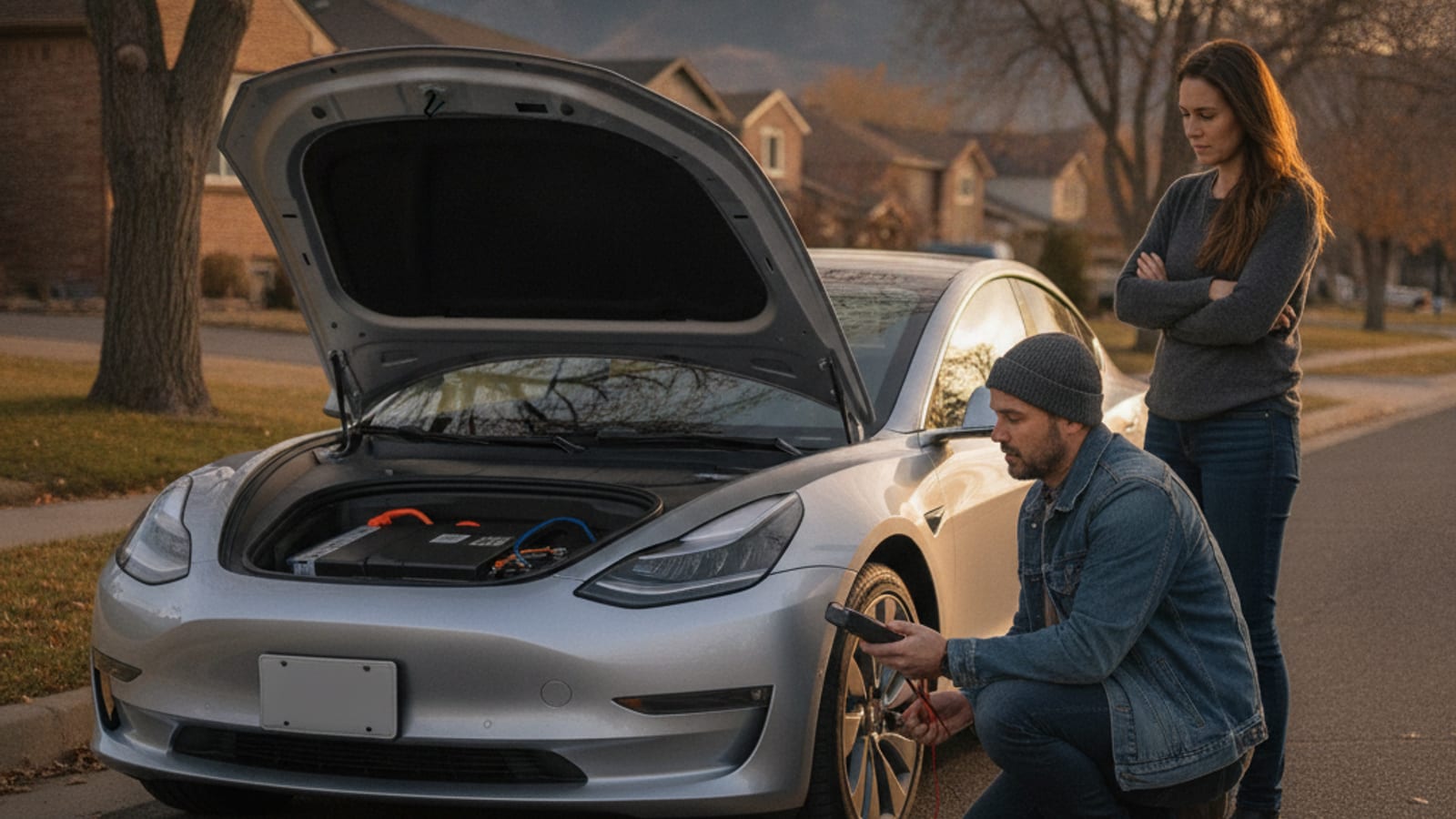
A 2023 Tesla Model 3 with a lithium 12-volt battery still goes dark after a cold soak in a Denver lot. The pack can show plenty of range. The screen stays black. The doors will not open. The car looks finished, and it isn’t. The lithium 12-volt fails the same way the older lead-acid did: it cannot wake the contactors and the computers after a hard freeze. A Tesla 12-volt jump is a separate script from a charge. Call (720) 738-6950 when you need an operator who works on the bumper.
What Tesla changed and what stayed the same
Tesla built a lithium-ion low-voltage battery into the Model Y starting in 2021, and into the refreshed Model 3 starting with the Highland launch in 2024. The 2023 Model 3 in your driveway, depending on build month, may carry either a lithium pack or the older lead-acid. Tesla’s own owner’s books describe the lithium unit for current production. The voltage stayed at roughly 12 volts. The job stayed the same: wake the contactors, run the computers, unlock the doors. The chemistry did not protect that job from a hard cold soak in a metro lot. A frozen lithium cell still has reduced output. The car still looks dead.
If your hood opens, the under-hood terminals are for jump-starting the low-voltage battery. They unlatch the hood. They do not charge the high-voltage pack. Use your owner’s manual for the exact terminal cover and procedure for the car in front of you. The manual is the source of truth for your VIN.
Why the lithium 12-volt still fails the cold
A lithium 12-volt packs more energy into a smaller box. It also accepts a charge profile that lead-acid does not. What it does not do is escape chemistry. Cold slows the chemical reaction inside any battery. The lithium pack’s internal resistance rises in the cold. The available cranking amps drop. The cell voltage sags when you ask it to wake a deeply discharged system. After a week in a metro parking structure at 10 below, even a healthy lithium 12-volt can fall below the threshold the car needs to wake up.
The traction pack above is fine. It can hold 200 miles of range while the 12-volt sits dead in a corner of the chassis. That is why a cold-soak Tesla that will not respond can still look fully charged on a tow driver’s scan tool. The high-voltage contactors are closed. The low-voltage computers cannot ask them to open.
What a no-wake Tesla looks like
You tap the door handle. Nothing. You press the brake and tap the screen. Nothing. The headlights do not come on. The mirrors do not unfold. The Tesla app shows “Offline” or “Last seen 8 days ago.” You may hear a quiet click from under the hood, or you may hear nothing at all. This is the dead 12-volt pattern, not the empty-pack pattern. The car is dark because the brain that wakes the car has no power.
A lithium pack also fails differently than lead-acid at the moment of failure. Lead-acid often gives warning over weeks. Lithium can sit at a usable voltage and then drop fast when the temperature falls below a working range. That sudden drop surprises drivers who expected the old slow fade.
What to try before you call anyone
If you can reach the under-hood terminals, a lithium-safe jump pack can bring the 12-volt back. Confirm the pack you carry is rated for lithium batteries, not just lead-acid. A traditional heavy jumper pack may push a charging profile the lithium cell does not want. Check the booster’s manual for the lithium setting. The hood opens with an external 12-volt supply at the terminals on most Model 3 and Model Y cars. The owner’s manual walks the procedure. Do this in a safe, visible spot, away from a travel lane.
If the dash comes back, the traction pack should engage normally. Drive somewhere warm. Let the DC-DC converter top up the 12-volt from the pack. If the dash does not come back, the 12-volt is too far gone for a portable pack. You need a real jump or a tow.
What Tesla roadside will and won’t do
Tesla’s roadside program is requested in the Tesla app. Confirm what it covers for your VIN before you tap. Tesla’s published policy describes out-of-range assistance as may-be-available and not financially covered. A 12-volt jump is normally part of the program. A Level 2 charge on a Denver shoulder is not. Tesla does not bring 240V to your bumper in the metro.
Tesla sends a contractor, not a Tesla employee. The contractor may be far. The contractor may not be able to fix a dead lithium 12-volt in the field. A failed 12-volt sometimes needs an on-site replacement, which is its own procedure. The general script is in Tesla roadside sends a contractor, not Tesla.
What CDOT Safety Patrol will do on a shoulder
CDOT Safety Patrol covers the Denver metro on listed segments: I-25 South from 120th Avenue to Arapahoe Road, I-70 East from Wadsworth to Airport Boulevard, and portions of US-6, C-470, and I-225. I-70 Mountain Corridor runs Morrison to Vail on the same list. Safety Patrol will jump a 12-volt on those segments. It will not charge the traction pack. Its published services are tires, jump-starts, emergency fuel, debris removal, and minor mechanical help. EV charging is not on that list.
Hours are limited. Front Range weekday windows run 6:00 to 9:30 a.m. and 2:30 to 7:00 p.m. Weekend hours run 10:00 a.m. to 7:00 p.m. Mountain Corridor hours run 6:00 a.m. to 7:00 p.m. on Friday through Sunday and during significant weather. A Tesla that goes dark at 11 p.m. on a Tuesday sits outside every free option.
What a local operator can do on site
Charge Pro DEN is a referral line for stranded drivers. We don’t own trucks, and we don’t employ technicians. We match you with an independent local operator. The operator quotes you before any cable goes in. They bill you directly for the work they do.
A 12-volt jump on a Model 3 or Model Y is a small job for an operator with a lithium-safe booster. The operator pulls to your bumper in Denver, Lakewood, Aurora, or wherever the car sits. They open the under-hood panel, attach a lithium-rated booster, and wait for the dash. If the lithium pack will not take a charge, the operator carries a replacement 12-volt that they can swap on site. The work is on your bumper, in your lot, and the operator quotes first.
Cold-soak lots are the worst case
January in Denver runs a normal low around 18 degrees. Real cold drops well below that. The January 2024 arctic blast took Denver from 47 to minus 19 in about 48 hours. A car that survives a normal Front Range winter on a regular lithium 12-volt can fail in that kind of swing. A car that sits in an uncovered lot at Denver International for a week in January is the most common case we hear: a traveler returns to a Tesla that shows range in the app but will not unlock or wake.
The 12-volt runs the thermal management for itself and the contactors. Below its working temperature, it cannot do that work. Add phantom drain from sentry mode, the cabin overheat protection, and the periodic wake to check the charging schedule, and a 12-volt at 10 percent of charge on Sunday may be at 0 percent by Friday. The traction pack above still has energy. The car still looks charged. The 12-volt cannot wake it.
What to do if you must leave the car
If the car is in a travel lane or another dangerous place, call 911. Hazards on, per CRS 42-4-230. You may not stop on the paved main-traveled part of a highway under CRS 42-4-1202 unless the vehicle cannot be moved further. Move the car to the shoulder if you can. If you cannot, stay in the car with your seatbelt on and call for help.
If the car is in a safe spot and you need to leave, lock what locks. A Tesla with a dead 12-volt will not lock itself through the app. You may need to leave it unlocked until an operator arrives. Note the location. Take photos of the dash state and the screen if anything responds briefly.
The lithium 12-volt is still a 12-volt
Tesla’s move to lithium for the low-voltage battery reduced weight and extended life under normal use. It did not change the fundamental rule: the 12-volt is what wakes the car. Cold still kills it. Phantom drain still drains it. Old age still ages it. A 2023 Model 3 with a lithium 12-volt behaves more like a lithium jump target than a different kind of battery.
If you carry a portable booster, confirm it has a lithium mode. If your booster is older than the lithium switch in your car, it may push the wrong profile. Check the manual. Replace the booster if it does not support lithium 12-volt chemistry.
How to reach a local operator
Call (720) 738-6950 when you need a Denver metro operator on the bumper for a 12-volt jump. The line is a referral to an independent operator. We don’t set a price, we don’t promise an arrival time, and we don’t publish hours. The operator does. They quote you before they start. You pay them. We work with Tesla and every other major EV brand. The non-Tesla EV rescue page covers the same kind of work on CCS or J1772 cars.
If the 12-volt will not take a jump, the operator can replace it on site. If the pack is also empty, the operator brings a 240-volt Level 2 source and adds 10 to 20 miles so you can drive to a stall. That is a separate service from a jump, and the operator confirms the call before they roll.
Frequently asked questions
Does a lithium 12-volt fail differently than lead-acid?
Cold chemistry still slows a lithium cell. The internal resistance rises, available cranking amps drop, and the voltage sags under load. A lithium 12-volt often gives less warning than a fading lead-acid. A car that drove home fine can be dark the next morning.
Why does the Tesla app show range but the car is dead?
The high-voltage pack and the 12-volt are separate systems. Range shows traction pack state. A dead 12-volt cuts the brain that wakes the car and tells the contactors to close. The range can sit at 50 percent while the car looks finished.
Does Tesla roadside bring a charge?
No. Tesla’s path in the app requests a jump or a tow. Tesla does not bring a 240-volt Level 2 source to a Denver shoulder. Out-of-range assistance is a policy category, not a guaranteed service.
Will a regular jumper pack work on a lithium 12-volt?
Some will, some won’t. A booster rated for lead-acid may push a profile the lithium cell does not want. Use a lithium-rated booster or follow your booster’s manual for the lithium setting. The terminals and procedure for Model 3 and Model Y are in the owner’s manual.
What if the car is in a Denver airport lot?
Same answer: dead 12-volt is most likely. A traveler returning from a trip often sees the car as fully charged in the app, then finds it dark in the lot. A local operator pulls into the lot, quotes a jump, and bills directly. Confirm the lot name and stall number when you call.
Can a Denver operator replace the 12-volt on the bumper?
Yes. Operators we refer carry replacement lithium 12-volt packs for Model 3 and Model Y and can swap on site when the original will not take a jump. Confirm the model year and battery type when you call.