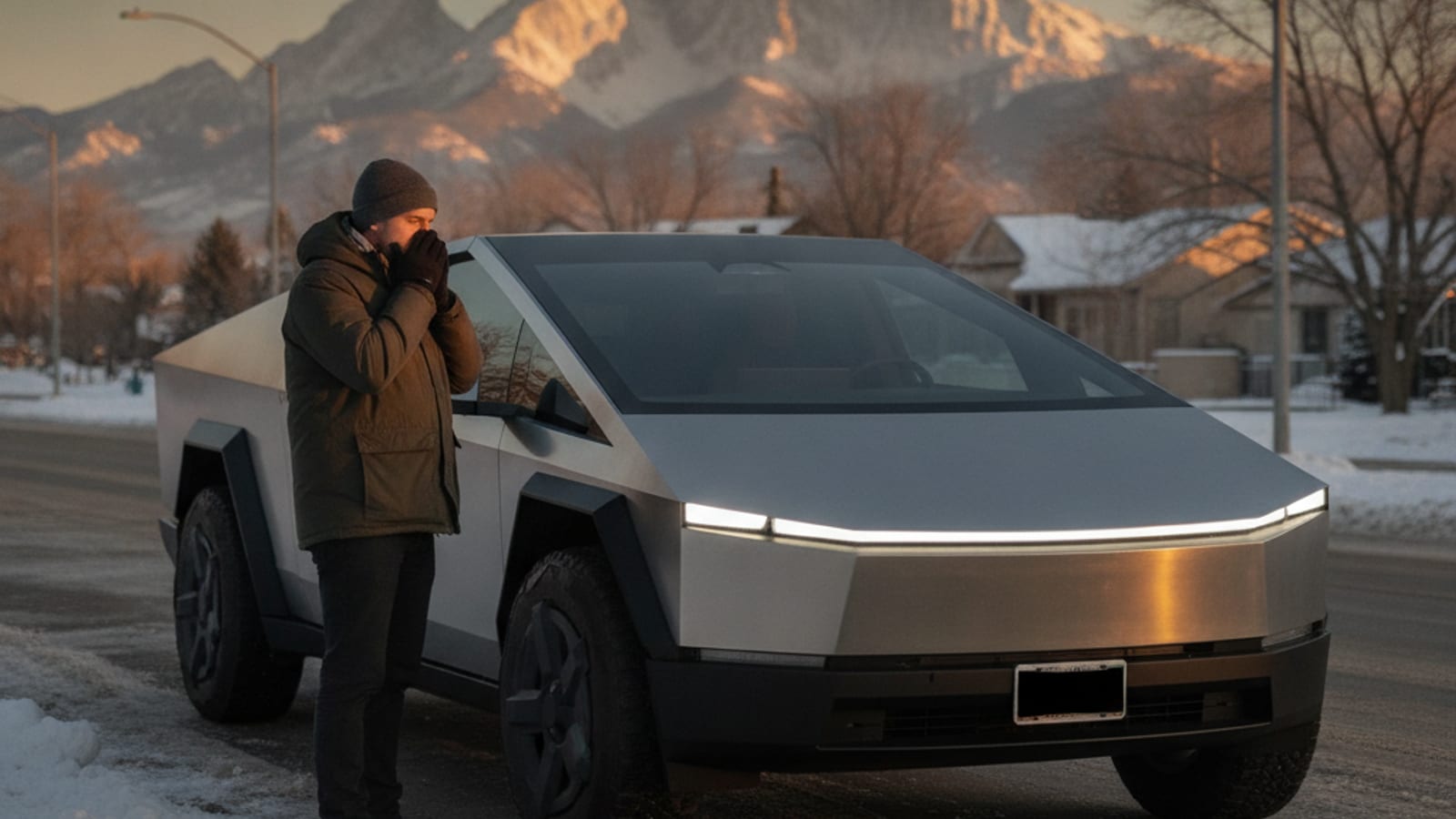
A Tesla Cybertruck that won’t start after a cold night in Denver is almost always the 12-volt battery. The big traction pack may still hold plenty of range, but the small low-voltage battery that runs the computers, the contactors, the screen and the door locks has dropped below the threshold. The car looks finished. It isn’t. A 12V jump or an on-site replacement is a different job than a tow. CDOT Safety Patrol will jump one on listed freeways during posted hours, and the operators we refer jump or replace one on site and quote you before any work starts. If the Cybertruck is in a travel lane or another dangerous place, call 911. Otherwise call (720) 738-6950 for a referral to an independent local operator.
What a dead Cybertruck looks like in the cold
The dark center screen is the giveaway. The fob will not unlock the doors. The Tesla app shows the truck offline. A key card tap on the B-pillar does nothing. Yet the traction pack under the floor still holds a real amount of energy. That gap is the diagnostic.
The 12-volt in a Cybertruck runs the same jobs it runs in any newer Tesla. Computers, contactors, door locks, headlights, infotainment. It charges off the traction pack while the truck is awake. When the 12V gets too low to close the contactors, the whole truck looks dead even though the pack still holds range. The lantern has power. The switch just won’t fire.
Cold makes it worse. Below about 15 degrees the battery management system wakes the truck to run thermal management on the pack, and that draw hits the 12V while the truck sits parked and dark. January’s normal low around Denver sits near 18 degrees. A January 2024 arctic blast dropped Denver from 47 to minus 19 in about 48 hours. That kind of swing finishes an aging 12V that had been limping through the season.
Why the 12-volt fails first on a Cybertruck in Denver
Age is the first cause. Most factory 12V batteries last about four to six years in a Colorado climate. A battery that sat through two or three winters is on borrowed time when the fourth one shows up. The Cybertruck is a newer platform, but the same chemistry rules apply.
Phantom drain is the second. Even parked in a warm garage, the 12V runs the alarm, the sentry logic if armed, and the wake-on-approach sensors. Over a Denver airport week in January, that small drain pulls a weak battery down. Below about 15 degrees the battery management system wakes the truck to warm the pack, and that wake cycle is the biggest drain of all. A cold-soak in a Denver parking lot for a few days is enough to take a marginal 12V from low to dead.
Cold chemistry is the third. A lead-acid 12V loses a chunk of its usable capacity when it gets cold. The same battery that closes the contactors on a 60 degree morning may not close them at 5 degrees. If the battery was already at 60 percent state of charge, a hard freeze may pull it under the cutoff the truck needs to look awake.
A short-trip pattern is the fourth. A Cybertruck driver who runs errands around town and parks on the street never gives the traction pack time to top up the 12V the way a longer highway drive would. Add cold, and the 12V never recovers between trips.
Quick checks before you call
Five checks take about a minute and tell you which job this is.
Try the key card. Hold it against the B-pillar reader for a few seconds. A faint wake on the screen confirms the 12V is low but not fully dead. A no-response confirms a deeper failure.
Try a different fob. A dead fob battery mimics a dead truck. Swap in a fresh battery if you carry one, or try another fob from the household.
Look at the dashboard. If the truck is in a garage with some light, the cluster may show a faint glow before the screen dies. A flashing red icon or a 12V warning that returns at start is the signal.
Open the mobile app. A Cybertruck that is reachable on the app is awake. A Cybertruck that shows offline has a 12V too low to keep the network card alive. Note the time it went offline. A truck offline for an hour in a Denver airport lot has a different problem than one offline for a week.
If four of the five checks come back negative, the 12V is dead and the traction pack is not your problem. If the screen showed a low-battery gauge before it went dark, the traction pack is your problem and a 12V jump will not help you. For the broader empty-pack case, read out of charge recovery.
What CDOT Safety Patrol will and will not do
CDOT Safety Patrol covers parts of the Denver metro on a published segment list. The Front Range weekday windows run 6:00 to 9:30 a.m. and 2:30 to 7:00 p.m. Weekend hours run 10:00 a.m. to 7:00 p.m. The Mountain Corridor runs 6:00 a.m. to 7:00 p.m. Friday through Sunday and during significant weather. The published menu is tires, jumps, fuel, debris, and minor mechanical help. CDOT’s own pages mention nothing about electric vehicles or EV charging.
A Safety Patrol truck will jump a 12V battery. It will not bring a Level 2 source to charge a traction pack. If your Cybertruck is on a covered segment during posted hours, the jump is free. If your Cybertruck is sitting at 4 percent on the shoulder of US-6 because the pack is genuinely empty, that is the wrong call.
Pull to the outside shoulder on a covered segment, turn your hazards on, and call for the patrol. The patrol will hook a portable jump box to the front jump posts, the truck will wake, and you can drive away. If the 12V dies again on the next start, the battery needs replacement, not another jump.
What Tesla roadside will and will not do
Tesla runs its own roadside program, accessed through the Tesla app. Coverage depends on the VIN, the year, and the program the truck shipped with. Read the coverage in the app before you need it. Do not assume Tesla sends a charger to a stranded EV. Do not assume Tesla replaces a 12V on the shoulder.
Tesla roadside will help with a flat tire, a lockout, and out-of-power situations that need transport. A 12V jump may be available through the program, but confirm what the specific coverage pays for. Out-of-charge transport often shows up as a tow credit toward a Supercharger, not as a mobile charge in place. For the longer read on what Tesla RSA does and does not include in this metro, see Tesla roadside, CDOT patrol, or a local boost.
If the pack is genuinely at zero, a Tesla tow to a Supercharger is one path. A local operator with a 240V Level 2 source is another. Each is a separate quote and a separate bill.
What the operators we refer do
Charge Pro DEN is a referral line. We do not own trucks and we do not employ technicians. We match you with an independent local operator. The operator quotes you before any cable goes in, and bills you directly for the work they do.
For a 12V job the operator brings a portable jump box rated for low-voltage lithium. They connect to the front jump posts on the Cybertruck, the contactors close, the truck wakes, and you drive away. If the 12V is too damaged to take a charge, the operator can replace it on site with a stock unit. For the Tesla-specific 12V job, see Tesla 12V battery jump.
For an empty pack the operator brings a 240V Level 2 source with a native NACS plug. Typical charging time adds about 10 to 20 miles in 15 to 30 minutes. The clock starts when charging starts, not before. It is not an arrival time, and we do not promise one. For the broader Level 2 in place service, see mobile EV charging. For the broader cold-morning no-wake pattern that applies to every Tesla, read how to tell if your Tesla’s 12-volt is dead.
How to tell which job yours is
The deciding question is what the dashboard showed before the truck died. If the gauge was under 20 percent and dropping, the pack is your problem. A 12V jump on an empty pack will close the contactors long enough for the truck to wake, drive a few hundred feet, and die again.
If the gauge showed plenty of range and the truck simply would not wake after a cold night, the 12V is the failure. A jump is the right job. For the broader split between pack and 12V, see can roadside jump an EV 12V.
A third case is a 12V that will not hold a charge after a jump. The truck wakes, you drive a block, the truck goes dark again. That battery is at end of life and needs replacement on site.
What you can do in the next two minutes
Turn your hazards on. Move to the outside shoulder if you can do so safely. If the truck is in a travel lane or another dangerous place, call 911 and stay in the truck with your belt on. If the truck is off the road, stay buckled until traffic has passed.
Try a different fob. Try the key card on the B-pillar. If the screen shows a faint wake, leave the headlights off and the climate off to keep the 12V from sagging. Do not try to start the truck again until help arrives. Repeated start attempts will pull the 12V lower and may lock out the operator’s jump box from working.
If the truck is on a covered CDOT Safety Patrol segment during posted hours, the free jump is the right call. If it is outside posted hours, or on an uncovered segment, call (720) 738-6950 for an operator referral.
Colorado law on the shoulder
CRS 42-4-1202 covers a disabled vehicle on a highway. You may not stop on the paved main-traveled part of a highway. The exception is a vehicle so disabled it cannot be moved off. Hazard lights must be on under CRS 42-4-230. A violation is a class B traffic infraction. The plain read is that you may sit on the shoulder with hazards on while you sort a jump or a tow. You may not abandon the truck.
CRS 42-4-1803 sets no fixed clock for abandonment. A vehicle is abandoned on officer discretion, not on a 24 hour or 72 hour threshold. State Patrol holds abandoned-vehicle authority under that statute.
If the truck is on private property, the Colorado Towing Bill of Rights (HB22-1314) covers the 24 hour written-notice rule for most nonconsensual tows and a recovery path after paying a set share of the fee. Exact dollar and percent figures are not in this page. Confirm with the property owner before you assume a tow is authorized.
When a tow is still the right tool
A 12V jump or replacement does not straighten bent suspension. A truck that cannot roll under its own power needs a flatbed. A truck with a damaged charge port, a coolant leak, or a high-voltage warning needs a shop, not a charge. Tesla roadside and AAA exist for that kind of work. If the truck must reach a specific shop, a charge may delay the hook.
Recurrent Auto studied more than 30,000 U.S. EVs in winter. At 32 degrees, EVs kept about 78 percent of max range. At 20 degrees, about 70 percent. The point is that a Front Range morning at 10 degrees does not care what the gauge said at the trailhead. Plan margin, not just range.
How to avoid the next dead 12V
Three habits cut the risk. First, drive a longer route once a week. Short trips never top up the 12V the way a sustained drive does. Second, plug in at home if you have a charger. A plugged-in Cybertruck runs the BMS on shore power and keeps the 12V warm. Third, replace the 12V on schedule. A four-year-old battery in a Denver climate is a battery that has one more winter in it, not three.
If your truck sat dark through a cold snap, drive it for at least 30 minutes before shutting it off again. The traction pack will top up the 12V during that run. If you are leaving the truck for a week in a Denver airport lot in January, ask a friend to check on it. The dead 12V call from the airport is one of the most common metro calls we refer.
When to call Charge Pro DEN
Call (720) 738-6950 when you want a referral to an independent local operator. We do not promise an arrival time, and we do not quote a price. The operator does both, before they start work. We serve the Denver metro from the plains to the foothills, and from the metro to the I-70 Mountain Corridor. Treat the number as a referral number, not a rolling promise. If the truck is in a travel lane, call 911 first.
Frequently asked questions
How do I know my Cybertruck’s 12-volt is dead and not the traction pack?
The deciding question is what the gauge showed before the truck died. A pack that went dark at 5 percent is empty. A pack that went dark at 60 percent after a cold night is fine, and the 12V is the failure. The screen, doors, and fob will not respond on a 12V failure even though the pack holds range. A jump box on the front jump posts will wake the truck in about 30 seconds if the 12V is the problem. A jump will not refill an empty pack.
Can CDOT Safety Patrol jump a Cybertruck 12V on a Denver freeway?
Yes, on a covered segment during posted hours. The Front Range weekday windows run 6:00 to 9:30 a.m. and 2:30 to 7:00 p.m. Weekend hours run 10:00 a.m. to 7:00 p.m. The published menu is tires, jumps, fuel, debris, and minor mechanical help. CDOT does not publish an EV charging service. The patrol will hook a portable jump box to the front jump posts and the truck will wake.
Will a 12V jump start the pack, or do I need a charge?
A 12V jump closes the contactors and lets the traction pack deliver power. It does not refill the traction pack. If the gauge was low before the truck died, a 12V jump will let you drive a short distance and the truck will die again. For an empty pack, the operator brings a 240V Level 2 source. For a 12V that will not hold a charge, the operator replaces it on site.