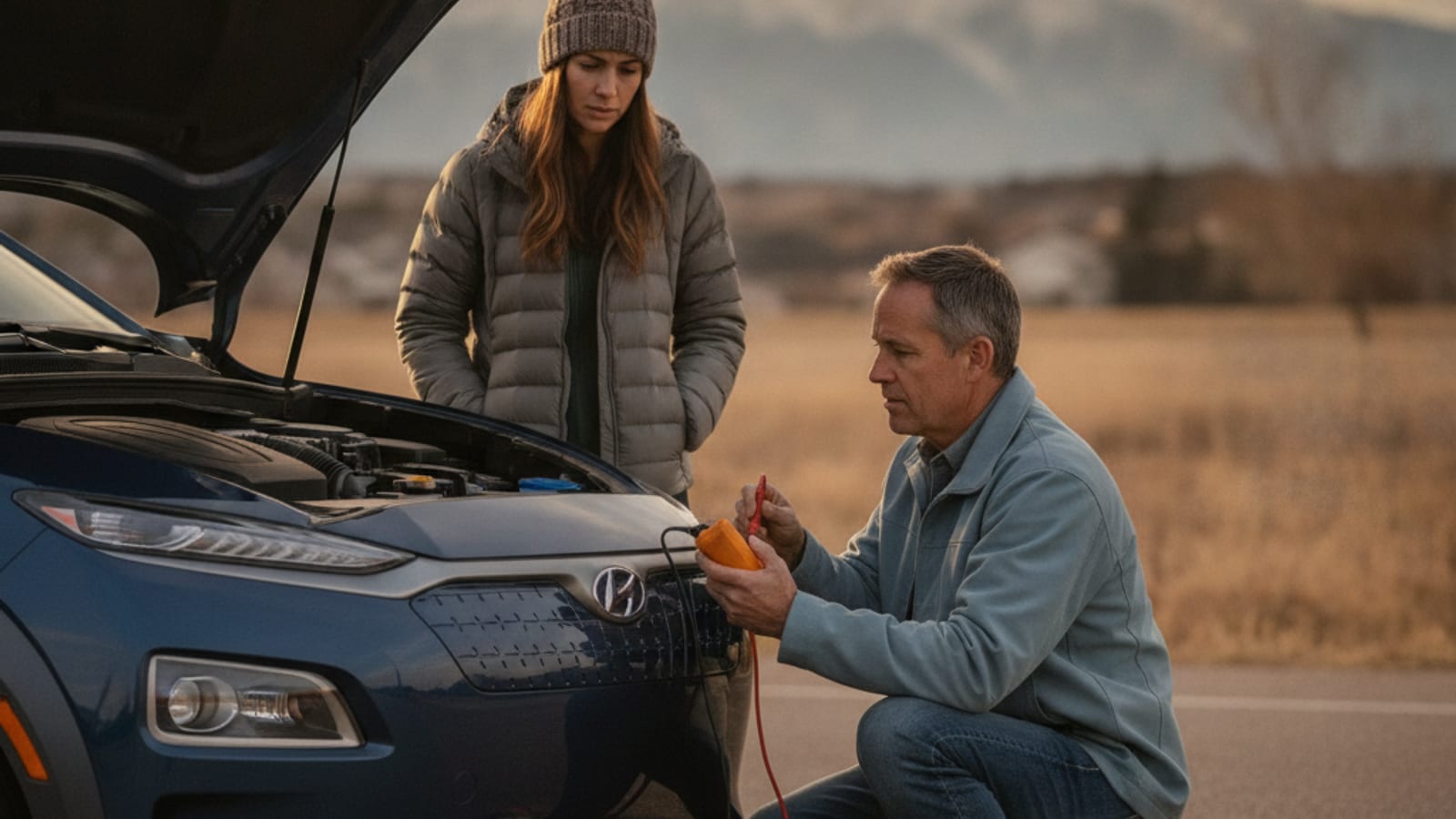
A Hyundai Kona Electric that won’t start in Denver usually has a dead 12-volt battery, not an empty pack. The traction battery still holds energy. The little battery that runs the computers, contactors and door locks gave up after a cold night. That is a jump or an on-site 12-volt replacement, not a tow and not a Level 2 charge. Call (720) 738-6950 to reach an independent operator who can come to the car.
What a no-start really means in a Kona Electric
The Kona Electric is a battery-electric crossover with a small high-voltage traction pack and a separate 12-volt battery. The 12-volt is what wakes the car. Press the start button, the 12-volt closes contactors, the dash lights up, and the car is ready to drive. If the 12-volt is too weak to close contactors, the dash stays dark and the car looks dead even though the high-voltage pack is full.
A driver who walks out to the Kona on a sub-freezing Denver morning sees a black dash, no ready light, sometimes a clicking from under the hood, and a key fob that will not unlock the doors in some cases. None of that means the traction pack is empty. It means the 12-volt dropped below the threshold the car needs to boot.
Recurrent Auto studied more than 30,000 U.S. EVs in winter. At 32 degrees, EVs kept about 78 percent of max range. At 20 degrees, about 70 percent. Cold cuts range, and it is hard on the 12-volt at the same time. A Kona that sat through a Denver freeze is the worst case for both.
Why an overnight in Denver can take out the 12-volt
The battery management system on a Kona Electric wakes periodically when the pack is cold, to run thermal conditioning. That wake draws from the 12-volt, not the traction pack. On a healthy 12-volt the draw is a small cycle that the battery recovers from the next time the car is driven. On a marginal 12-volt, or on a Kona that sits for a week on an airport lot, the draw runs the 12-volt down to the point where the car will not boot.
Three Front Range situations hit this hardest.
Street parking with no overnight plug. More than half of Denver housing predates 1980. A driver in Capitol Hill, Baker, or Edgewater parks on the street, plugs into a Level 2 on the block, and the car sits through a 14-degree night. The BMS wakes. The 12-volt runs down. The Kona will not wake in the morning.
Long airport dwell. A Kona left at Denver International for a week in January comes back to a 12-volt that has been waking the thermal system every hour. That car usually starts with a jump, sometimes needs the 12-volt replaced on site.
A driveway in the foothills. An owner in Evergreen, Kittredge, or Aspen Park plugs in at home and assumes the Kona is fine. The car sits through a single-digit night. Cold plus altitude plus a 12-volt past year four is enough.
The donor fix is the same in each case. The traction pack is fine. The 12-volt is dead. Treat it as a 12-volt job.
The first checks before you call anyone
A driver can do three checks in five minutes that tell whether the Kona needs a 12-volt jump or something bigger.
Check the dash and the headlights. A Kona with a weak 12-volt may unlock with the fob but show a dead dash and dim or no headlights. If the headlights look weak or the interior lights flicker when you pull the handle, the 12-volt is the problem.
Try the mechanical key. The Kona key fob hides a mechanical key blade. Use it on the driver’s door if the fob will not wake the car. That gets you in without waiting on a dead 12-volt.
Listen at the front. With the fob held to the start button (some years will read it there when the battery is too weak to read the fob from the seat), listen for clicks under the hood. Repeated clicks with no dash lights means the 12-volt is too weak to hold a contactor closed.
If those three checks point at the 12-volt, the next call is the referral line. An operator we refer can bring a portable jump, a fresh 12-volt on a service truck, or a Level 2 source if the actual problem turns out to be an empty pack. They will quote you before any cable goes in.
What a mobile operator does that a tow truck can’t
A flatbed tow takes the Kona to a shop. That is the wrong tool for a 12-volt job. The car does not need new motors or a transmission. It needs power at the 12-volt terminals for about 10 minutes, or a fresh 12-volt swapped in if the existing one will not take a charge. A mobile EV operator does that on site, in your driveway, in a parking lot, in a DEN economy stall.
Charge Pro DEN is a referral line for stranded drivers in the Denver metro. The brand performs no work, owns no trucks, employs no technicians, sets no price, and promises no arrival time. We match you with an independent local operator. The operator quotes you before they start. They bill you directly for the work they do.
A 12-volt jump on a Kona takes minutes once the operator is on site. If the 12-volt is past saving, the operator can swap in a fresh one on the spot in many cases. If the actual diagnosis turns out to be a low traction pack, a mobile EV charging referral adds 10 to 20 miles of range in 15 to 30 minutes of Level 2 charging, and the clock starts when the cable is in, not before. Read jump start an EV 12-volt in Denver cold for the cold-weather jump procedure in detail. For a broader how-to on the Hyundai family of EVs, Hyundai Ioniq 5 won’t start in the Denver cold walks the same 12-volt-first pattern.
Operators we refer handle Tesla, Hyundai, Kia, and the rest of the EV market on the Front Range. A jump and an on-site 12-volt swap are the common Kona calls here, not a tow.
When to call CDOT Safety Patrol or E-470 instead
If the Kona dies on a covered freeway, the state’s free patrol can jump it. CDOT Safety Patrol covers I-25 South from 120th Avenue to Arapahoe Road, I-70 East from Wadsworth to Airport Boulevard, portions of US-6, C-470, and I-225, and the I-70 Mountain Corridor from Morrison to Vail. Front Range hours are 6:00 to 9:30 a.m. and 2:30 to 7:00 p.m. on weekdays, 10:00 a.m. to 7:00 p.m. on weekends. Mountain Corridor hours run 6:00 a.m. to 7:00 p.m. Friday through Sunday and during significant weather.
Pull to the outside shoulder and turn on hazards before you call. CDOT’s published menu covers flat tires, jump-starts, fuel, debris and minor mechanical help. Their pages do not mention EV charging. If the Kona will not wake from a dead 12-volt, that is on the patrol’s list. If the traction pack is empty, skip that call.
On E-470, dial *470 for the same jump-and-tire list, or *CSP (*277) for State Patrol. The authority publishes free roadside assistance for cashless-toll-road drivers. It does not publish an EV charging service.
Neither option quotes a price. Both are free. They cover a 12-volt jump, not a Level 2 charge.
What a tow is still the right answer for
A 12-volt jump is the right tool when the car is otherwise fine and the 12-volt is the cause. It is the wrong tool when the Kona cannot roll. A bent suspension, a flat that will not come off, a pack that has gone fully to zero and the car will not shift out of park, all of those are tow jobs, not jump jobs.
CRS 42-4-1202 covers a disabled vehicle on a highway. You may not stop on the paved main-traveled part of a highway. The exception is a vehicle so disabled it cannot be moved off the roadway. Hazard lights must be on under CRS 42-4-230. A violation is a class B traffic infraction.
CRS 42-4-1803 sets no fixed hour count for abandonment on public property. No Colorado statute treats a disabled EV as a special class. The Colorado Public Utilities Commission regulates towing carriers. Exact tow fee figures were not verified for this page.
How to call the referral line
If you have decided the Kona needs a 12-volt jump and you are not on a CDOT-covered freeway, the next step is the referral number. Charge Pro DEN does not own trucks and does not send a crew. The line matches you with an independent operator who quotes before work begins.
Turn hazards on and stay visible to traffic if you are on a shoulder. Stay in the car if that is the safer choice. Have the car’s VIN and approximate location ready when you call. The operator confirms what the job is and quotes you. Then they come to the car.
For metro-wide service the line covers Denver, Aurora, Lakewood, Golden, Englewood, Thornton, Westminster, Broomfield, Boulder, Lone Tree, Highlands Ranch, Castle Rock, Centennial, and the rest of the 50-city service area from the plains to the foothills. Call (720) 738-6950 to start the match. Treat it as a referral number, not a rolling promise.
Frequently asked questions
Will the Kona’s high-voltage pack still have range if the 12-volt is dead?
In most cases, yes. The two systems are separate. The traction pack runs the motors. The 12-volt runs the computers, contactors, and door locks. A 12-volt failure leaves the high-voltage pack untouched. The recovery is a jump and a short drive, or a fresh 12-volt if the existing one will not take a charge.
Can I jump a Hyundai Kona Electric from another car?
Yes, with the usual care. The Kona has a designated 12-volt jump point under the hood. Hook the donor battery positive to the Kona positive jump point, negative to a clean ground away from the pack. Do not let the donor vehicle’s engine run a high-output alternator into the Kona’s 12-volt rail. A portable lithium jump pack made for 12-volt automotive use is safer. Operators we refer carry those.
Is a 12-volt replacement something a mobile operator can do on a Kona?
Often yes. The Kona’s 12-volt is under the hood, accessible without dropping the pack. Operators we refer carry common group sizes and can swap on site. They quote you before the work starts. Confirm the group size and the brand with the operator when you call.
Could a Kona that won’t start be a software issue instead of the 12-volt?
Sometimes. A failed over-the-air update, a frozen infotainment module, or a bad body control module can also produce a no-start. Those usually need a dealer or a shop. A mobile operator’s first check is the 12-volt. If a jump does not get the dash to light, the operator will tell you the next step.
How do I tell the difference between a dead 12-volt and an empty pack?
Look at the last state of charge before the car died. If the dash or the app showed 30 percent or more and the car is now dark, the 12-volt is the more likely cause. If the dash showed 5 percent or less, the pack may be empty and the 12-volt may also be dead from the failed wake. Either way, call the referral line and describe the last state of charge. The operator will bring the right kit.