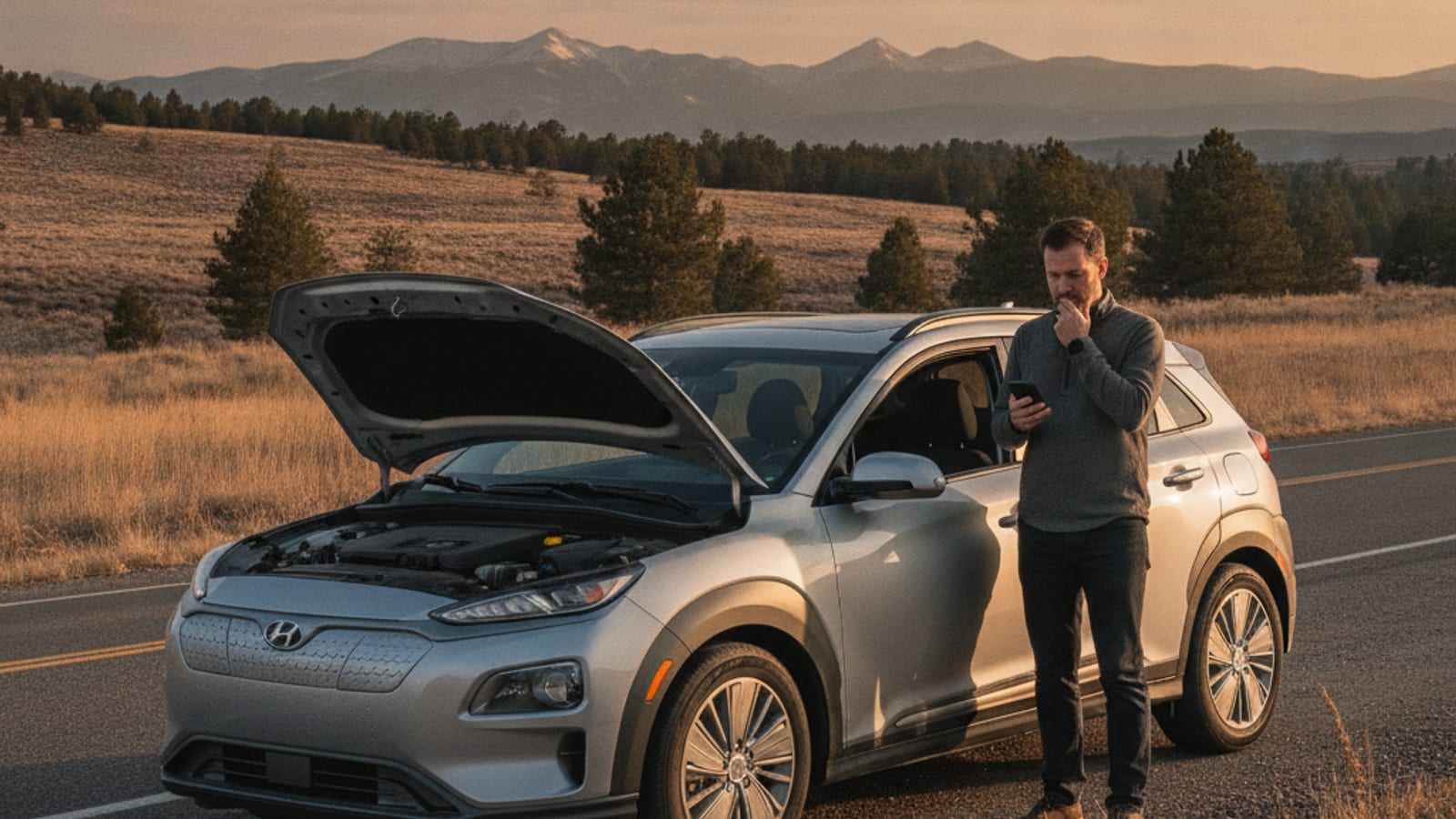
A Kia Niro EV that will not start in the Denver metro almost always has a dead 12-volt battery, not an empty traction pack. The traction pack is high voltage and runs the wheels. The 12-volt runs the computers, the contactors, the locks, and the lights. When the 12-volt dies, the car looks completely dead even though the pack still holds plenty of charge. Call (720) 738-6950 and Charge Pro DEN refers an independent local operator who quotes you before any cable goes in.
The pack is rarely the cause
Denver sits at 5,280 feet and gets arctic drops in winter. January’s normal low around the city sits near 18 degrees, and the all-time record is minus 29 from 1875. A Niro left on street parking overnight takes that cold straight through the body. The traction pack holds charge well in the cold. The 12-volt, a small lead-acid or lithium brick under the hood, does not. Below about 15 degrees the car’s thermal management wakes the pack to protect itself, which draws down the 12-volt a little each cycle. A weak 12-volt that sat through a few Front Range nights eventually does not recover.
The owner’s manual covers this. The Niro’s first no-start step is the 12-volt, not the pack. The same rule covers the Ioniq 5, the EV6, and most other modern EVs. The pack may say 60 percent on the app, and the dash can still be black.
What a no-start actually looks like
A no-start Niro does not click like a gas car. The symptoms are quieter and easier to misread.
- The key fob does not unlock the doors, or it works only when held against the door handle.
- The dashboard does not light up when you press the start button.
- The hazard lights work but the cabin lights do not, or the cabin lights are dim.
- The car’s app shows the pack at some range, while the car itself is unresponsive.
These point at the 12-volt. A truly empty pack gives a different set of symptoms: the doors unlock, the dash lights up, a turtle icon or a “check electric vehicle system” warning shows, and the car will not ready. If the doors do not even unlock, treat it as a 12-volt problem until proven otherwise.
The street-parking overnight pattern
More than half of Denver’s housing predates 1980. A very large share of Denver drivers do not have a driveway plug. Their cars sit on the street, on a parking pad, or in a shared lot. The car loses cabin warmth overnight. Phantom drain runs against a marginal 12-volt. A weak one finally quits before sunrise.
The same pattern shows up in Glendale, in parts of Edgewater, and in older blocks of Wheat Ridge, where street parking and older housing dominate. The Niro is a popular urban EV because the size works on tight streets. The exact drivers who picked it for that reason are the same drivers who find a dead 12-volt on a Tuesday in February.
The first checks before you call anyone
A 12-volt that has just quit can sometimes be coaxed back. Try these in order, and stop at the first one that works.
- Look at the fob. Many Niro owners do not realize the fob carries a mechanical key blade. Pull it and use it in the driver’s door lock. If the doors unlock, you have at least some 12-volt left for the cabin.
- Press the brake pedal and try the start button twice, with a ten-second pause. The second press sometimes latches a contactor the first one barely missed.
- Pop the hood and look at the 12-volt. If you see a swollen case, white powder on the posts, or a wet smell, the battery is gone. Do not try to jump it. Move to step 4.
- Try a jump from a known-good 12-volt source. The Niro has dedicated jump posts under the hood, marked red for positive and a clean chassis ground for negative. Connect positive first, then negative to ground, not to the battery’s negative post. Wait a minute. Try the start button. If the dash lights, the 12-volt was the cause.
If step 4 works, drive the car for at least thirty minutes before you shut it off. That gives the DC-DC converter time to put some charge back into the 12-volt. A 12-volt that had to be jumped is a 12-volt that may fail again the next morning. Plan a replacement.
What CDOT Safety Patrol will and will not do
If the Niro died on a covered Front Range freeway segment, CDOT Safety Patrol may be on shift. CDOT’s published menu is flat tires, jump-starts, emergency fuel, minor mechanical help, debris removal, and incident support. A 12-volt jump is on that list. CDOT’s Safety Patrol and breakdown pages mention nothing about EVs or charging. That silence is the gap: the patrol will wake a dead 12-volt. It will not bring a charge to an empty pack.
Front Range patrol windows run 6:00 to 9:30 a.m. and 2:30 to 7:00 p.m. on weekdays, and 10:00 a.m. to 7:00 p.m. on weekends. If the no-start lands outside those hours on a listed segment, the patrol is off shift and you wait.
E-470’s patrol is a different program. Dial *470 for jump-starts, fluid top-offs, and tire help on the eastern loop. E-470 does not publish an EV charging service.
What a local operator does that CDOT does not
Charge Pro DEN does not own trucks, does not employ technicians, and does not set prices. The brand matches stranded drivers with independent local operators. The operator quotes you before any cable goes in. They bill you directly for the work they do.
The first visit is usually a 12-volt jump. If the 12-volt is gone, the operator can replace it on site with a fresh unit. They carry the right Niro group size. They also carry lithium jump packs sized for an EV 12-volt, which avoid the voltage spikes that a gas-car jump can send through an EV’s sensitive electronics.
For a pack that is genuinely low on charge, a mobile EV charging referral brings a 240-volt Level 2 source to the bumper. Tesla drivers get a native NACS plug. Niro drivers use CCS. Typical charging time adds about 10 to 20 miles. That clock starts when the cable goes in. It is not an arrival time and we do not promise one.
For a Niro that will not ready because of a different failure mode, the right path is non-Tesla EV rescue. For a confirmed 12-volt problem, out-of-charge recovery covers the jump or the on-site swap.
Cold, capacity, and what the studies say
Recurrent Auto studied more than 30,000 U.S. EVs in winter. At 32 degrees, the average EV held about 78 percent of its max range. At 20 degrees, that drops to about 70. AAA’s dynamometer study reported about 39 percent range loss at 20 degrees. The pack itself loses capacity in the cold. A Niro that started the day at 80 percent in a Denver driveway in January may genuinely have less range than the gauge claims.
That is a separate problem from a dead 12-volt. The gauge may say 80 percent while the pack can only deliver the equivalent of 60 percent of summer range. The 12-volt on top of that may simply not have enough juice to wake the car. Either way, the cure starts with the 12-volt.
A long uphill commute out of the foothills drains more than the trip meter expects. Drivers in Evergreen and the SH-74 corridor know the climb. Cold plus grade plus heater is the worst combination. A Niro that climbs home in the dark on a winter evening can land in the driveway with a pack near empty and a 12-volt that worked harder than usual to run the heater. The next morning is when the 12-volt may finally quit.
What to do if the car will not ready after a jump
A jump that wakes the car but does not let it ready is a different problem. The 12-volt is now live, but something else is wrong. Common Niro causes:
- A blown high-voltage fuse from a recent charging fault.
- A contactor that the 12-volt cannot pull closed.
- A charging port latch that did not release cleanly and left a system warning.
- An extreme pack state, where the pack has dropped below its own operating floor.
Do not keep trying the start button. Each press cycles the contactors and the cooling system. That draws the 12-volt back down. Call a local operator, and let the car sit with hazards off until they arrive.
When a tow is the right tool
A roadside jump does not straighten a bent suspension. A Niro that has been hit, that has a flat it cannot roll on, or that has a damaged pack needs a flatbed, not a charge. A jump will not pull a wheel off a curb. AAA and other clubs exist for that work. For a Denver-metro stranding on a covered CDOT segment, the free patrol will arrange a tow if needed.
CRS 42-4-1202 covers a disabled vehicle on a highway. A driver may not stop on the paved main-traveled part of a highway. The exception is a vehicle so disabled it cannot be moved off. Hazard lights must be on under CRS 42-4-230. That is the law that lets you sit on the shoulder with hazards on while you sort a jump. No Colorado statute treats a disabled EV as a special class. A stranded Niro is governed by the same disabled-vehicle statutes as any car.
A short list of what to keep in the car
A small kit prevents a 12-volt no-start from becoming a tow. Keep these in the cargo area:
- A lithium jump pack rated for an EV 12-volt, with the right Niro adapter.
- A set of basic jumper cables, even though the jump pack is the first choice.
- The mechanical key blade, removed from the fob, in a labeled bag.
- A reflective vest, in case the no-start happens on a shoulder.
- The owner’s manual, with the jump-post diagram bookmarked.
That kit does not prevent a dead 12-volt. It turns a dead 12-volt into a ten-minute fix instead of a two-hour wait.
How to tell it was the 12-volt and not the pack
After a successful jump, watch for these signs that the 12-volt was the only problem:
- The car readied normally and drove.
- The pack gauge showed the same range it had before.
- No warning lights stayed on after the car readied.
- The next cold start worked without intervention.
If any of those are wrong, take the Niro to a service shop that works on EVs. A 12-volt jump is a fix for a 12-volt problem. It does not reset a pack fault, clear a contactor error, or replace a failed DC-DC converter. A mobile EV charging referral adds range on site. A shop visit diagnoses what is actually wrong.
For the broader pattern of a 12-volt that wakes the car but leaves a warning, read can roadside jump an EV 12V. It covers the same decision tree from a different angle.
What Charge Pro DEN does
Charge Pro DEN is a referral line. We do not own trucks. We do not set prices. We do not promise an arrival time. We match you with an independent local operator who carries EV 12-volt jump gear and Level 2 charging gear. The operator quotes you before any cable goes in. They bill you directly for the work they do.
The number is (720) 738-6950. Call when the Niro will not wake and you do not want to guess between a jump, a charge, and a tow. We serve the Denver metro from the plains to the foothills. Treat it as a referral number, not a rolling promise.
Frequently asked questions
How do I know if the Kia Niro EV has a dead 12-volt or an empty pack?
The 12-volt controls the locks, the dashboard, and the contactors. If the doors do not unlock from the fob, or the dashboard is dark when you press the start button, treat it as a 12-volt problem. If the doors unlock, the dash lights, and the car shows a turtle or a warning, the pack is low. The pack gauge on the app is a starting hint, not a verdict.
Can I jump a Kia Niro EV from another car?
Yes, with care. Use the Niro’s under-hood jump posts, not the battery posts directly. Connect positive to the red post. Connect negative to a clean chassis ground, not the 12-volt’s negative terminal. A lithium jump pack rated for EVs is the cleaner option. A gas-car jump can send voltage spikes through an EV’s electronics if it is miswired.
Will replacing the 12-volt fix a Niro that will not start every morning?
Often. A 12-volt that needed a jump is usually at end of life. Replace it with the correct group size and CCA rating. If the new 12-volt also fails within a few weeks, the problem is parasitic drain or a failing DC-DC converter. That needs a service shop, not another jump.
Does CDOT Safety Patrol jump EVs on Denver freeways?
CDOT Safety Patrol’s published menu includes jump-starts. CDOT’s pages mention nothing about electric vehicles, so treat the jump as a 12-volt jump, not a charge to an empty pack. Front Range patrol hours are 6:00 to 9:30 a.m. and 2:30 to 7:00 p.m. on weekdays, and 10:00 a.m. to 7:00 p.m. on weekends. Outside those windows, the patrol is off shift.
What should I do if the Niro jumps but will not ready?
Stop trying the start button. Each press cycles contactors and drains the 12-volt back down. Leave the hazards off if you are safely off the road. Call (720) 738-6950 for a local operator who can diagnose on site or arrange a flatbed to a service shop that works on EVs.