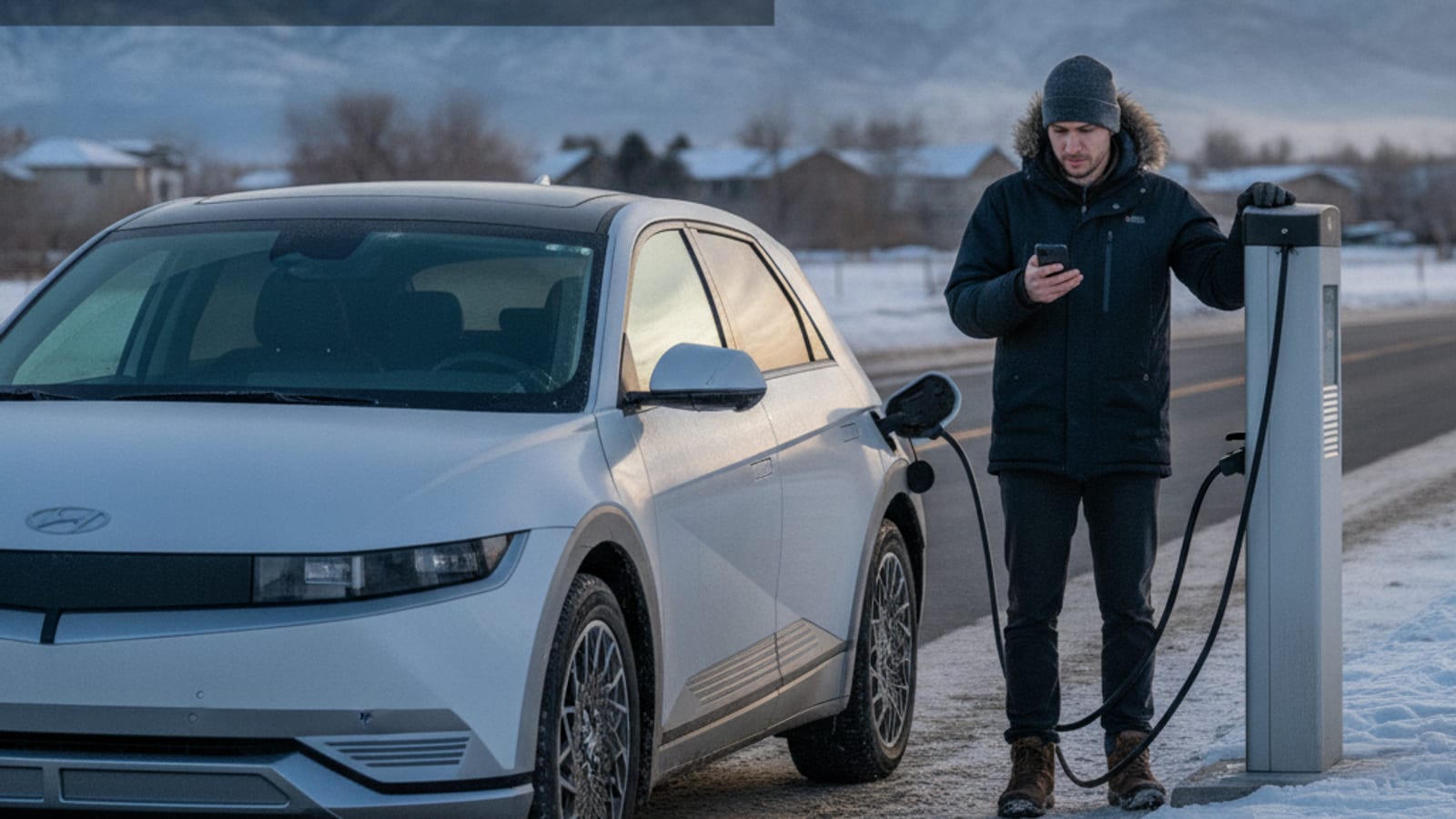
Hyundai Ioniq 5 charging time gets longer when the air drops below freezing, and on a Denver morning that air is rarely above freezing from November through March. The published numbers assume a warm pack. A cold pack charges slower at home, slower at DC fast, and slower on a roadside boost. None of that is a defect in the car. It is chemistry. If you are stuck or stranded anywhere in the Denver metro, call (720) 738-6950 and we will match you with an independent operator who brings a 240-volt Level 2 source to your bumper and quotes you before any cable goes in.
The published numbers assume a warm pack
The 2026 Ioniq 5 ships with two pack sizes in the U.S., a smaller standard pack and a larger long-range pack, both built on Hyundai’s E-GMP 800-volt platform. The DC fast charge rate, the AC onboard charger size, and whether your car has the heat pump option all depend on your year and trim. Pull your VIN’s spec sheet from Hyundai before you trust any forum number.
In warm conditions Hyundai USA publishes the following targets for the standard 2026 Ioniq 5:
- AC Level 2 at 240 volts and 10.9 kW, 10 percent to 100 percent: about 5 hours 40 minutes on the smaller pack, about 7 hours 20 minutes on the larger pack.
- NACS 150 kW DC fast, 10 percent to 80 percent: about 24 minutes on the smaller pack, about 30 minutes on the larger pack.
- CCS adapter 50 kW DC fast, 10 percent to 80 percent: about 61 minutes on the smaller pack, about 81 minutes on the larger pack.
- CCS adapter above 250 kW at 800 volts DC, 10 percent to 80 percent: about 20 minutes on either pack.
Source: Hyundai USA 2026 Ioniq 5 specifications. Those are the warm-pack, 10-to-80 percent fast-charge numbers and the 10-to-100 percent home numbers. They are also the numbers that matter most for a stranded driver, because nobody asks how long a charge takes from 90 to 100 when their pack is at 4 percent on a shoulder.
The two endpoints are different sessions. DC fast stops at 80 percent by design. Home charging continues to 100 percent. A fast-charge session is not a full charge. Hyundai USA did not publish a DC time to 100 percent.
Why the Ioniq 5 charges slower when it is this cold
A lithium pack charges fastest when it sits around 70 to 100 degrees Fahrenheit. Below about 50 degrees, the chemistry slows. Below freezing, the car throttles charging to protect the pack. The Ioniq 5 has a battery management system that preheats the pack when you navigate to a DC fast charger, which is the right thing to do for the cells but does add minutes to your session.
Two specific things change at Front Range temperatures:
- Home Level 2 slows down. The 10.9 kW AC onboard charger throttles to a lower rate on a cold soak. Plan on the same percent-to-full taking noticeably longer on a January night than on an October night, even at the same outlet.
- DC fast charging throttles harder. The 800-volt architecture supports very high DC rates, but cold-pack limits can drop your peak rate by half or more. A 30 minute warm-pack session can stretch past 45 minutes on a cold morning. Below about 15 degrees, the car will spend the first part of the session heating the pack before it accepts full rate.
The cold-soak penalty is not unique to the Ioniq 5. It is the same direction for every EV on the road. The Ioniq 5 is just one of the more popular EVs in Denver, and the question shows up most often from its drivers. For the broader winter pattern, read EV battery care in a Denver winter. That post covers the documented winter loss figures across 30,000 U.S. EVs.
What a Denver winter morning looks like
NWS Boulder climate normals put Denver’s January low around 18 degrees. The all-time record is minus 29 on January 9, 1875. January 2024 took Denver from 47 to minus 19 in about 48 hours on January 16 and 17. The point is not to scare you. The point is that a Denver winter does not treat any car gently, and an EV that sat outside overnight has a colder pack than a forum poster in a coastal garage would expect.
Recurrent Auto’s study of more than 30,000 U.S. EVs found the average pack held about 78 percent of max range at 32 degrees, and about 70 percent at 20 degrees. AAA’s own dynamometer study put the loss at about 39 percent at 20 degrees. Both numbers cover the same direction, with AAA being the harsher reading. They are also range figures, not charging-time figures. The slower charging in cold is the related but separate problem: a cold pack charges slower because the chemistry resists incoming current, and the car itself derates the charge rate to protect the cells.
Practical consequences for an Ioniq 5 driver in the Denver metro:
- Plan on the home Level 2 session taking about 20 to 30 percent longer on a January morning than the published 5 hours 40 minutes or 7 hours 20 minutes.
- Plan on a DC fast session from low state of charge to 80 percent taking 10 to 20 minutes longer than the published warm-pack number.
- Treat the car’s preconditioning as a feature, not an extravagance. If you navigate to a DC fast charger while plugged in, the pack warms on the way there.
The climb up I-70 changes the picture again
Cold plus grade is the worst combination. The Denver plain sits at 5,280 feet at the State Capitol. The Eisenhower-Johnson Memorial Tunnel west portal sits at 11,158 feet. That is nearly 6,000 vertical feet over roughly 50 miles of I-70, with the steepest grades between Floyd Hill and the tunnel. An Ioniq 5 that climbs past Idaho Springs at 7,526 feet with a heater running in January is doing two range-killers at the same time.
The published range numbers do not include a heater drawing 5 to 7 kW continuously. A real Front Range winter climb eats a comfortable-looking gauge faster than the trip meter predicts. The Idaho Springs Supercharger, 8 stalls in the current inventory, is the last confirmed Tesla-compatible fast charge before the tunnel from the Denver side. Georgetown, sitting between Idaho Springs and the tunnel, has no Supercharger in the current inventory. A driver leaving Golden with 50 percent on the dash is making a different decision than a driver leaving Golden with 20 percent.
Cold does not change the climb penalty. It stacks on top of it.
Regen on the descent returns a real share
The flip side of the climb is the descent, and the Ioniq 5 is good at it. InsideEVs and Notebookcheck both covered a real-world test of EVs running Loveland Pass. A Hyundai Ioniq 5 used about 10 percent of its battery over a 75-mile descent, crediting regenerative braking. The same reporting framed regen on descents as recovering roughly two-thirds of the energy spent climbing. The E-GMP platform supports strong regen through one-pedal driving, and the Ioniq 5 has an i-Pedal mode that brings the car to a full stop without touching the brake.
The descent regen only helps if you started the climb with margin. The Ioniq 5 that reaches Idaho Springs at 8 percent is going to limp over the tunnel. The Ioniq 5 that reaches Idaho Springs at 40 percent is going to arrive in Silverthorne close to where it started. Drivers also dial regen down on icy descents for traction. If you are on a snow-packed road out of the tunnel, full regen can upset the rear axle when the surface is slick. Use the paddles to soften regen on the steep and icy stretches, then put it back on for the flatter miles.
A roadside boost adds 10 to 20 miles
When the Ioniq 5 will not wake up in the cold, or when the pack is at the wrong end of zero, the move is a 240-volt Level 2 boost on site. The Ioniq 5 charges through a CCS combo port on U.S. cars. Operators we refer bring a 240-volt Level 2 source with a CCS or J1772 adapter. A Level 2 boost typically adds about 10 to 20 miles of range in 15 to 30 minutes of charging, all of which depends on the car’s current state of charge and the temperature. That is enough to clear a shoulder and reach a stall, or to roll the last few miles home to Evergreen or back into the metro.
For a more stranded layout, use the broader mobile EV charging service page. That post covers what the operator actually rolls with, and why a Level 2 boost is the right tool for an empty pack.
Charge Pro DEN is a referral line. We do not own trucks. We do not employ technicians. We match you with an independent local operator. The operator quotes you before any cable goes in. They bill you directly for the work they do. We do not promise an arrival time, we do not publish hours, and we do not set a price. Use us as the matchmaker and let the operator quote you on site.
What the cold soak does to the 12-volt
A separate problem follows the cold-soak question. The Ioniq 5 has a 12-volt auxiliary battery that powers the computers, the contactors, the door locks, and the wake-up sequence. On a cold soak, the 12-volt drains faster than the traction pack does. A car that sat in a DEN parking lot for a week in January can come back with plenty of traction range and a dead 12-volt. The car looks finished. It is not finished. It needs a 12-volt jump.
CDOT Safety Patrol will jump a 12-volt on its covered metro segments. So will most mobile operators we refer. The 12-volt work is fast. The traction pack is fine. The out-of-charge recovery page covers the empty-pack case separately; the 12-volt dead case is the cold-soak story, not the empty-pack story.
For the broader no-wake picture, the Ioniq 5 battery size and cold range post covers how the traction pack and the 12-volt split the cold problem, and what regen does on the way back down.
A few practical rules for a Front Range Ioniq 5 driver
A few rules worth keeping in the car:
- Read your VIN’s spec sheet. Pack size, onboard charger size, and DC fast rate vary by year and trim. Do not trust any forum number.
- Plug in overnight whenever you can. Even a 120-volt outlet buys preconditioning time. A warm pack charges faster in the morning.
- Navigate to a DC fast charger while plugged in. The pack will precondition on the way, and the session will hit its peak rate sooner.
- Plan for 20 to 30 percent slower. Both home Level 2 and DC fast take longer on a January morning than the published numbers. Treat the slower number as the working number.
- Treat cold and grade as one problem. A climb to the tunnel with a heater running is two range-killers stacked. Add the destination charger to the navigation before you leave.
- Top up at Idaho Springs on the way west. Georgetown has no Supercharger in the current inventory. The stretch past Idaho Springs is the committed stretch.
If you cannot make the next charger and you are stuck on the shoulder, call (720) 738-6950. We match you with an operator who brings 240 volts to the bumper and quotes before work starts. Treat the number as a referral line, not a rolling promise.
Frequently asked questions
How long does it take to charge a Hyundai Ioniq 5 at home in Denver?
Plan on 20 to 30 percent longer than the published warm-pack numbers in a Denver winter. The 10.9 kW onboard charger throttles on a cold soak. A smaller pack that Hyundai quotes at about 5 hours 40 minutes from 10 to 100 percent in warm conditions will take closer to 7 hours on a January morning. A larger pack that Hyundai quotes at about 7 hours 20 minutes will stretch past 9 hours.
Does the Ioniq 5 charge slower at DC fast in cold weather?
Yes. The 800-volt architecture supports very high DC rates, but cold-pack limits can drop your peak rate by half or more. A warm-pack session from low state of charge to 80 percent in about 20 to 30 minutes can stretch past 45 minutes on a cold morning. Below about 15 degrees the car will spend the first part of the session heating the pack before it accepts full rate.
What does a roadside boost add to a cold Ioniq 5?
A 240-volt Level 2 boost typically adds about 10 to 20 miles of range in 15 to 30 minutes of charging, all of which depends on the car’s current state of charge and the temperature. That is enough to clear a shoulder and reach a stall, or to roll the last few miles home. The operator quotes you before any cable goes in.
Does preconditioning help the Ioniq 5 charge faster in cold weather?
Yes. If you navigate to a DC fast charger while plugged in, the battery management system warms the pack on the way. The session will hit its peak rate sooner. Preconditioning is also gentler on the cells than forcing a cold pack to accept high current.
Can I leave the Ioniq 5 plugged in overnight in Denver?
Yes, and it is the right move when the forecast is cold. Plugged-in overnight charging lets the battery management system run thermal management from the wall instead of the pack. A cold-soaked pack is the slower pack. A plugged-in pack is a warmer pack.