A Tesla on a Denver night doesn’t charge on one timer. Superchargers, a home 240-volt plug, and a wall outlet all run different clocks. A roadside Level 2 unit is a fourth clock. If the pack is already empty on a shoulder, ignore the overnight number. Operators we connect you with typically add 10 to 20 miles in 15 to 30 minutes of charging. That’s charging time on the car, not a promise of when a truck arrives.
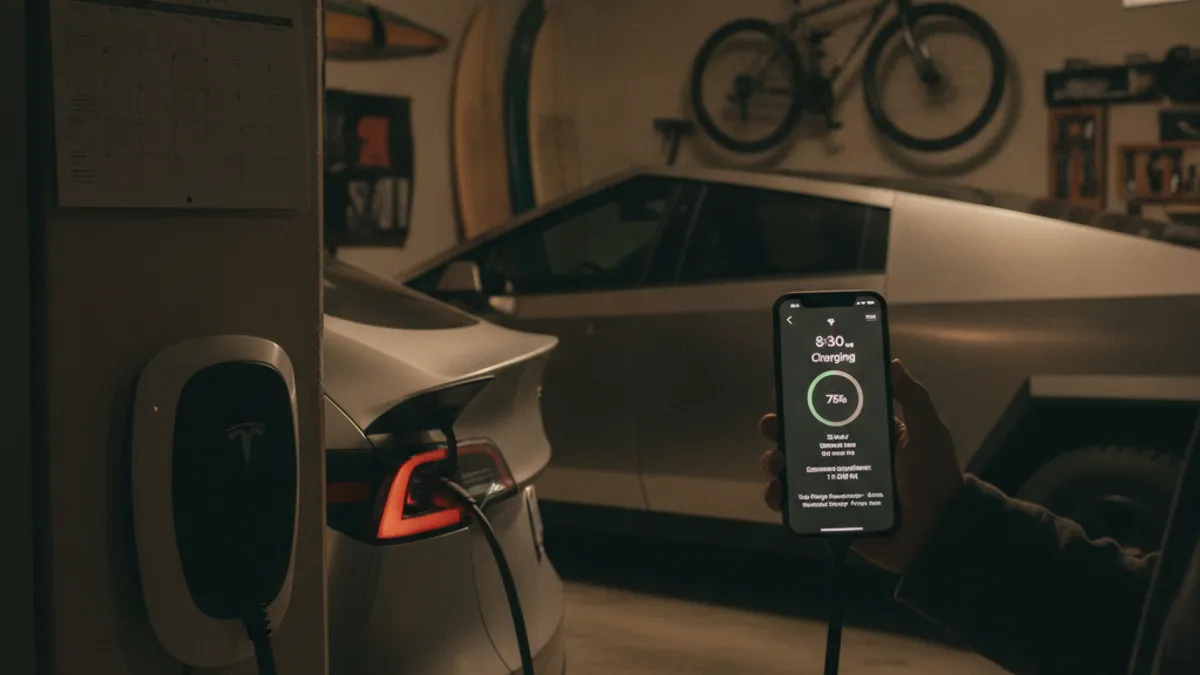
People want one number. Denver gives you four.
Searchers type how long does it take to charge a Tesla and expect a single minute count. The plug decides the wait, and so does pack temperature. Whether you can still drive to a stall matters too. Tesla charging uses the same three levels as every other EV. The roadside case is the one most charts skip.
Supercharger minutes, then the crawl to full
A Supercharger sends direct current into the pack. So does a CCS fast stall from Electrify America or EVgo. Both skip the onboard charger and feed the pack directly. A Model 3 or Y often reaches about 80% in 25 to 40 minutes on a newer stall. Older Model S and Model X cars run slower, and older stalls do too.
Past 80%, the charge rate falls off hard. Lithium-ion cells take charge fastest in the middle of their range. They slow down to protect the pack as they near full. Ten to 80% can look like a short break. Eighty to 100% on the same stall can take nearly as long again. Most drivers unplug at 80% and skip that tail.
Tesla navigation can precondition the battery when you route to a Supercharger. Do that before you leave a cold garage. A warm pack accepts DC current closer to what the stall can deliver. Skip it on an 18-degree morning and you sit through a warm-up first.
Superchargers sit across the Denver metro. Denver, Park Meadows in Lone Tree, Highlands Ranch, Boulder, Castle Rock, and Idaho Springs all have sites. Idaho Springs is the last Supercharger on I-70 west from the Denver side. Those stalls help when the car can still roll. They don’t help at zero on a shoulder.
Overnight at home, and the outlet that crawls
A 240-volt Level 2 charger is the daily default. From near empty to full, that session typically runs 6 to 10 hours. You plug in after dinner and wake up ready.
Who bills that session depends on the street. Xcel Energy covers Denver, Aurora, Lakewood, Boulder, and much of the core. CORE Electric Cooperative covers the south-metro Douglas County corridor. That includes Highlands Ranch, Parker, Castle Rock, and Lone Tree. United Power covers much of the north and northeast. It splits streets with Xcel in Thornton, Westminster, Arvada, Broomfield, and Erie. Don’t assume Xcel is on the bill in Castle Rock.
A standard 120-volt wall outlet is the slow clock. It adds about 3 to 5 miles of range per hour. A fill from near empty can take two to three days of continuous charging. That works only if the car sits for days. It can’t cover a cold commute plus cabin heat on overnight hours alone. Home 240-volt charging versus a roadside charge is the comparison if you’re deciding after the fact.
What a Front Range night does to every clock
Denver sits at 5,280 feet on the Capitol’s west steps. January’s normal low sits around 18 degrees here. January 2024’s arctic blast dropped Denver from 47 to minus 19 in two days. A pack that sat outside through that isn’t a mild overnight chill. It’s a battery that won’t take a fast charge until it warms.
Recurrent Auto studied more than 30,000 U.S. EVs in winter. Packs kept about 78% of max range at 32 degrees. At 20 degrees the average was about 70%. Those are fleet averages, not Tesla-published range numbers.
The metro isn’t one climate on the same night. A car on open plains in Aurora cools faster than one in a Lakewood garage. Climbing toward Evergreen spends more energy than a flat I-25 run through Thornton. Descent recovers a large share of a climb through regen. Drivers often ease regen off on ice. That’s the right call for traction and a worse call for the pack.
A week in a cold DEN lot can kill the 12-volt. That small battery is a separate system from the traction pack. Dark screens and a silent charge port are a jump or a 12-volt replacement. They’re not a six-hour Level 2 session.
When you can’t wait for 6 to 10 hours
Misjudge the remaining miles after a Tech Center dwell or a Red Rocks show, and the overnight window is closed. CDOT Safety Patrol covers segments of I-25 South, I-70 East, US-6, C-470, and I-225. It also covers the I-70 mountain corridor from Morrison toward Vail. The patrol will jump a 12-volt and change a tire. Its published pages say nothing about charging an EV.
A disabled Tesla on the shoulder falls under CRS 42-4-1202 like any other car. Keep the hazards on, and move off the travel lane if you still can.
Mobile EV charging is the clock for that moment. Independent operators bring a 240-volt Level 2 source to the car. On a Tesla that’s a native NACS plug. They typically add 10 to 20 miles in 15 to 30 minutes of charging. That boost is often enough to reach a Supercharger or get home if you’re close.
Charge Pro DEN is a referral line. We match stranded Tesla drivers with local operators. We don’t own trucks and we don’t set the price. The operator quotes you before starting and bills you directly. What a mobile charger brings is that Level 2 source, plus CCS or J1772 adapters for other brands.
If the car won’t wake, check the 12-volt before you blame the pack. For a Tesla already at zero, out-of-charge recovery is the service that fits. Call (720) 738-6950 when you need an operator quoted to your location.
Frequently asked questions
How long does it take to charge a Tesla from empty on a Supercharger?
Roughly 25 to 40 minutes to about 80%, depending on the model and the stall. Charging past 80% slows down a lot, so most drivers stop there.
How long does a home Tesla charger take overnight?
A 240-volt Level 2 home charger typically takes 6 to 10 hours from near empty to full. That fits a normal night if the car is already plugged in.
Can a roadside Level 2 charge fill a Tesla?
No. Operators typically add 10 to 20 miles in 15 to 30 minutes of charging. That’s enough to reach a stall or get home, not a full pack.