If your EV hits zero in Longmont, you need charge brought to the car. Charge Pro DEN is a referral line for EV roadside assistance across the Denver metro. We connect you with an independent local operator. They can add range at the curb or on Main Street. A Ken Pratt parking pad works the same way. The operator quotes you before they start. They bill you directly once the work is done.
Longmont Power and Communications sets the charger story
Most Denver-metro homes sit on Xcel, CORE, or United Power. Longmont doesn’t sit on any of those three. Longmont Power and Communications is the City’s municipal utility. Home-charger rebates and public Level 2 questions go to the City, not to Xcel.
The published program name is the LPC EV Charger Rebate. The City also lists public Level 2 charging. Confirm current terms on longmontcolorado.gov before you plan a wall unit. Rebate dollar amounts weren’t confirmed in our research. Don’t treat a number you heard last year as current. The utility on your bill is the one that sets the rules.
If you live in Longmont, a wall-unit question goes to LPC. If the car already hit zero, that’s a different call. A rebate form won’t wake a pack that’s empty.
ZIP codes here are 80501, 80503, and 80504. The city sits in Boulder and Weld Counties. About 37.6 percent of housing here was built before 1980. A lot of that older stock never had a driveway circuit.
How Longmont drivers actually get stuck
Longmont is the large city on this corridor after Boulder. People commute west on SH-119, the Diagonal, toward Boulder. They also run east when I-25 is the commute. US-287 is Main Street through the historic district. SH-66 cuts across the north side of town. Ken Pratt Boulevard carries SH-119 along the south edge.
Tesla Superchargers are listed in Longmont in the NREL inventory. The City lists public Level 2 charging as well. You can still finish a dwell with an empty pack. Roosevelt Park, the Longmont Museum, and Union Reservoir are real local stops. The St. Vrain Greenway is another place cars sit. Errands along the Ken Pratt corridor add up without looking like a road trip. A long sit in Prospect or Fox Hill does the same.
Older central Longmont isn’t built like the newer edges. Old Town and the Main Street district have apartments and street parking. Many of those buildings have no plug. Southmoor Park, Clover Basin, and Renaissance more often charge at home. The southwest and southeast edges follow that home-charging pattern. A walk-up in 80501 often means no overnight Level 2. That’s a Longmont split, not a generic Front Range note.
Neighbors on every side shape the next hop. Niwot sits just down the Diagonal from town. Erie sits toward I-25 and the plains. Boulder is the west commute on SH-119. Frederick and Firestone sit east of the interstate. Range that looks fine on Main Street can feel tight on the Diagonal.
Cold on the St. Vrain, and which battery failed
Longmont sits on the northern edge of the metro. It’s on the St. Vrain, on open high plains. Winters here are hard on a parked pack. The September 2013 flood is the disaster people still name. For an EV, the daily problem is a cold soak.
Recurrent Auto studied winter range on more than 30,000 U.S. EVs. At 32 degrees, EVs kept about 78 percent of max range on average. At 20 degrees, that fell to about 70 percent. Denver’s January normal low sits around 18 degrees. Longmont is exposed plains north of that core. Treat a cold morning as worse than the dash suggested.
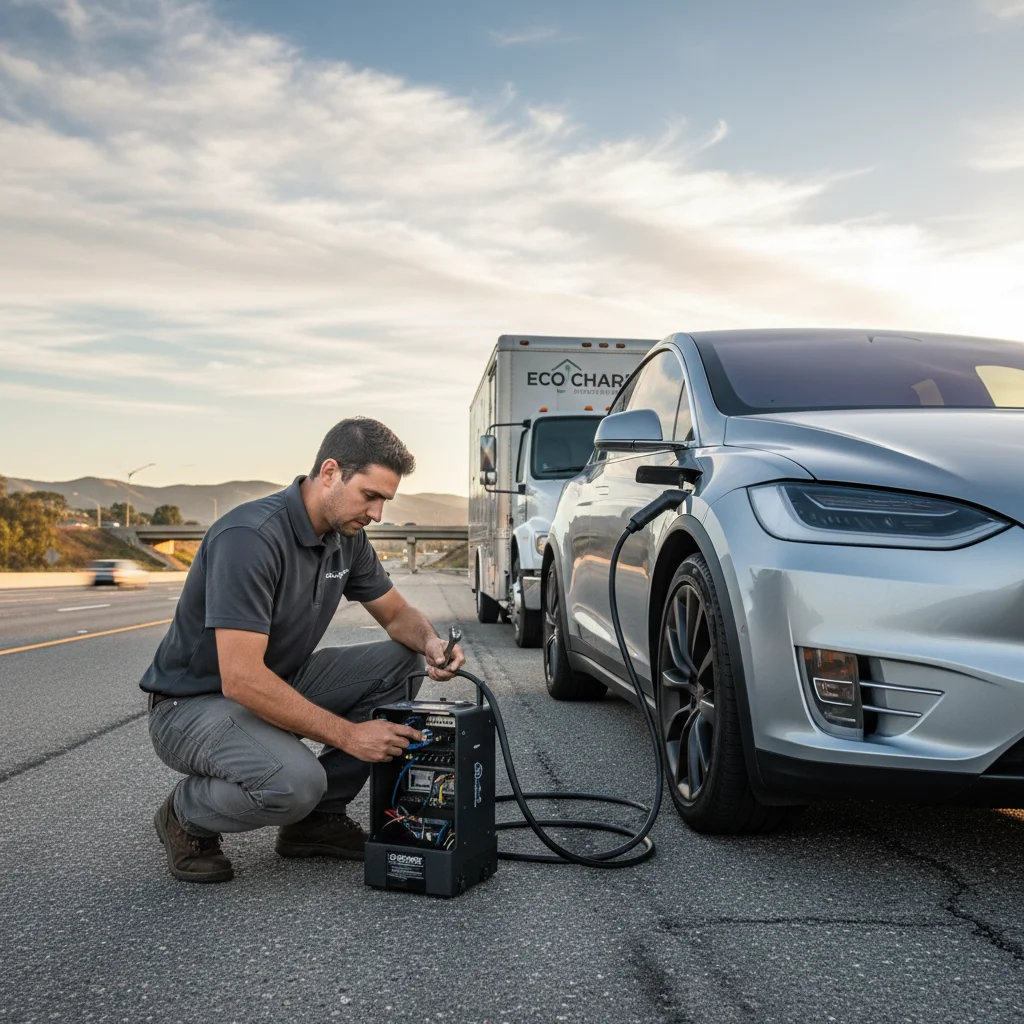
Two failures look the same from the sidewalk. The traction pack can be empty after a day’s driving. The 12-volt battery can also be dead. The 12-volt wakes the computers, the locks, and the contactors. A pack with miles left still sits dark if the 12-volt has given up. Operators on these calls can jump or replace a 12-volt on site. They can also bring a 240-volt Level 2 source when the pack is empty.
If the car won’t unlock after a night outside, start with the 12-volt. If the car is on and reads zero, you need pack energy. Mixing those two up is how people request a flatbed they don’t need. A Tesla 12-volt jump is a different job from a pack fill.
What the operator brings to a Longmont stop
Charge Pro DEN doesn’t hold a shop, a fleet, or a yard. We match stranded drivers with local mobile rescue operators. The operator quotes you before any cable goes in. They bill you directly, not through a shop invoice.
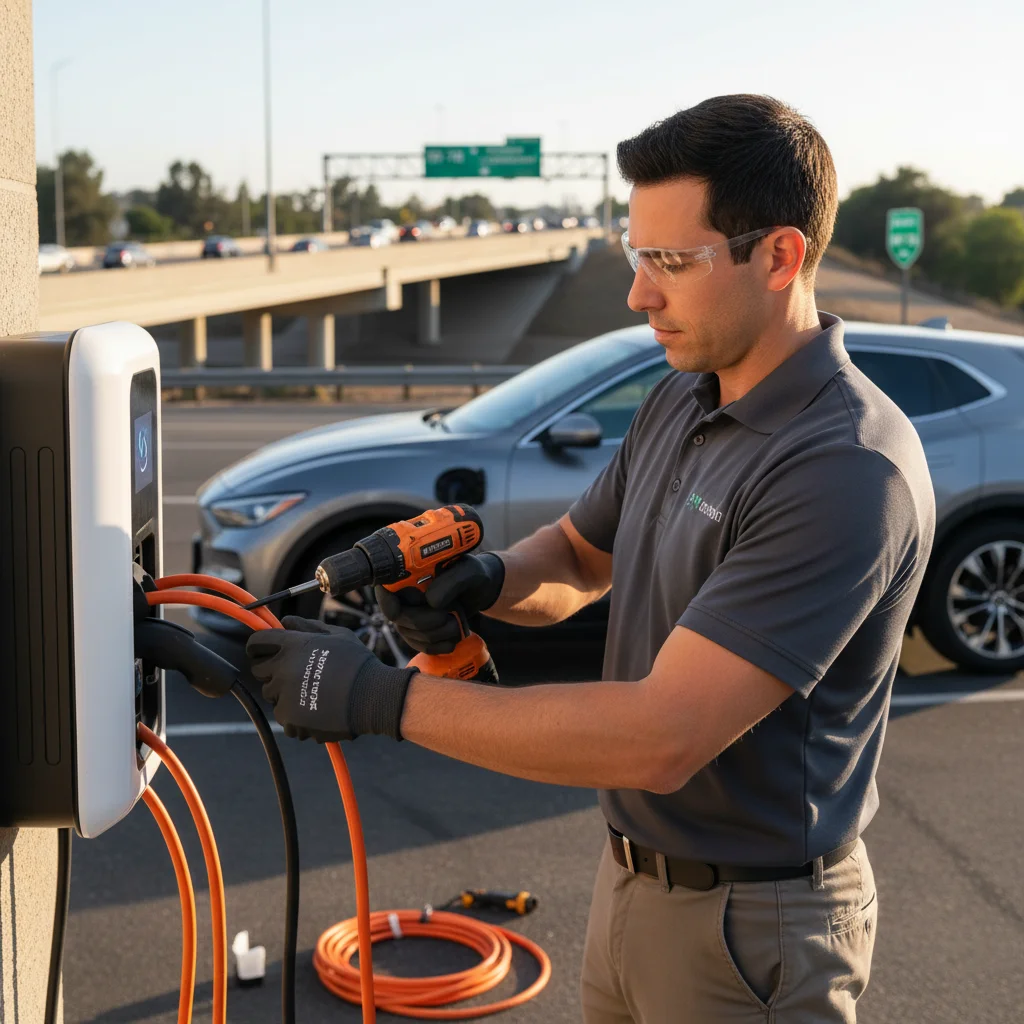
What they bring is a 240-volt Level 2 source. Tesla cars take a native NACS plug at the port. Other makes use a CCS or J1772 adapter. Typical charging time adds 10 to 20 miles of range in 15 to 30 minutes. That’s time on the cable, not a travel window. Nobody here will quote an arrival clock.
That out-of-charge recovery covers Tesla and every major EV brand. It also covers the 12-volt job on the same stop. A gas-car jump pack isn’t the same tool. The operator isn’t there to install a wall charger. That’s a home-install job in LPC territory. This call is only to get the car moving.
Give a real pin, not just the word Longmont. Main Street and Ken Pratt are different dispatches. A breakdown on I-25 east of town is different again. The I-25 North Express Lanes were built with at least an 8-foot outside shoulder. If you stall there, move right and stay off the traveled lanes.
Shoulder rules, and what CDOT won’t do
Colorado has no statute that carves out a disabled EV. CRS 42-4-1202 is the disabled-vehicle rule that covers you. Outside a business or residential district, stay off the paved travel lanes. A car that couldn’t move further may sit on the shoulder with hazards on. A violation is a class B traffic infraction.
CDOT Safety Patrol is free on the freeway segments it lists. It’ll jump a 12-volt, change a tire, and handle debris. Its published pages say nothing about charging an EV. Don’t wait on a state truck for a pack fill. The published Front Range segments don’t include Longmont’s streets. They also don’t list US-287 or SH-119. The listed I-25 South coverage runs from 120th Ave to Arapahoe Road. That stretch sits well south of Longmont.
Abandoned-vehicle rules live in CRS 42-4-1803 to 1805. There’s no fixed hour clock in the statute. An officer decides on reasonable grounds, not a posted timer. Don’t assume you can wait overnight on US-287.
Charge in place, or tow the car
If the only problem is an empty pack, you need energy, not a shop. A mobile charge lets you roll to a stall you already trust. It can also cover the miles home if the remaining range is enough. A tow still leaves you needing a charge at the other end.
A tow can still be the right call. A mechanical fault, a tire, or a frozen charge port may need a shop. Compare those paths in our note on charge in place or a tow in Colorado. The operator on a Longmont stop will tell you which case they’re looking at.
Public fast charging in town is a real option. Use it when you can reach it under your own miles. When you can’t, the roadside Level 2 visit is the stopgap. Check PlugShare or the AFDC map before a Boulder run. Those maps won’t help once you’re already sitting.
When the next town is the problem
The Boulder commute on the Diagonal leaves a lot of packs short. The Boulder roadside write-up covers the west side of the Diagonal. If the car died before you left town, stay put. Read Your EV stalled in Longmont for the charge-versus-boost fork. Niwot and Erie sit on the same commuting pattern. The car doesn’t care which city line you crossed.
How to get an operator on the phone
Stay with the car if it’s safe. Keep your hazards on while you wait. If you’re on I-25, use that outside shoulder. Then use the referral line at the bottom. We connect you with a local independent operator. They quote the job before any work starts.
Call (720) 738-6950 when you need that match. Charge Pro DEN serves Longmont and the rest of the Denver metro. We don’t promise a clock on the referral.