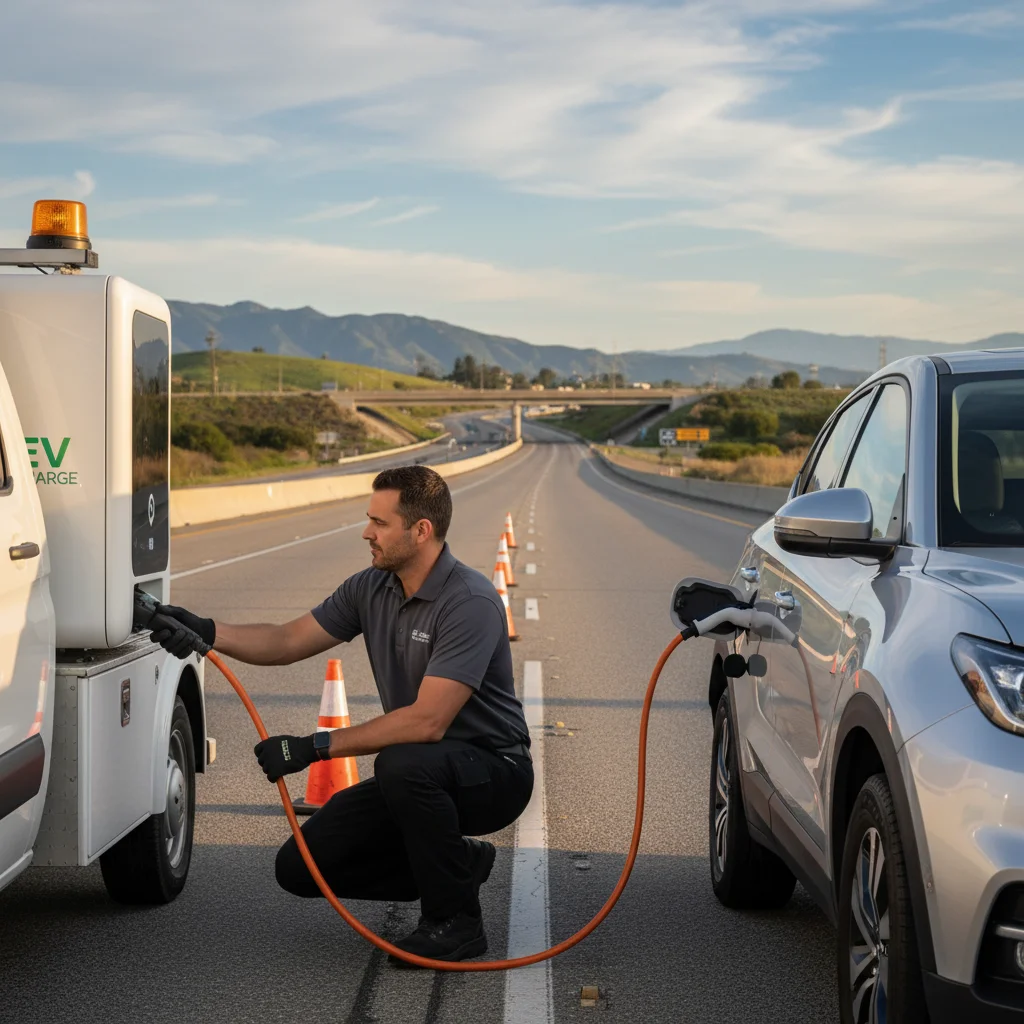
A cold Littleton morning is when a lot of EVs refuse to ready. The house is older. There’s no 240-volt plug in the driveway. EV roadside assistance in Littleton means a mobile operator coming to the car. It’s not a shop visit. It’s not a tow as the first move. EV roadside assistance here is a charge or a 12-volt jump on site.
Older houses, three counties, and no driveway plug
Census ACS figures put Littleton at 45,092 residents. About 46.9% of the housing was built before 1980. That’s apartments and older blocks around historic Downtown Littleton. Main Street, Ketring, and Highland were built for a different kind of car. They were not built for a 240-volt EV circuit.
Newer southwest streets toward C-470 feel like another city. Southbridge, Ken Caryl-adjacent pockets, and the Roxborough approach often have overnight Level 2. The car sat plugged in. It wakes with a buffer.
Littleton also straddles Arapahoe, Douglas, and Jefferson counties. Xcel Energy lists the city in its South Denver Metro territory. If your meter sits toward Highlands Ranch or Roxborough Park, confirm the utility by address. CORE Electric Cooperative serves that Douglas County corridor.
Xcel publishes several EV program names. They include EV Accelerate At Home and EV Home Wiring Rebate. Rebate dollar amounts were not confirmed in the sources used for this page. Ask Xcel with your service address before you budget a panel or a wall unit.
A 120-volt carport outlet is not that wall unit. Whether Level 1 charging is enough through a Denver winter depends on the overnight low. On a January morning, the official climate normal low sits around 18 degrees. That’s hard on a trickle charge. It’s also hard on the 12-volt battery that wakes the car.
Santa Fe, Bowles, Mineral, and the C-470 edge
US-85, Santa Fe Drive, is the north-south spine through town. Broadway, Bowles Avenue, and Mineral Avenue feed it. SH-75, Platte Canyon Road, runs toward Chatfield and the foothills. C-470 is the south edge.
Those roads carry work trips into Englewood, Centennial, Sheridan, and the Denver Tech Center. Cabin heat, a cold pack, and a rolling commute stack together. The gauge you trusted at 9 p.m. is not the gauge you have at 7 a.m.
Recurrent Auto’s winter study of more than 30,000 U.S. EVs is the range figure to use. Cars held about 78% of max range at 32 degrees. They held about 70% at 20 degrees on average. Denver’s January normal low is around 18.
The January 2024 arctic blast is the local extreme. Denver went from 47 degrees to minus 19 in about 48 hours. An unplugged car on an older Littleton street felt that swing. It’s a 12-volt problem as much as a pack problem.
RTD’s Littleton/Downtown and Littleton/Mineral stations add a long sit. You come back to a vehicle that’s been cold for hours. The traction pack may still show miles. The 12-volt that runs locks and computers may not.
If you stall on Santa Fe or C-470, get out of the live lanes. Colorado’s disabled-vehicle rule is CRS 42-4-1202. Outside a business or residential district, don’t sit on the paved through lanes. The exception is a car that truly cannot move. Hazard lights belong on under CRS 42-4-230. If you’re already on a C-470 shoulder with no miles left, the C-470 steps stay the same. Hazards on. Stay out of traffic. Charge in place if you cannot roll.
Main Street, Aspen Grove, and a car that sat too long
Historic Downtown Littleton is errands, dinner, and street parking. Hudson Gardens and Aspen Grove are longer dwells. Chatfield State Park and the reservoir are the recreation sit. None of those stops is a problem if you arrived with margin. They become one when you arrived already low. The car sat through the cold. You still have to get back toward Bowles or C-470.
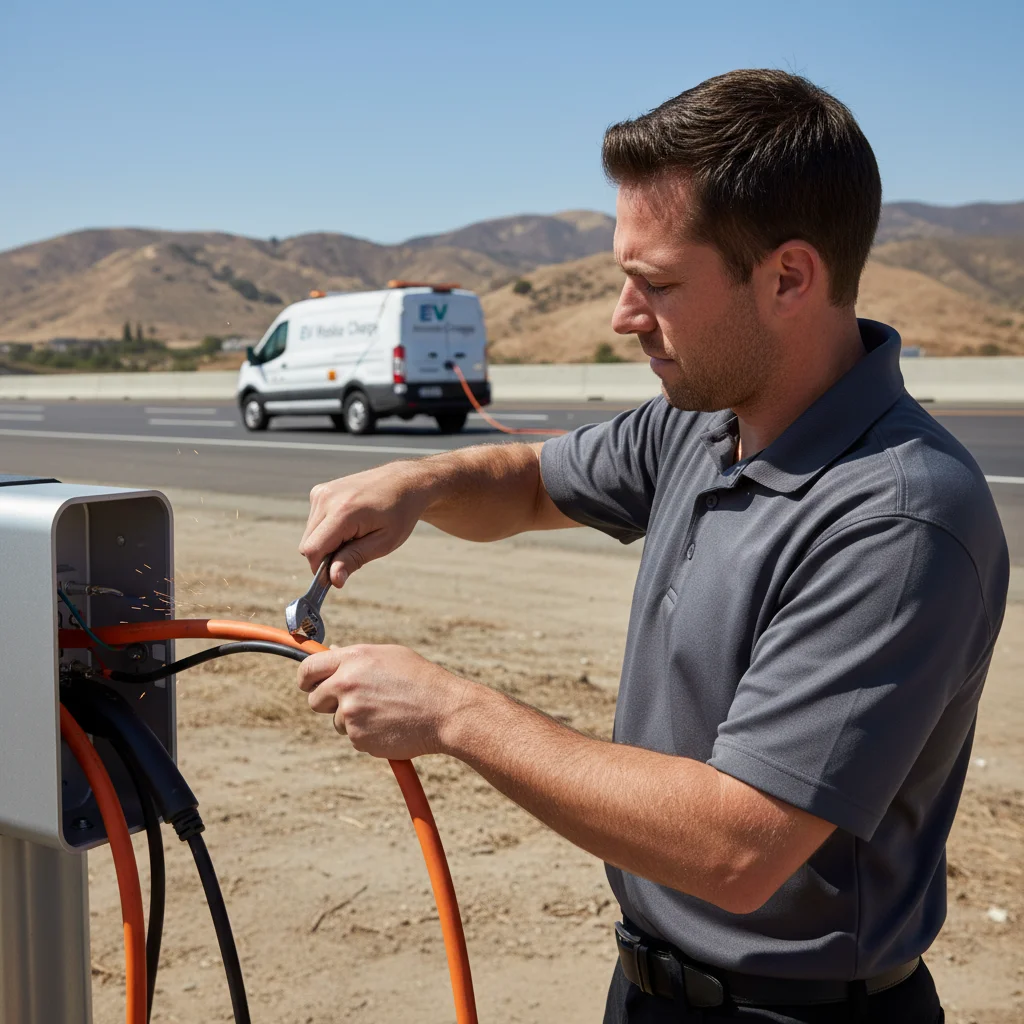
Don’t assume the traction pack is empty because the screens are dark. A long sit in the south metro is often a dead 12-volt. Locks, computers, and the ready sequence all lean on that small battery. The operators we connect you with can jump or replace a 12-volt on site. They handle Tesla and every major EV brand. Which battery actually matters when you’re stranded is the 12-volt versus pack check.
If the pack is truly at zero, you still need a way to move. Tesla Superchargers sit in the current inventory in Highlands Ranch, Centennial, and Lone Tree near Park Meadows. Naming those sites isn’t a promise they’re open. Check the in-car map. Then decide if you can drive. If not, you need a mobile EV charge where you sit.
Columbine, Ken Caryl, Englewood, Sheridan, and Highlands Ranch share this south-metro edge.
Empty pack, dead 12-volt, or doors that will not open
Treat the car as two systems. The big pack moves the wheels. The 12-volt wakes everything else. A cold night in an older driveway with no plug can drain either one, or both.
If the app still talks to the car, check the percentage. Near zero means you need energy in the pack. If the app is silent, start with the 12-volt. A flatbed is the last tool when a jump would have opened the car.
Colorado has no separate statute for a disabled EV. A stranded electric car follows the same shoulder rules as any other car. Abandoned-vehicle law is CRS 42-4-1803 through 42-4-1805. Officers use reasonable grounds. The statute doesn’t set a 24-hour or 72-hour clock. Don’t wait on an invented deadline. Get a charge, get a jump, or move the car when you can.
What the operator brings to a Littleton curb
Charge Pro DEN is a referral line. We don’t own trucks. We don’t employ technicians. We don’t set the price. We match you with an independent local operator. That operator quotes you before work starts and bills you directly.
The operator brings a 240-volt Level 2 source. Tesla cars get a native NACS plug. Other EVs get a CCS or J1772 adapter. Typical charging time is 15 to 30 minutes. That window is for adding about 10 to 20 miles. It’s not a clock on when someone arrives. Arrival depends on which operator is free and where you are parked.
That boost is usually enough to reach a home plug. It can also cover a workplace stall or a fast site in the nav. It’s not a full pack. It’s not a repair. The pros we connect you with are licensed and insured.
Tesla’s own roadside program is a separate dispatcher. The operators we connect you with work independently of that queue.
CDOT can jump a 12-volt, not charge the pack
CDOT Safety Patrol covers portions of C-470, plus listed stretches of I-25, I-70, US-6, and I-225. The published help is free on those segments. It includes flat tires, 12-volt jumps, and emergency fuel. Front Range hours are 6:00 to 9:30 a.m. and 2:30 to 7:00 p.m. on weekdays. Weekends are 10:00 a.m. to 7:00 p.m.
CDOT’s Safety Patrol page and its “my car broke down” page mention nothing about EV charging. They don’t describe a mobile charge for a dead pack. A patrol truck may jump a 12-volt during those hours. It doesn’t bring 240 volts to an empty traction battery.
If you’re on a C-470 shoulder, keep hazard lights on. Stay in the vehicle if that’s the safer choice. COtrip.org and the 511 line are CDOT’s live feed for closures. Traction law and chain law activate by signage and by that feed. A fixed seasonal date for the traction law was not confirmed in the agency material used here.
How the call works when you’re stuck
Call when the car will not ready in a driveway off Bowles or Broadway. Call from a Downtown lot, a Chatfield parking area, or a Santa Fe shoulder. Call when a dead 12-volt has you locked out in the cold.
We take the location, the make, and the connector. We connect you with a local operator. They charge in place when the pack is empty. They jump or replace a 12-volt when that’s the actual fault.
If C-470 or Santa Fe is the pin, say so up front. For the next city south, see Highlands Ranch help when home charging was not enough.
Charge Pro DEN serves the Denver metro, including Littleton. We don’t perform the work. The operator on scene does. The number to call is (720) 738-6950.