EV roadside assistance in Edgewater is a curb charge or a 12-volt jump. This Jefferson County city sits west of downtown Denver on 0.695 square miles. About 83 percent of the housing was built before 1980. That’s the oldest stock in this region. A lot of apartments and bungalows never got a 240-volt home outlet. You park on Sheridan Boulevard or 25th Avenue and hope morning still works. On a cold Front Range night, hope isn’t a charger. The operators we send bring a Level 2 source to the car. They quote you before any work starts.
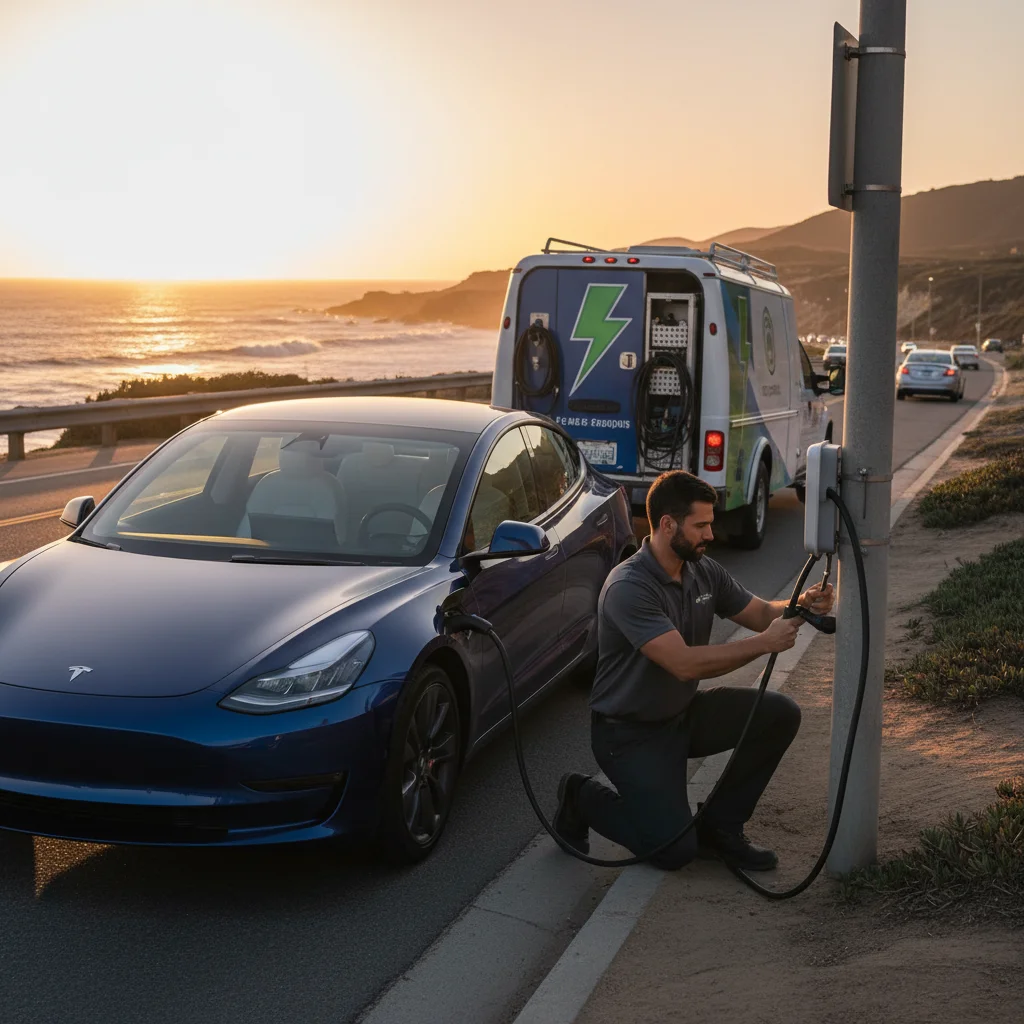
Why an Edgewater morning stalls an unplugged EV
Edgewater is a dense inner-ring city on 0.695 square miles. ACS population is 4,955, and the 2024 Census estimate is 4,880. ZIP 80214 covers the city, and Xcel Energy sells the power.
Age of the housing is the stranding story. Pre-1980 units are 82.7 percent of the stock. Garages, if they exist, were wired for a door opener, not a car. Many residents park on the street overnight without a plug. A dedicated home Level 2 setup is often not practical here. It’s how inner-ring Jefferson County was built.
You feel that gap on a January morning. Denver’s normal January low sits around 18 degrees. Recurrent Auto studied more than 30,000 U.S. EVs in winter. They found about 78 percent of max range left at 32 degrees. At 20 degrees the average was about 70 percent. Heat-pump models held about ten points more at 32. You don’t need I-70 for that loss. A short evening at the Edgewater Public Market can spend the margin. Then the car sits until dawn in the cold.
Hispanic or Latino residents are 40.9 percent of the city. A lot of households here compare a flatbed bill to a charge in place. The operator quotes first, and you decide before they plug in.
Home charging is the long-term fix when the building allows it. Xcel lists EV Accelerate At Home and an EV Home Wiring Rebate. It also lists Optimize Your Charge, Charging Perks, and the RE-TOU time-of-use rate. A Residential EV Rebate sits on the same Xcel EV pages. Confirm what is open on Xcel’s site before you count on it. Rebate dollar amounts aren’t something we publish. None of those programs start a car that already won’t ready. Weigh a house circuit against a curb boost when you have time. Our home 240-volt charging versus a roadside charge guide walks that choice.
Colorado also has HOA charging-access language in CRS 38-33.3-106.8. If you rent or live under an association, ask them first. Read the current statute before you assume you can add a plug.
Sheridan, 25th Avenue, and the Sloan’s Lake edge
Sheridan Boulevard is the spine of the city. 20th and 25th Avenues cut across it. US-6 runs close, and a wrong turn can put you on a shoulder. Walker Branch Park and the 25th Avenue corridor are everyday local geography. The Edgewater Public Market district is the evening dwell. Sloan’s Lake Park sits just across the Denver city line. People walk the lake and come back to a dark dash. The car is in Edgewater then, not in Denver.
The problem here is rarely a canyon climb. This city is a flat inner-ring street grid. The problem is dwell, cold, and no overnight plug. Cabin heat, a long sit, and a weak 12-volt stack on each other. You can still have traction-pack miles and a car that won’t unlock.
If you’re stuck on Sheridan, stay out of the through lanes. Turn the hazard lights on and wait off the travel path. If you reached a US-6 shoulder, CRS 42-4-1202 applies. A truly disabled vehicle may sit off the travel lanes with hazards on. Stopping on the pavement without that excuse is a class B traffic infraction. Don’t invent a clock for how long you can sit. CRS 42-4-1803 treats abandonment as officer discretion, not a posted hour count.
CDOT Safety Patrol covers portions of US-6. It offers free jump-starts, flat tires, and minor mechanical help. Published weekday windows are 6:00 to 9:30 a.m. and 2:30 to 7:00 p.m. Weekend hours are 10:00 a.m. to 7:00 p.m. CDOT’s Safety Patrol pages mention nothing about charging an EV. A 12-volt jump from patrol isn’t a pack fill. COtrip.org and 511 are for road status, not a mobile charger.
Empty pack, or the 12-volt that won’t wake
Two failures can look identical from the sidewalk. An empty traction pack needs energy, not another starter jump. A dead 12-volt needs a jump or a replacement on site. Teslas still have that small 12-volt battery in the cold. So does every major EV brand the operators handle. Cold overnight parking is hard on that small battery. The January 2024 arctic blast dropped Denver from 47 to minus 19. That swing happened across about 48 hours in mid-January. A week of ordinary 18-degree lows is enough to finish a tired 12-volt.
Check the simple tells before you call a flatbed. See whether the app still talks to the car. See whether the locks, lights, and screen still wake. If the car is dark and silent, start with the 12-volt. If the car is awake and the range is gone, you need a charge.
Operators we connect you with bring a 240-volt Level 2 source. Native NACS covers Tesla, with CCS or J1772 adapters for other EVs. Typical charging time is 15 to 30 minutes. That’s plug time, never a promise about when someone arrives. That window usually adds about 10 to 20 miles of range. Enough to reach a charger you can actually use. Or to get home if home will take a plug tonight. They can also jump or replace a 12-volt on site.
Don’t assume AAA or a factory app will bring Level 2. Ask what they will do before you wait in the cold. Tesla-specific cold 12-volt signs are in our Tesla 12-volt failure in Denver cold post. For the local rescue call, start with EV roadside assistance.
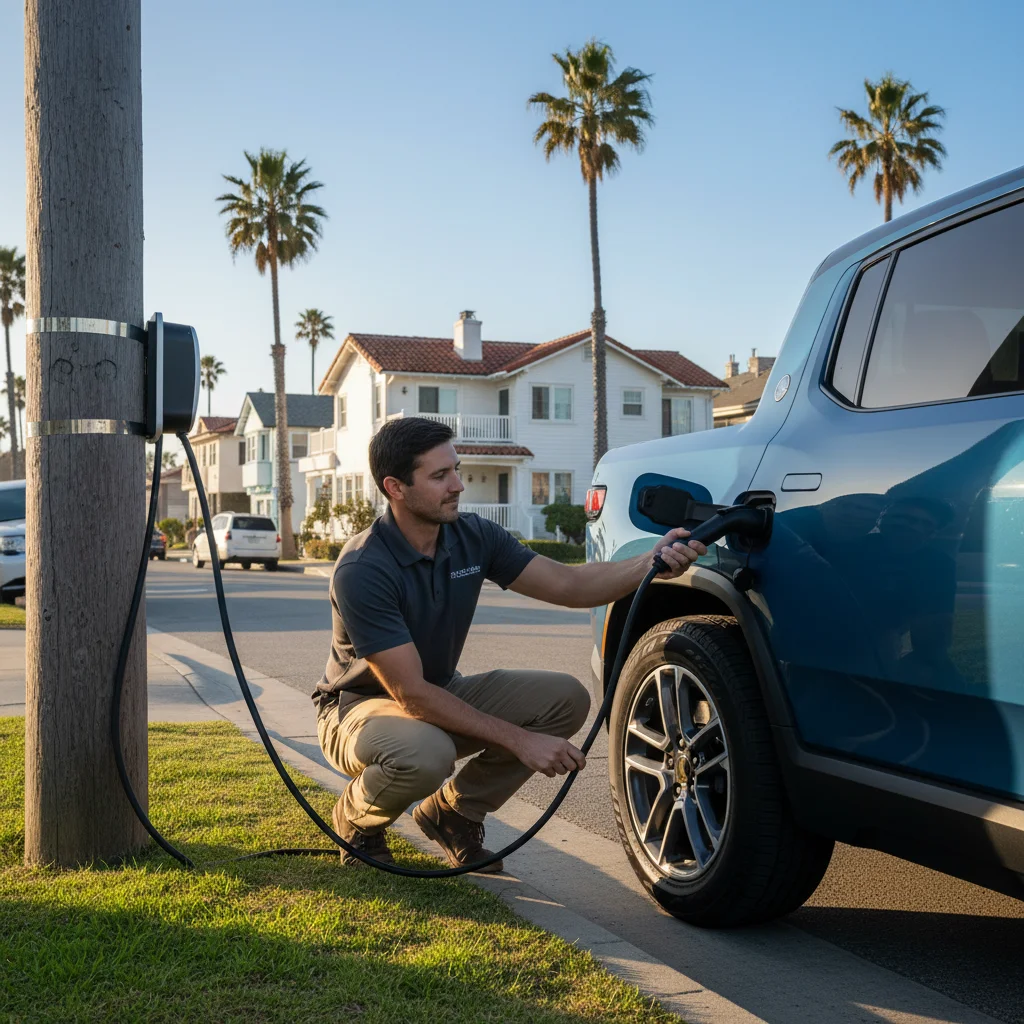
Charge in place on a parked-up block
Edgewater blocks are short, and street parking is tight. A flatbed still has to find a legal pull-out. It also needs a path out to Sheridan or US-6. A mobile EV charge meets the stall you already occupy. You leave under your own power after the plug comes off. For a true out-of-charge event, that’s usually the cleaner path.
Tow anyway if the car is mechanically dead. Tow if it’s sitting in a live lane. Tow if it can’t accept a charge. Colorado has no EV-specific breakdown statute on the books. A stranded EV follows the same disabled-vehicle rules as any car. The only EV-specific statutes here are HOA charging access and charging-space parking enforcement. Neither of those statutes is a roadside rescue rule.
If a private lot already called a wrecker, HB22-1314 applies. It requires 24-hour written notice before most private-property tows. It also requires carriers to take cash and cards. Exact tow fee figures aren’t verified in our ledger. The Colorado Public Utilities Commission regulates towing carriers. Confirm the bill with them if the car is already gone. Charge versus tow in metro terms is in charge in place or tow.
Lakewood, Wheat Ridge, and the Denver line
Lakewood, Wheat Ridge, and Denver wrap this city. The NREL inventory shows three Tesla Supercharger sites in Lakewood. That’s not a claim about how far they sit from your curb. If the car won’t roll, a Supercharger in Lakewood doesn’t help yet. Errands that end with a dead car on the Lakewood side match our EV roadside assistance in Lakewood post.
Wheat Ridge is the I-70 approach toward the foothills. Edgewater is still on the flat west-of-downtown grid. Don’t treat them as the same call. Denver’s Sloan’s Lake edge is a short walk and a different set of streets. For Edgewater itself, use the EV charging in Edgewater city page.
Colorado crossed 200,000 registered EVs by October 2025, per the Colorado Energy Office. Battery-electric vehicles were 12.5 percent of new Denver-metro registrations. That figure is year-to-date through June 2026 in CADA’s Q2 2026 Auto Outlook. That’s roughly one in nine new vehicles. Statewide BEV registrations fell 55.3 percent in the first half of 2026. That drop followed the federal tax credit expiring on September 30, 2025. Older inner-ring streets didn’t suddenly rewire themselves.
What Charge Pro DEN actually is
Charge Pro DEN is a referral line for stranded EV drivers. It matches you with independent local mobile rescue operators. It performs no work, owns no trucks, and employs no technicians. It holds no contractor license and sets no prices. It publishes no arrival time and no shop hours. Service area is the Denver metro, including Edgewater. The operator quotes the driver before starting and bills the driver directly.
Tell the operator the block you’re on. Sheridan, 25th, the Public Market lot, or the Sloan’s Lake edge. Give the make and whether the car unlocks. That last detail often sorts pack versus 12-volt before anyone rolls.
We don’t claim the brand is licensed or insured as a contractor. The pros we connect you with are licensed and insured. That’s a network claim, and it’s the one we’ll make.
When the car won’t ready
Stay out of live lanes if the car won’t ready. Keep hazard lights on while you wait off the travel path. If you can roll a few feet into a legal stall, do that. Check the app, the locks, and the screen. A dark, silent car usually means the 12-volt is down. Awake with zero miles means you need energy.
A household Level 1 outlet is a slow overnight trickle. It’s a weak plan on an 18-degree morning when you needed to leave. A roadside Level 2 boost is built for that gap. It doesn’t replace a future home circuit. It gets you off the curb today.
Call (720) 738-6950 to reach the referral line. We’ll connect you with a local operator. They’ll quote you before they start.