A Capitol Hill curb on a cold morning is a hard place to sit empty. EV roadside assistance in Denver is a local operator bringing a charge to that curb. More than half of Denver’s housing predates 1980. Renters in Capitol Hill, Cheesman Park, Baker, and Five Points often street-park. There’s no garage circuit to recover on overnight.
Why Denver packs hit empty on the street
Denver sits a mile up on a 153-square-mile high plain. The official 5,280-foot mark is the west steps of the State Capitol. January’s normal low is around 18 degrees. In January 2024 Denver swung from 47 to minus 19 in about 48 hours. Altitude plus cold pulls range faster than the trip meter shows.
Recurrent’s winter study is the figure to keep in your head. EVs keep about 78 percent of max range at 32 degrees. They keep about 70 percent at 20 degrees. An AAA dynamometer study put range loss near 39 percent at 20 degrees. Heaters, wind on Peña Boulevard, and a climb on I-25 all stack on that.
Xcel Energy serves the city. Wash Park, Five Points, RiNo, and the Highlands weren’t built for a home EV circuit. You live on public charging. Then a cold soak takes the last buffer. Below about 15 degrees, the pack’s thermal system can wake itself. That’s phantom drain, not a broken car. Colfax Avenue is US-40, and it’s the longest commercial street in America. Night parking along Colfax, Speer, Federal, and Colorado Boulevard is normal here. Green Valley Ranch and Montbello sit farther east, still on the same high plain.
Glendale is a one-square-mile enclave city, fully surrounded by Denver. It’s apartments, Infinity Park, and the Cherry Creek corridor. Cars sit for hours in those garages after dinner or a match. Colorado Boulevard and Leetsdale Drive see the same cold-morning empty-pack calls.
A downtown commuter miscounts the last charge after Union Station or Ball Arena. A weak 12-volt often won’t wake after a week in a cold airport lot. Those look alike from the sidewalk, but they aren’t the same job. Read your EV died on Capitol Hill with no driveway plug for that apartment pattern. Broader city context is on the Denver EV charging page.
Empty pack versus limp mode versus a dead 12-volt
Low and empty aren’t the same roadside problem. A low pack still moves, usually in turtle mode. Warnings stack on the dash as the buffer disappears. Some cars keep a small reserve after the gauge hits zero. That reserve is for getting off the travel lane. If you’re still rolling, read what to do when your EV is running low.
True empty means the high-voltage pack can’t move the car. The pedal does nothing. You may not get reverse or neutral. If the 12-volt is also down, doors and hazards can fail. The 12-volt is a separate battery. It wakes the computers, locks, and contactors. A long cold soak in a DEN lot commonly kills that small battery. The pack can still hold energy while the car stays dark. That’s a jump or an on-site 12-volt swap, not a pack fill.
If the dash is dark and the car won’t unlock, start with the 12-volt. If the car is awake and the range reads zero, you’re in out-of-charge territory. Tell the operator which one you’re looking at. It changes the kit they roll.
Get off the travel lane before you call
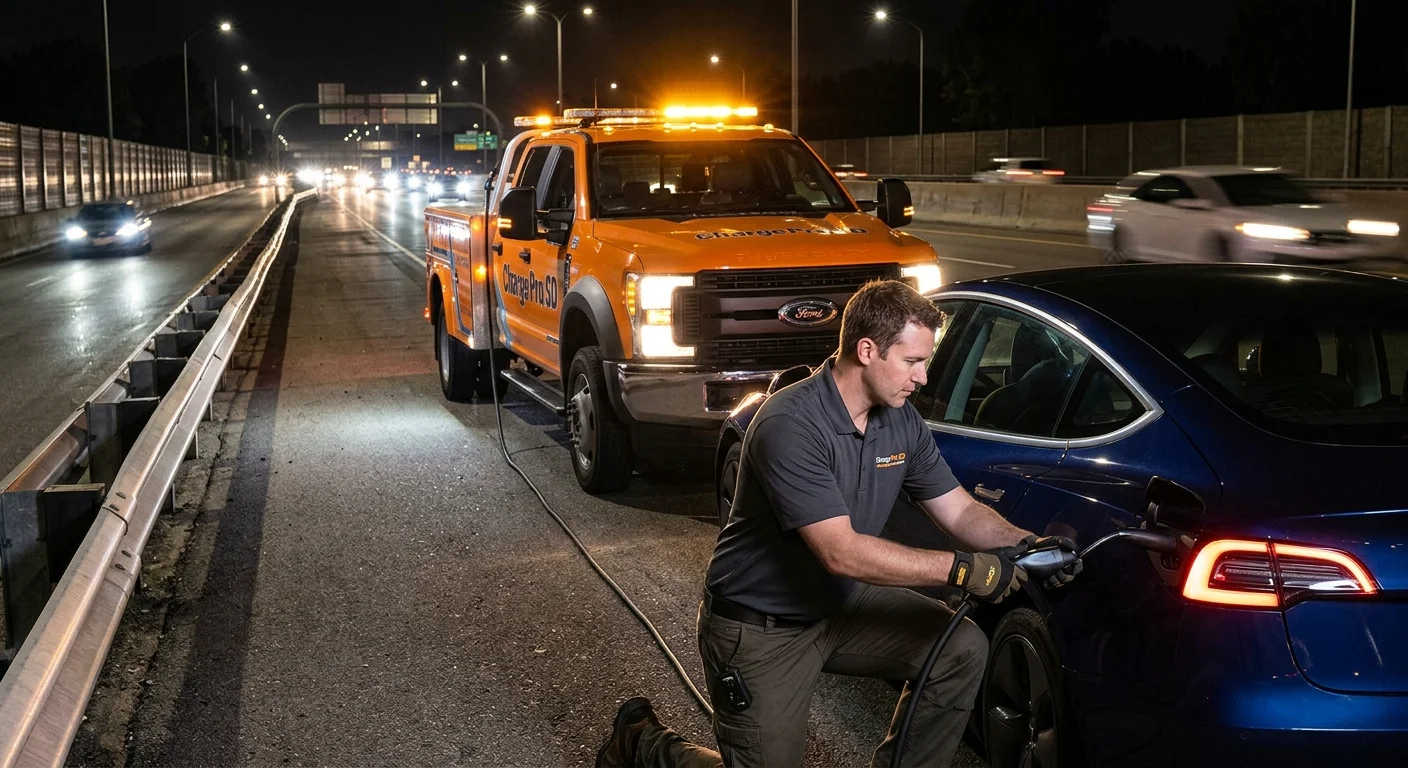
If you’re still rolling, coast to the shoulder with hazards on. On I-25, I-70, I-225, US-6, or Peña Boulevard, stay belted inside. The cabin beats standing in traffic after dark. Don’t try to push it. Traction packs make these cars very heavy. If you’re blocking a lane, call 911 first.
Colorado’s disabled-vehicle rule is CRS 42-4-1202. Outside a business or residential district, the paved travel lane isn’t a parking spot. The exception is a vehicle so disabled it can’t be moved off. Hazards are required under CRS 42-4-230. A genuine stall on the shoulder, lights on, is lawful. Colorado has no separate statute for a dead EV. The same shoulder rules apply.
Abandoned-vehicle rules sit in CRS 42-4-1803. There’s no published hour count before a car is abandoned. An officer decides on reasonable grounds. Don’t assume you have a set window.
CDOT Safety Patrol covers parts of I-25 South, I-70 East, and US-6. C-470 and I-225 have coverage on published segments too. They’ll change a tire, jump a 12-volt, and handle emergency fuel. Weekday Front Range hours run 6:00 to 9:30 a.m. Afternoon coverage is 2:30 to 7:00 p.m. Weekend hours are 10:00 a.m. to 7:00 p.m. Their published pages don’t mention charging an EV. The free state truck won’t fill a pack.
E-470 is the east-metro toll loop, not a city street. A disabled driver there dials *470 for that authority’s help. *CSP reaches State Patrol on that road. Same limit: jumps and tires, not a traction charge.
What a mobile charge actually is
Charge Pro DEN is a referral line. We match you with an independent local operator. We don’t own trucks and we don’t employ technicians. The operator quotes you before work starts. They bill you directly.
EV roadside assistance here is a charge or a 12-volt rescue at the car. It isn’t a shop appointment. When the pack is at zero, out-of-charge recovery is the job. The operator brings Level 2 power to where you sit.
The pros we connect you with roll a 240-volt Level 2 source. Teslas take a native NACS plug. Other EVs use a CCS or J1772 adapter. A typical session adds about 10 to 20 miles of range. Charging time for that boost is usually 15 to 30 minutes. That’s charging time, never an arrival window. Tesla and every major EV brand are in scope. So is a 12-volt jump or replacement on site.
A conventional tow is a different tool. A car that won’t go into neutral needs a wrecker who knows EVs. Bad towing can damage the drivetrain. Charge in place avoids that when the only problem is energy. Weigh those paths in mobile charge or tow.
What happens at the curb
Give a clear pin, the make and model, and whether the car still wakes. Say if you’re on a freeway shoulder, a Capitol Hill block, or a garage. The operator checks the scene first. Then they connect to the charge port.
They’re not filling the pack to 100 percent at the curb. The point is enough range to reach a public stall you already use. Home works too if you can actually plug in there. Denver has several Supercharger sites in the core. EVgo and Electrify America add DC fast locations across the metro. Confirm a reachable stall in your app before you unplug. Don’t guess how far it is.
If the car is dark, they start with the 12-volt. Waking it can be the whole job. If the pack is empty and the 12-volt is fine, they charge. If both are down, they may need both steps. The truck itself is covered in what a mobile EV charger brings.
Street parking, a long downtown dwell, and a cold lot
The apartment call is Denver’s signature stranding. You parked on the street in Baker or the Highlands. Overnight thermal management ate the margin. Morning range isn’t what you left. Public charging is the plan you already live on. A mobile charge is how you reach it when the car already sat down.
The commuter call is a miscount. Cherry Creek, City Park, Empower Field, Coors Field, and the 16th Street Mall add dwell. Cabin heat and a high-plains freeze do the rest. You thought you had enough for I-25 or Colorado Boulevard.
The third call is a car that sat too long. Airport-adjacent lots and downtown garages kill weak 12-volts. The pack can still hold a charge. The car won’t ready. Don’t assume you drained the traction battery to zero.
Lakewood, Wheat Ridge, Aurora, Englewood, and Commerce City share this high-plains cold. Glendale’s apartment stock matches Capitol Hill more than a suburban driveway. The operator you get is tied to the pin you send.
When this is the right call
Call when the car won’t move and the pack reads empty. Call when you’re on a shoulder and can’t limp to a stall. Call when a street-parked Denver car woke dead with no home plug. Don’t push the car. Don’t wait on a patrol that can’t charge an EV.
Charge Pro DEN covers the Denver metro. We connect you with a pro who quotes first. Call (720) 738-6950 when you need that match.