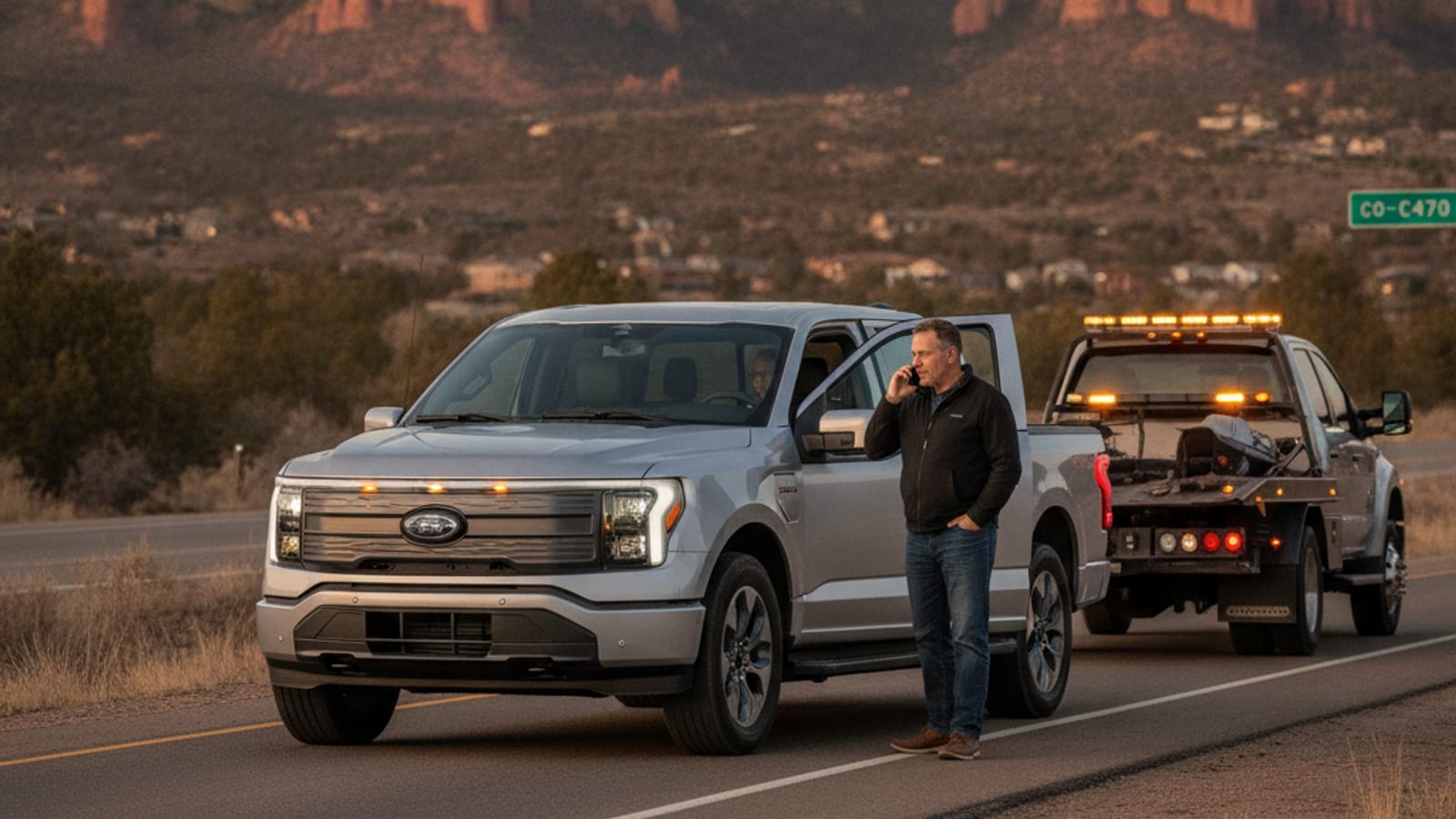
EV roadside assistance in Columbine starts with the 12-volt. The pack may show plenty of range on the dash, and the car still will not wake. Columbine is a large, older, comfortable CDP southwest of Denver where most drivers charge at home but where long retail dwells at Southwest Plaza and Clement Park drain a marginal 12-volt faster than the pack moves. Charge Pro DEN is a referral line. We match you with an independent local operator who quotes before any cable goes in. Call (720) 738-6950 for that match.
Why Columbine calls end up being a 12-volt
Columbine is an unincorporated CDP of about 25,681 people across Arapahoe and Jefferson counties. Roughly seven out of ten homes here were built before 1980, but median household income sits near $129,480. That combination matters for EV drivers. Income supports home charging despite the older housing stock, but older homes also mean older 12-volt batteries behind a relatively new traction pack. When a Columbine driver leaves an EV in a driveway or a parking lot for days, the 12-volt can drain past the point where the pack can wake the car.
The traction pack and the 12-volt are two different systems. The pack moves the car. The 12-volt runs the computers, contactors, and door locks. When the 12-volt dies, the whole car looks finished. The pack may still hold a healthy state of charge. The fix is a 12-volt jump, not a tow to a public stall.
Recurrent Auto studied more than 30,000 U.S. EVs in winter. At 32 degrees, EVs kept about 78 percent of max range. At 20 degrees, the average dropped to about 70 percent. Cold eats range, and it also wakes the battery management system to run thermal management. That phantom drain shows up faster on a marginal 12-volt sitting through a cold snap.
The Southwest Plaza and Clement Park dwell
Southwest Plaza sits at Wadsworth and Bowles, the busiest retail corridor in Columbine. Cars park there for hours. A weekend shopper who walks the mall, eats, and returns to the lot often finds a car that will not ready. The same pattern shows up at Clement Park, a Jefferson County open-space park on Ken Caryl Avenue where families leave cars for an afternoon.
A long dwell in cold weather drains a weak 12-volt battery, even when the traction pack still has range. The driver walks up, presses the door handle, and nothing happens. The dash stays dark. The car looks broken because the 12-volt is dead, not because the pack is empty.
CDOT Safety Patrol covers portions of C-470 and US-6, but Southwest Plaza and Clement Park are on local streets. The state’s free patrol won’t dispatch to a parking lot here. A local mobile operator is the call.
What the operators we refer bring
Charge Pro DEN does not own trucks and does not employ technicians. The operators we refer carry a 240-volt Level 2 source for an empty pack and a 12-volt booster for a dead 12-volt. They bring the right adapter for your car. Tesla drivers get a native NACS plug on the lead. Other EVs use a CCS or J1772 adapter.
The operator confirms equipment, access, price, and timing before any work starts. They bill you directly for what they do. We don’t set the price and we don’t quote an arrival window.
A typical roadside charge adds about 10 to 20 miles of range in 15 to 30 minutes of charging. The clock starts when charging starts, not before. That range is enough to reach a home charger, a public stall, or the next Supercharger site. For an empty pack, our referral connects you with out-of-charge recovery. For the broader choice between a charge and a tow, read mobile EV charging and decide which fits.
Operators we refer can jump a 12-volt on site and replace one when that is the job. If the dash showed low range first, treat the situation as an empty pack. If the car sat dark through a freeze, start with the 12-volt.
The C-470 launch and the commute home
Columbine sits right at C-470, the west-metro loop that launches the mountain and south-metro runs. Drivers leave home in the morning with a comfortable margin and come home on the last of a charge. The west edge of Columbine climbs gently toward Ken Caryl and the hogback. The east edge feeds Bowles and Wadsworth into the Tech Center.
When a Columbine driver misjudges the last charge, the I-25 North and US-36 Express Lane shoulders are not relevant. C-470 is the local spine, and CDOT’s Safety Patrol coverage includes portions of C-470 during published hours. A driver who breaks down on a listed segment can pull to the shoulder and wait for the free patrol. The patrol will jump a 12-volt. It will not bring a charge.
CRS 42-4-1202 covers a disabled vehicle on a highway. A driver may not stop on the paved main-traveled part of a highway except a vehicle so disabled it cannot be moved off. Hazard lights must be on under CRS 42-4-230. A violation is a class B traffic infraction. None of those statutes treat a disabled EV as a special class. The same shoulder law applies.
If you stop on C-470 with hazards on, the free patrol may show up during a posted window. Front Range weekday hours run 6:00 to 9:30 a.m. and 2:30 to 7:00 p.m. Weekend hours run 10:00 a.m. to 7:00 p.m. Outside those windows, the patrol is off shift. Don’t wait on a patrol that isn’t coming. CDOT Safety Patrol and CDOT’s “my car broke down” page mention nothing about EV charging as a published service.
The Columbine housing pattern and the no-plug exception
Most Columbine drivers charge at home. The housing stock is older, but the income supports a charger install. For drivers in apartments or on street parking along Wadsworth and Bowles, home charging is rare. Those drivers live on the public charging network and on cold-morning no-charge calls.
The same pattern shows up across the south metro. Drivers in Centennial and Littleton face the same split between home-charging subdivisions and older apartment corridors. If you are on public charging, plan the next stall before you need it. If the pack is already low, the call is a mobile charge, not a flatbed to a stall you might wait on for an hour.
The metro’s three utility regimes matter when you call about a home charger. Columbine sits in Xcel Energy territory, so your rebate and rate questions go to Xcel. The south-metro Douglas County corridor, including Highlands Ranch, Lone Tree, and Castle Rock, sits on CORE Electric Cooperative, not Xcel. CORE’s residential COREV Charge program is at capacity and closed to new applicants. Drivers in those cities should confirm CORE’s current programs on the utility’s own page before planning an install.
AAA, Tesla roadside, and what each actually does
AAA still makes sense for flats, lockouts, and wrecks. It is a membership club with a tow network behind it. It is not automatically a charger for a dead pack. This page couldn’t confirm a published AAA Colorado policy for on-site EV charging. Open the AAA app and read your membership booklet. Ask whether the truck will be a flatbed. Ask whether the truck carries EV charging gear. Get that answer while you still have phone battery.
Tesla has its own roadside path in the Tesla app. Confirm what it covers for your VIN and year. Don’t assume Tesla sends a charger to you. Don’t assume Tesla replaces a 12-volt on the shoulder. For the broader script, read Tesla, AAA, and a local mobile rescue. That post stays on who covers which job.
The operators we refer handle Tesla and every major EV brand. A stuck charge port is a latch problem, not a tow problem. Ask the operator about the port before anyone hooks a winch. A charge port frozen shut after a cold night is a port release, not a flatbed.
Long dwell versus empty pack
A long retail dwell in cold weather is the Columbine pattern. The dash did not show low range when you parked. The car sat for hours in the cold. Now the car will not ready. That is a 12-volt call.
An empty pack is the other pattern. The dash showed a low battery warning before you parked. The car sat for an hour. Now the car will not move. That is a Level 2 charge call.
The fix is different. The operator asks which pattern fits before they roll. Be ready to answer which one matches your car.
How to choose from a Columbine shoulder or lot
Turn your hazards on and stay visible to traffic. Stay in the car if that is the safer choice. If you are on a listed CDOT Safety Patrol segment, check the clock. During published hours, that free jump is for a dark 12-volt. Skip it when the pack was already at zero.
If the car is otherwise fine and the 12-volt died in a parking lot, call for a mobile operator. The Tesla 12V battery jump page covers the same job for a Tesla. For non-Tesla EVs, the non-Tesla EV rescue path is the right referral. We serve the Denver metro from the plains to the foothills. The operator quotes you before they start work. Call (720) 738-6950 when you want that match.
Frequently asked questions
How do I know whether my EV problem in Columbine is the 12-volt or the pack?
The 12-volt runs the computers, contactors, and door locks. If the car sat dark through a cold night or a long retail dwell and the traction pack still showed range, start with the 12-volt. If the dash showed a low range warning before you parked, treat it as an empty pack. A mobile operator asks which pattern fits before they roll.
Will CDOT Safety Patrol jump my EV in Columbine?
CDOT Safety Patrol covers portions of C-470 and US-6 during posted hours. It will jump a 12-volt on a listed segment. It does not bring a charge to a stranded EV. Local streets around Southwest Plaza and Clement Park are not on the patrol’s coverage list.
Can I keep AAA and still call Charge Pro DEN?
You can keep both, because they solve different problems. AAA and CDOT patrol move or jump a car. A mobile operator adds range on site instead. Charge Pro DEN is a referral line, not a membership club. There is no fee to call (720) 738-6950 for a match.