The display looked fine when you left Denver International. A few miles later the number is falling in the wind. You’re on I-70 east of the airport, aimed at Bennett. That’s the last real town before the long plains run toward Limon and Kansas. Pull fully onto the shoulder and turn the hazards on. You need EV roadside assistance Bennett drivers actually use. That’s a charge or a 12-volt jump, not a shop visit.
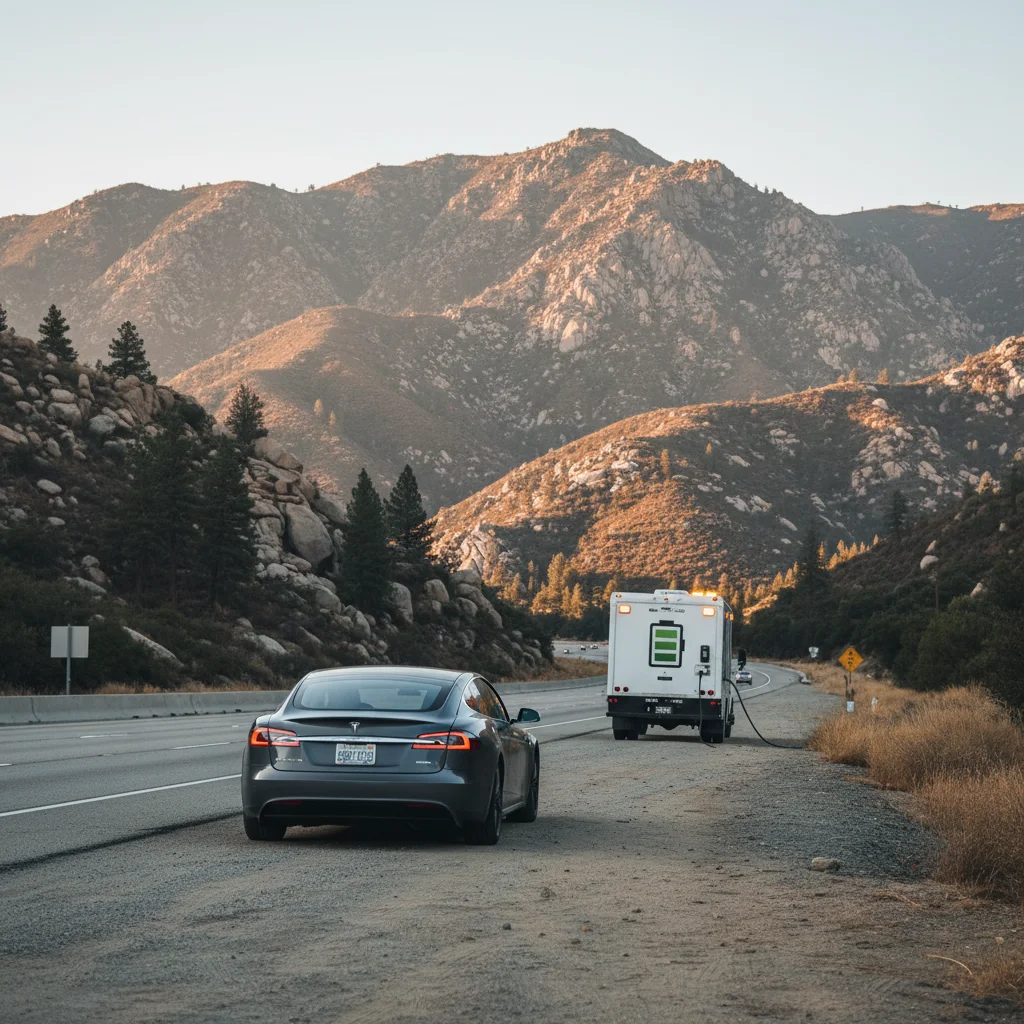
This isn’t the core metro anymore
Bennett sits on I-70 in Adams County and Arapahoe County. The Census 2024 estimate is 3,916 people. Drivers name the townsite, Muegge Farms, and the I-70 Bennett interchange. Watkins sits west, and Aurora sits farther west. Kiowa sits south, and Strasburg is the next name east.
CORE Electric Cooperative serves Bennett. CORE even keeps a district office in town. If you live here, CORE bills the house, not Xcel. CORE doesn’t roll a charger to the shoulder. A member account and a stranded car are different problems.
US-36, SH-79, and Kiowa-Bennett Road all feed this eastern edge. Kiowa Creek country and the ranch land sit wide open. There’s no foothill to blunt the wind. Ground blizzards and hard cold come straight in. Metro shops sit behind you, toward Watkins and Aurora. Services thin fast once you pass those towns and stay pointed at Kansas.
If the car can still creep, the Bennett town center beats an interstate shoulder. If it can’t, stay put with the lights on.
What you’re allowed to do on the shoulder
Colorado doesn’t write a special breakdown statute for EVs. A stranded electric car follows the same rules as any other car. CRS 42-4-1202 says you can’t stop on the paved travel lanes. That applies outside a business or residential district. The exception is a vehicle so disabled you couldn’t keep it moving. Hazard lights have to be on, per CRS 42-4-230.
Abandoned-vehicle rules live in CRS 42-4-1803 through 42-4-1805. An officer can treat a car as abandoned on reasonable grounds. The statute doesn’t set a published hour count. Don’t assume you have a hidden window. Colorado State Patrol handles crashes, enforcement, and abandoned-vehicle authority.
Check COtrip.org for I-70 closures before you decide to wait. Traction law and chain law appear on signs and on COtrip. For traction law, AWD or 4WD is one path. M+S winter tires with at least 3/16-inch tread is the other. In a severe storm, the chain law can cover every vehicle. Confirm the post before you keep driving east.
CDOT’s free patrol stops short of this town
CDOT Safety Patrol is free on the freeway segments it lists. Published I-70 East coverage runs from Wadsworth to Airport Boulevard. Bennett sits east of that published end. The I-70 Mountain Corridor patrol runs Morrison to Vail. That’s west, toward the tunnel, not toward the plains.
Front Range metro hours are 6:00 to 9:30 a.m. and 2:30 to 7:00 p.m. on weekdays. Weekends run 10:00 a.m. to 7:00 p.m. The patrol lists flat tires, jump-starts, emergency fuel, minor mechanical help, debris removal, and incident support. CDOT’s own pages mention nothing about electric vehicles or bringing a charge. A 12-volt jump may still be in their toolkit.
E-470’s *470 roadside line covers the toll loop. It isn’t a Bennett I-70 dispatch. Peña Boulevard is the only road in and out of Denver International. It has closed in plains storms, including the March 2019 bomb cyclone. If you just came from the airport, remember the plains weather. A thin pack fails out here.
Tesla roadside, insurer clubs, and AAA each run their own script. Many of those scripts jump a 12-volt or send a flatbed. They often don’t bring energy to the pack. Read when AAA brings a charge or only a tow before you assume the membership covers this. Charge Pro DEN is a referral line for the Denver metro. It matches stranded drivers with independent local operators. It owns no trucks, employs no technicians, and performs no work. The operator quotes you before starting and bills you directly.
Dead pack, dead 12-volt, or both
Plains cold makes this mix-up common. The car won’t ready, and the screen stays dark. That can still be the small 12-volt, not an empty pack. The 12-volt runs computers, contactors, and latches. When it quits, the high-voltage pack can still hold miles. A jump or an on-site 12-volt replacement can wake the car. That’s a different job from out-of-charge recovery.
If the traction pack is truly at zero, you need energy at the charge port. Operators in the network bring a 240-volt Level 2 source to the car. Teslas take a native NACS plug. Other brands use a CCS or J1772 adapter. The usual add is 10 to 20 miles of range. That’s in 15 to 30 minutes of charging. That’s charging time on site, not when someone will show up.
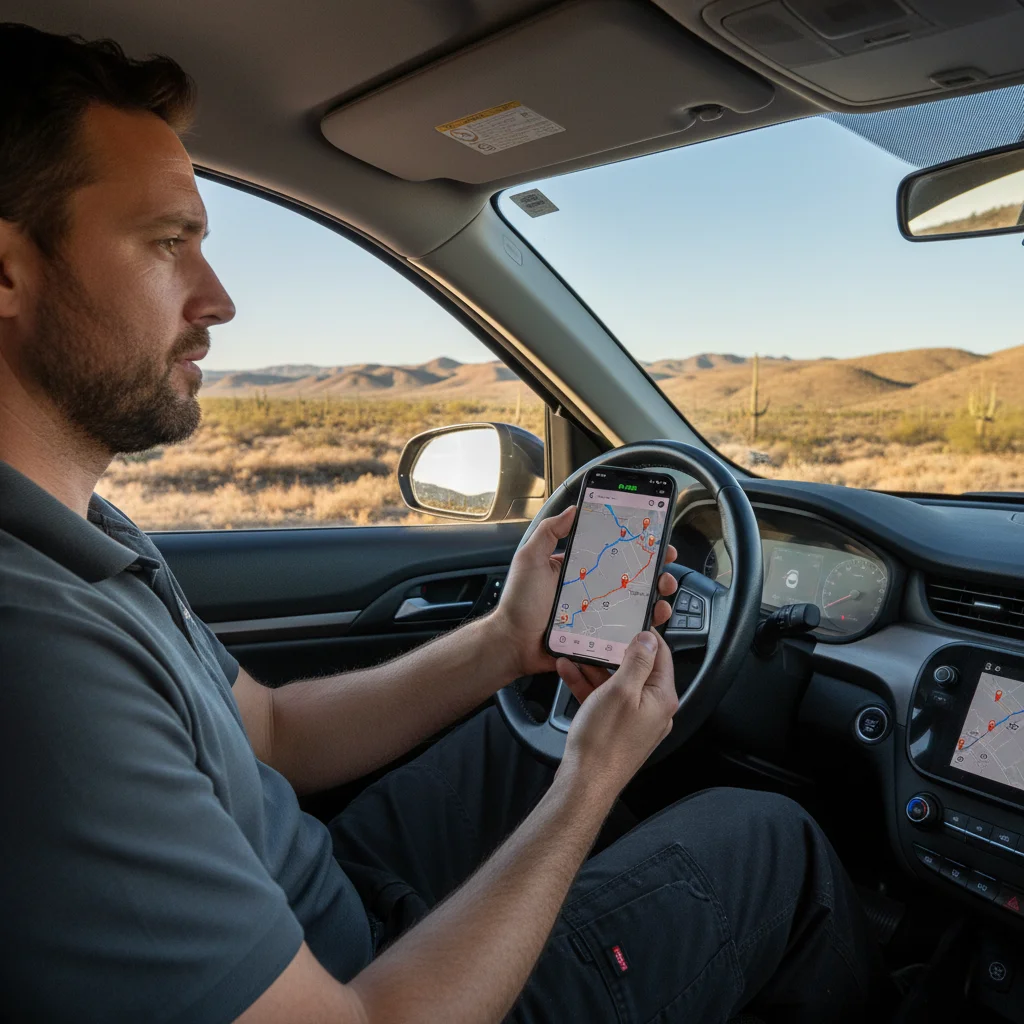
A mobile EV charge is a bump to the next planned stop. If you’re already in Bennett with an empty pack, say that on the call. If the 12-volt is the suspect, say that too. The operator plans for the job you described. Teslas and every major EV brand end up on this corridor.
Why the estimate falls apart east of Watkins
I-70 toward Bennett isn’t a mountain climb. You’re not dumping a pack on a mountain grade. The hit is wind, cold, and highway speed on open land. Cabin heat pulls from the same battery that moves the car. The thermal system works to keep the pack in its window. A headwind on the plains does the rest.
Recurrent Auto studied more than 30,000 U.S. EVs in winter. At 32 degrees, they kept about 78 percent of max range on average. At 20 degrees, about 70 percent. Heat-pump cars held about 10 points more at 32 degrees. AAA’s 2026 dynamometer study reported about 39 percent range loss at 20 degrees. Your dash used the last easy miles. It didn’t account for this wind.
January 2024 dropped Denver from 47 degrees to minus 19 in about 48 hours. That kind of blast reaches Bennett with nothing to slow it. Ground blizzards can take the lanes. If COtrip shows I-70 trouble, don’t keep rolling on a thin pack.
Watch real consumption, not the predicted miles. kWh per mile, or miles per kWh, tells you what this hour is using. If that number looks ugly, slow down while you can still move.
Check your charging app before you leave the airport corridor. The metro inventory includes Superchargers in Denver, Brighton, Thornton, Northglenn, Westminster, Arvada, and Longmont, among other listed sites. Confirm a stall is actually working. If you’re already past Watkins with a thin buffer, stop in town. Make the next decision while the car still rolls.
Closer-in I-70 steps live in out of charge on I-70. Watkins is one town west. EV roadside assistance in Watkins is the same plains problem with a little more metro behind it.
What moves the operator’s quote
Nobody posts a public menu for this corridor. Distance is the first lever. Bennett is the deepest-out point in the metro’s eastern reach. Time of day is the next lever. Weather is after that, and how many miles you need matters too. A 12-volt jump isn’t the same job as a Level 2 top-off.
The operator who takes the work quotes you before anything starts. You accept or you don’t. Charge Pro DEN doesn’t set that quote. The independent pro bills you directly. If a flatbed is the honest tool, you’ll hear that before work begins.
Have the mile marker ready, and say eastbound or westbound. Say whether you’re at the Bennett interchange, the townsite, Muegge Farms, or still west toward Watkins. Name the plug: NACS, CCS, or J1772. Name the symptom: won’t unlock, won’t ready, or the pack hit zero. Stay with the car if it’s safe.
If the car still moves, treat town as a pause
You’re picking someone up at the airport and heading toward a ranch. The mistake is trusting a city estimate on a plains highway.
Top off while you’re still in the dense metro or along the airport corridor. Precondition the cabin on plug power. Don’t make the pack heat the seats after you’re in the wind. Use an efficient drive mode.
If traction law is posted, follow the sign. COtrip and the overheads are the authority, not a group chat.
Bennett is a decision point. If you can still roll into town, stop and reassess. Pointing east toward Limon on a thin buffer is how a plains night gets long. Operators still quote the drive honestly if you’re farther out. You should hear that quote before anyone rolls.
If you live in Bennett, CORE is the utility. CORE’s COREV Charge program is at capacity and closed to new applications, per CORE’s own page. That fact belongs to home charging. It won’t help you on I-70 tonight. For a car that’s already stuck, EV roadside assistance is the call.
When you’re out of options, call Charge Pro DEN at (720) 738-6950. You’ll get matched with a local operator. That operator quotes the work before it starts. The number isn’t an arrival promise. It’s how you reach someone who can charge or jump the car you’re sitting in.