When a Commerce City delivery van EV dies between warehouse stops, charge it in place. You don’t unload the packages. You don’t wait for a shop bay. Charge Pro DEN matches you with an independent local operator. That operator brings a 240-volt Level 2 source to the van.
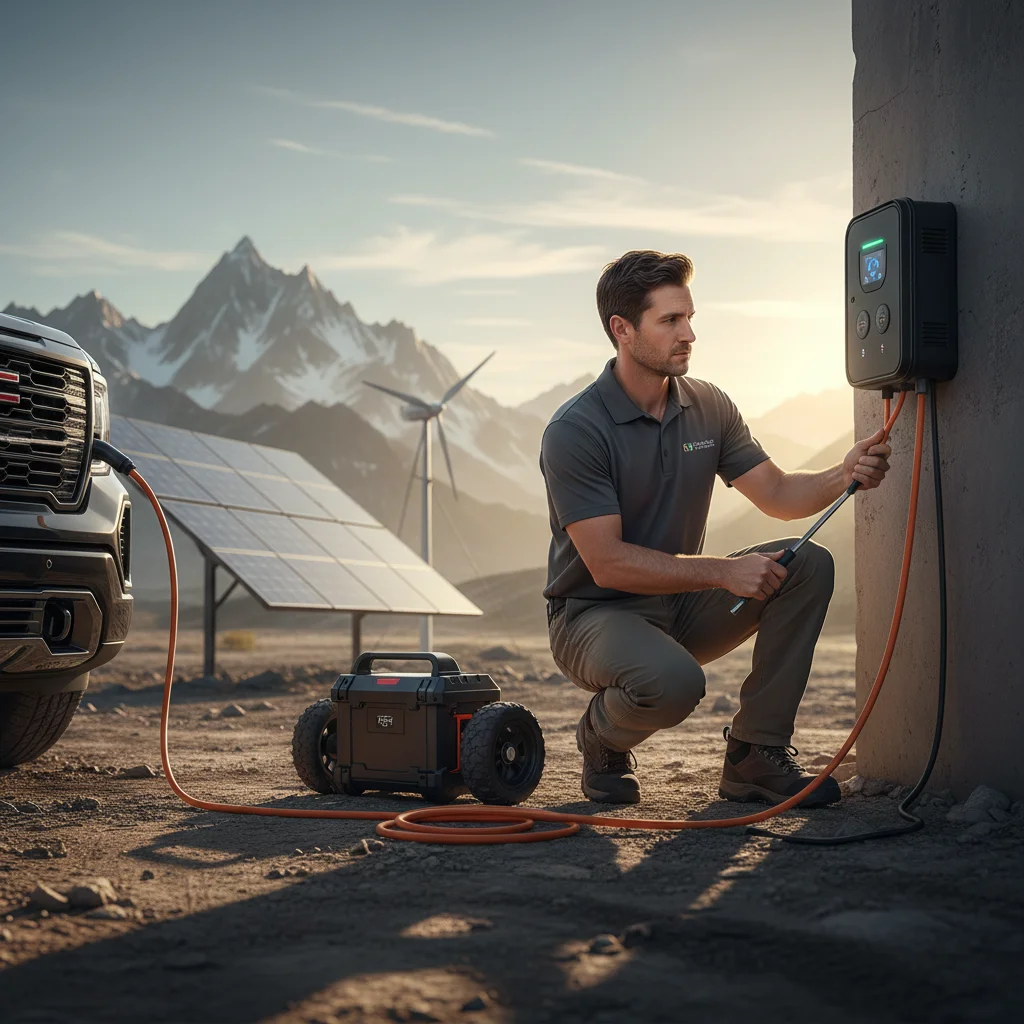
Warehouse yards, then a cold sit
Commerce City is the north metro’s logistics belt. It’s in Adams County. The city covers about 36.5 square miles of exposed industrial plains. Derby and Dupont sit south of I-70. That’s the older industrial core. Reunion and Buffalo Run sit north, toward E-470. The Villages at Buffalo Run and Belle Creek fill that growth edge. River Run is in the mix too.
Fleet vans run I-270, Vasquez Boulevard, SH-2, and Quebec Street between yards. Peña Boulevard is the east edge toward the airport. Last-mile loops often finish a hop with the pack already low. Fleet EVs do that on purpose. Then the van sits with the cabin off. Wind off the open ground east of town arrives here first.
January’s normal low is around 18 degrees. Recurrent Auto studied more than 30,000 U.S. EVs in winter. They found about 78 percent of max range left at 32 degrees. At 20 degrees, the average was about 70 percent. Cargo weight and cabin heat sit on top of that cold loss. Heat-pump models held about 10 points more at 32 degrees.
Dick’s Sporting Goods Park and the Suncor refinery sit on this industrial map. So does the Rocky Mountain Arsenal National Wildlife Refuge. The Denver Coliseum area sits just south. A van that dies here is usually between a warehouse and the next stop.
Confirm who actually powers the depot
United Power lists Commerce City in its service area. Xcel Energy is still in the broader metro. This city is also on the confirm-by-address list. So are Thornton, Northglenn, Westminster, Arvada, Broomfield, and Erie. Don’t assume a Denver Xcel bill applies to the yard.
United Power publishes United EV. It lists the EV Make-Ready Wiring Rebate. It also lists the EV Home Charge Panel Upgrade Rebate. The RTD1 time-of-use rate uses Simple Saver scheduling. Rebate dollar amounts are not confirmed here. Ask United Power before you plan a depot charger. Ask Xcel if that’s who serves the street. Crews who just moved up from Denver get this wrong a lot.
For the local layout, start with the Commerce City EV charging page. For a plains-side rescue walkthrough, read EV roadside assistance in Commerce City.
Pack empty, or just the 12-volt
A van that won’t ready is not always out of miles.
No dash lights and a dead fob usually mean the 12-volt. Lift gates and telematics draw from that small battery. So do the computers that wake the traction pack. A cold overnight in a Derby or Belle Creek lot can kill it. The big pack can still hold range. A jump or an on-site 12-volt replacement brings the van back. Then it can drive.
A live screen with zero miles is the traction pack. Stop-and-go, cargo weight, and cabin heat drain it. Operators typically add 10 to 20 miles in 15 to 30 minutes of charging. That clock is plug time, never an arrival window. Tesla-style inlets take a native NACS plug. Other brands use a CCS or J1772 adapter. See what a mobile EV charger brings.
Keep the load onboard either way. There’s no need to strip the box for a jump or a top-off.
Shoulder rules, and what free patrols actually do
CRS 42-4-1202 covers a disabled vehicle on the shoulder. Outside a business or residential district, you can’t stop on the paved travel lanes. A vehicle that’s truly disabled may sit off those lanes, hazards on. Colorado has no EV-specific breakdown statute. The same rules apply as a gas van. Abandoned-vehicle timing under CRS 42-4-1803 is officer discretion. The statute sets no 24-hour clock. Don’t wait around hoping one exists.
CDOT Safety Patrol covers I-70 East from Wadsworth to Airport Blvd. It also lists stretches of I-25, US-6, C-470, and I-225. Front Range weekday hours are 6:00 to 9:30 a.m. and 2:30 to 7:00 p.m. Weekend hours are 10:00 a.m. to 7:00 p.m. They jump a 12-volt and change a tire. Their pages don’t mention EV charging. They won’t fill the pack.
On E-470, pull to the shoulder and dial *470. That desk handles flats, jump-starts, fluids, phone help, and debris. It doesn’t bring a Level 2 charge. Corridor steps are in out of charge on E-470. COtrip.org and 511 cover closures. Colorado State Patrol handles crashes and dispatch.
Leave the van on the route
A loaded delivery van is a poor tow. Weight, cargo tie-down, and a second wait at a charger all stack. The route is already late.
A mobile charge keeps the van where it died. The operator quotes before work starts and bills you directly. Charge Pro DEN holds no trucks and sets no price. We refer. Compare the two paths in charge in place or tow.
If the fault isn’t a dead 12-volt or empty pack, the operator should say so. That’s fleet service or a shop, not a roadside boost.
Call with the corridor and the symptoms
Move the van somewhere legal if it still rolls. Keep hazards on. Name I-70, I-270, Vasquez, SH-2, E-470, or the yard. Say whether the dash lights. Say whether cargo is still aboard.
The boost itself is on mobile EV charging. Who sets the price is in who quotes a mobile charge. We don’t publish rates. The operator does, before they start.
Frequently asked questions
Do operators handle commercial delivery vans, or only cars?
Independent operators treat a delivery van’s 12-volt and pack like a passenger EV. Tesla and every major EV brand are in scope.
Can the van stay loaded during the charge?
Yes. There’s no need to unload for a 12-volt jump or a range top-off. The driver stays with the van.
Will CDOT or E-470 fill the pack?
No. On covered roads, in published hours, they can jump a 12-volt. They don’t bring a Level 2 charge to an empty van.
A dead battery between stops doesn’t have to end the shift. Call Charge Pro DEN at (720) 738-6950 and we’ll match you with a local operator.