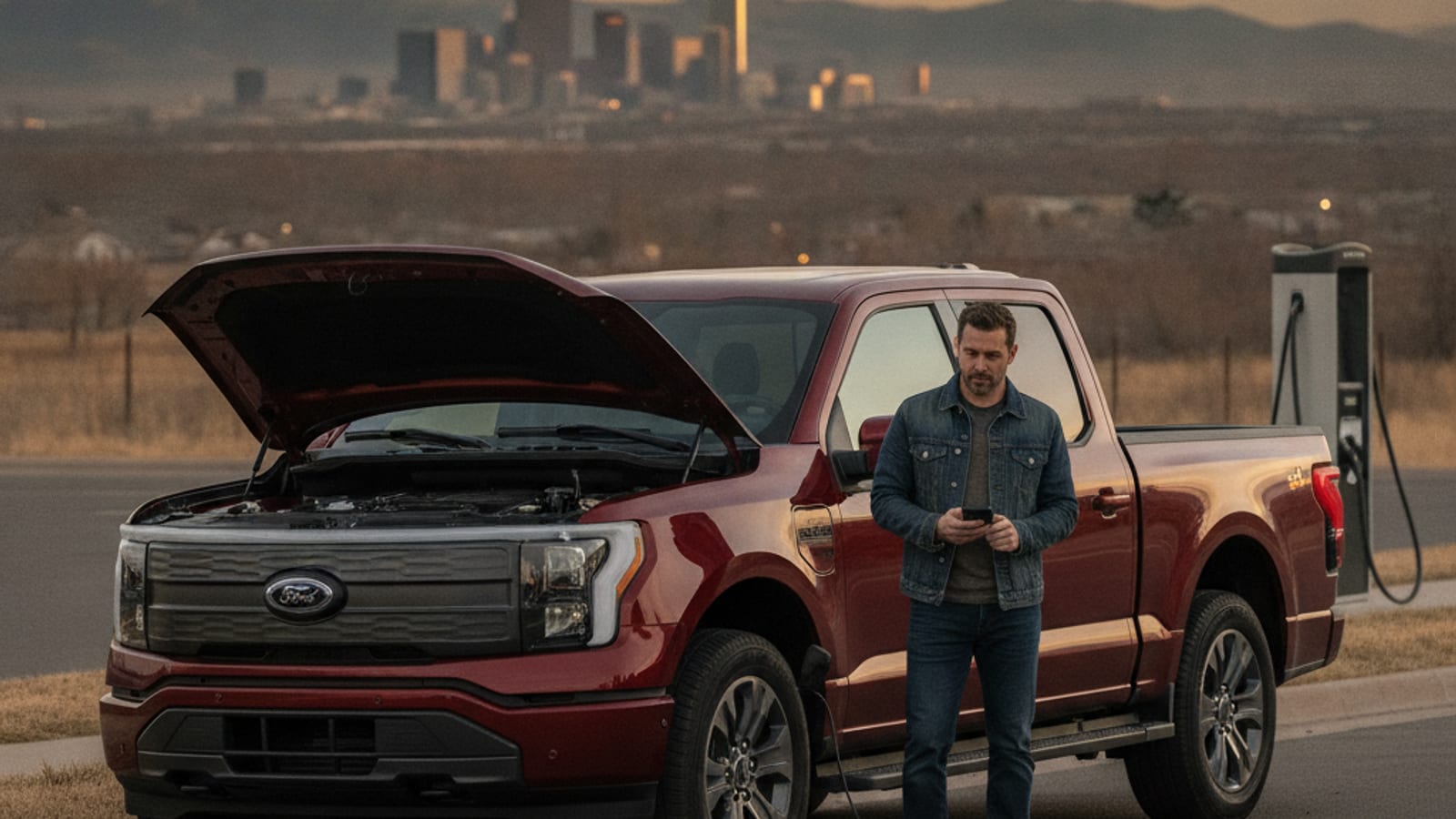
USAA roadside for a dead EV battery starts with a question you have to answer before you dial. USAA is the insurance and membership side of the company, and it dispatches its roadside help through a partner network. Confirm what your specific policy actually sends. Confirm what gear the truck carries. A separate option exists for a pack that is empty or a 12-volt that is dead: an independent local operator in the Denver metro with a 240-volt Level 2 source or a 12-volt jump can reach you on a shoulder, a driveway, or a parking structure. If that is the job, call (720) 738-6950. The operator quotes you before any cable goes in.
What USAA roadside is, and what it is not
USAA membership runs through insurance, banking, and a roadside program that is sold as an add-on or bundled with auto policies. The roadside phone line dispatches through a third-party network. That is the system the operator you speak with is reaching into.
Roadside programs generally include jump-starts, flat-tire changes, lockout help, fuel delivery for gas cars, and tows. Towing usually covers a set number of miles per disablement and a per-mile fee beyond that. Coverage specifics are tied to your membership tier and your policy language, not to a national price sheet.
This page does not publish a USAA mileage cap or a USAA jump-versus-tow table, because that information depends on your specific membership and the third-party dispatcher’s policy. Read your USAA coverage booklet, open the USAA app, and ask the dispatcher before you wait on the truck. Ask whether the truck carries EV charging gear. Ask whether this call will move as a flatbed to a shop.
The default answer for an empty pack is still a flatbed tow. The truck does not bring 240 volts to the bumper by default. A dead 12-volt battery is a different call: that is a jump, and most roadside trucks are equipped for one. The two situations get handled differently and they are easy to confuse when you are standing in a cold lot at 9 percent pack.
Cold Denver mornings kill the 12-volt, not the pack
January around Denver can drop to single digits and below. A car that sits outside overnight in that cold is doing more than losing range. The battery management system wakes to run thermal management on the traction pack. That wake cycle pulls from the 12-volt battery, which is a separate, smaller battery that runs the computers, contactors, and door locks.
A long sit in that cold can drain the 12-volt below the voltage the car needs to wake up. The traction pack may still hold hundreds of miles of range. The car looks dead because it cannot start the systems that wake the pack.
Recurrent Auto studied more than 30,000 U.S. EVs in winter. At 32 degrees, EVs kept about 78 percent of max range. At 20 degrees, they kept about 70 percent. AAA’s 2026 study found about 39 percent range loss at 20 degrees. Those figures are about range, not about the 12-volt. The 12-volt problem is a separate failure mode that shows up in the cold.
If the dash showed low range first, treat the situation as an empty pack. If the car sat dark through a freeze, treat it as a 12-volt first. A roadside jump is the right tool for a 12-volt. A flatbed is the wrong tool. A mobile Level 2 charge is the right tool for an empty pack.
USAA may jump a 12-volt, and it will not deliver a roadside charge
USAA roadside dispatches a partner-network truck. The average jump on that truck is a 12-volt jump: a small box of jumper cables and a portable battery. Most partner trucks do not carry a 240-volt Level 2 EV charger. If you ask for a charge and the dispatcher says no, that is the reason.
For an empty traction pack, a flatbed tow to a shop or a public charger is the typical USAA outcome. The truck lifts the car and delivers it somewhere with a plug. You wait on that stall to add enough range. The clock starts on the truck, not on your pack.
USAA roadside can dispatch a jump if you describe a 12-volt symptom. A driver who walked out to a dark EV after a cold night, who heard nothing when they pressed the brake, who could not unlock the doors with the key fob, is describing a 12-volt symptom. A driver who watched the range count down to zero on the highway is describing an empty pack. Different calls get different answers.
The referral path from mobile EV charging is a third option. An independent operator in the Denver metro brings a 240-volt Level 2 source with the right plug for your car. They add about 10 to 20 miles of range in 15 to 30 minutes of charging. That is enough to reach a public stall on your own wheels.
CDOT Safety Patrol will jump, not charge
The state’s free roadside program is CDOT Safety Patrol, run by the Division of Maintenance and Operations. On covered Front Range segments, including portions of I-25, I-70, US-6, C-470, and I-225, the patrol helps with tires, jumps, emergency fuel, debris, and minor mechanical problems. The published menu does not mention electric vehicles or EV charging. CDOT’s breakdown page is also silent on EV charging.
A CDOT patrol truck can jump a 12-volt on a covered segment during posted hours. It cannot deliver a charge to a traction pack. Front Range weekday windows run 6:00 to 9:30 a.m. and 2:30 to 7:00 p.m. Weekend windows run 10:00 a.m. to 7:00 p.m. The Mountain Corridor window is 6:00 a.m. to 7:00 p.m., Friday through Sunday and during significant weather. Outside those hours, the patrol is off shift and that free jump is not available.
For an EV that ran the pack to zero on I-70 west of Golden, the CDOT patrol is the wrong call. For an EV that sat in a cold Aurora or Denver lot overnight and will not wake, the CDOT patrol is the right call during hours, on a covered segment, when the issue is the 12-volt.
E-470’s own line will jump, not charge
On the eastern toll loop, E-470 publishes free roadside help through *470. The published list is flat tires, jump-starts, fluid top-offs, phone help, and debris removal. It does not include EV charging. *CSP, which is *277, reaches Colorado State Patrol. E-470 does not publish a charge service for an empty pack, and the shoulder is narrow in places, so the priority is to be visible and to ask for a jump when that is the actual job.
What a mobile EV charge actually is
Charge Pro DEN is a referral line for stranded drivers in the Denver metro. The brand performs no work, owns no trucks, and employs nobody. The match goes to an independent local operator who quotes before any cable goes in. The operator bills the driver directly. The dispatch number is (720) 738-6950.
The kit is a 240-volt Level 2 source on wheels. Tesla drivers get a native NACS plug on the lead. Other EVs use a CCS or J1772 adapter. Charging time is about 15 to 30 minutes on the cable, and the operator confirms the range added when charging finishes. The number quoted by the operator is the actual answer for your car on that day.
Those added miles let the driver reach a public stall under their own power. For an empty pack, the right service is out-of-charge recovery. For the broader choice between a charge and a tow, mobile EV charging walks the comparison. Operators we refer cover the metro from the plains to the foothills, including Aurora and Lakewood.
For a 12-volt jump on a dark car, Tesla 12V battery jump is the right service. The operator opens the front trunk on a Tesla or the under-hood fuse block on most other EVs, applies a portable jump pack or a jumper lead from a 12-volt source, and confirms the car wakes. A Tesla with the newer lithium 12-volt in the Model 3 and Model Y takes the same approach but with a different procedure on the front-trunk lead. The operator quotes the job before any cable goes in.
When to call USAA, when to call CDOT, and when to call a local operator
Three different phone numbers cover three different situations.
Call USAA first when the problem is a flat, a lockout, or a tow to a specific shop. The dispatcher reads your policy language and decides what the truck is allowed to do. That is the path the policy was built for, and it is the right path for a flatbed to a service center.
Call CDOT Safety Patrol during posted hours, on a covered segment, when the problem is a dark 12-volt after a cold night and the car is on a Front Range freeway or the Mountain Corridor. That free jump is exactly the job they publish, and the dispatch is handled by the patrol trucks themselves.
Call (720) 738-6950 for a referral when the problem is an empty traction pack or a 12-volt that will not wake in a driveway or parking structure. The independent operator brings Level 2 or a portable 12-volt source to the car. They quote you before starting. They bill you directly for the work they do. We serve the metro from the plains to the foothills. There is no membership with Charge Pro DEN.
A common call in this metro is a USAA member who woke up on a Monday in an Aurora apartment lot with a dead EV and a USAA card in their wallet. They call USAA, get told the truck will jump or tow, and realize the truck cannot add range to the empty pack. They call us next, and the operator reaches the lot with a Level 2 source. That two-call sequence is normal. The first call is the right first call. The second call is the right second call.
For a Tesla 12-volt jump on a Tesla that will not wake, the operator follows the same procedure Tesla documents for Model 3, Model Y, and the older Model S and Model X. The first step is the under-hood fuse block or the front-trunk leads, never the traction pack terminals. A wrong jump on the wrong terminals can damage the contactors or the DC-DC converter, and that is a tow, not a fix.
For EV roadside assistance in the broader sense, the metro has both free public options and paid private ones. The free options jump a 12-volt on a covered segment during posted hours. The paid options add range in place. Read each option for the actual job, not for the brand promise.
A safe shoulder is the first two minutes
CRS 42-4-1202 is the disabled-vehicle statute. Outside a business or residential district, a driver may not stop or leave a vehicle on the paved main-traveled part of a highway except when the vehicle is so disabled it cannot be moved off. Hazard lights must be on under CRS 42-4-230. A driver who can move the car to the right shoulder should do so. A driver who cannot should stay in the vehicle with hazards on and dial.
For an EV that lost power mid-drive on a Front Range freeway, that means pulling right, parking on the shoulder, turning on hazards, and calling for help. USAA, CDOT, or a referral line all start with the same two minutes of safe positioning. The next two minutes decide which number to dial.
Recurrent Auto’s data is real, and it explains the empty-pack pattern in winter. A 30-percent range loss on a cold morning is not a battery defect. It is the working chemistry of an EV in a Denver January. The right response is to leave more margin at the start, not to blame the car when the gauge drops fast.
Frequently asked questions
Does USAA roadside charge an EV?
USAA’s published roadside help covers flat tires, lockouts, jump-starts, fuel delivery for gas cars, and tows. The page could not confirm a published USAA policy for on-site EV charging in Colorado. Read your USAA coverage booklet and ask the dispatcher before you wait on the truck. Many empty-pack calls still move as a flatbed.
Will USAA jump a dead 12-volt on a Tesla?
A 12-volt jump is on most roadside menus, and a Tesla’s 12-volt is reachable through the under-hood fuse block on older Teslas or the front-trunk leads on newer ones. Confirm with USAA before the truck rolls, and ask whether the operator is comfortable with the Tesla-specific 12-volt procedure. A wrong jump can damage the DC-DC converter, which is an expensive tow.
Can I keep USAA and still call for a mobile charge?
You can keep both, because they solve different problems. USAA roadside covers flats, lockouts, and flatbed tows. A local Level 2 operator adds range on site. There is no membership with Charge Pro DEN. Calling one does not cancel the other.
What if the pack is at zero and USAA flatbeds me to a shop?
The shop may not have a public stall open that day. You could pay shop rates for the day. A mobile Level 2 charge in place adds the 10 to 20 miles you need to reach a public charger under your own wheels, which is usually faster and cheaper. Call (720) 738-6950 if you want that match.