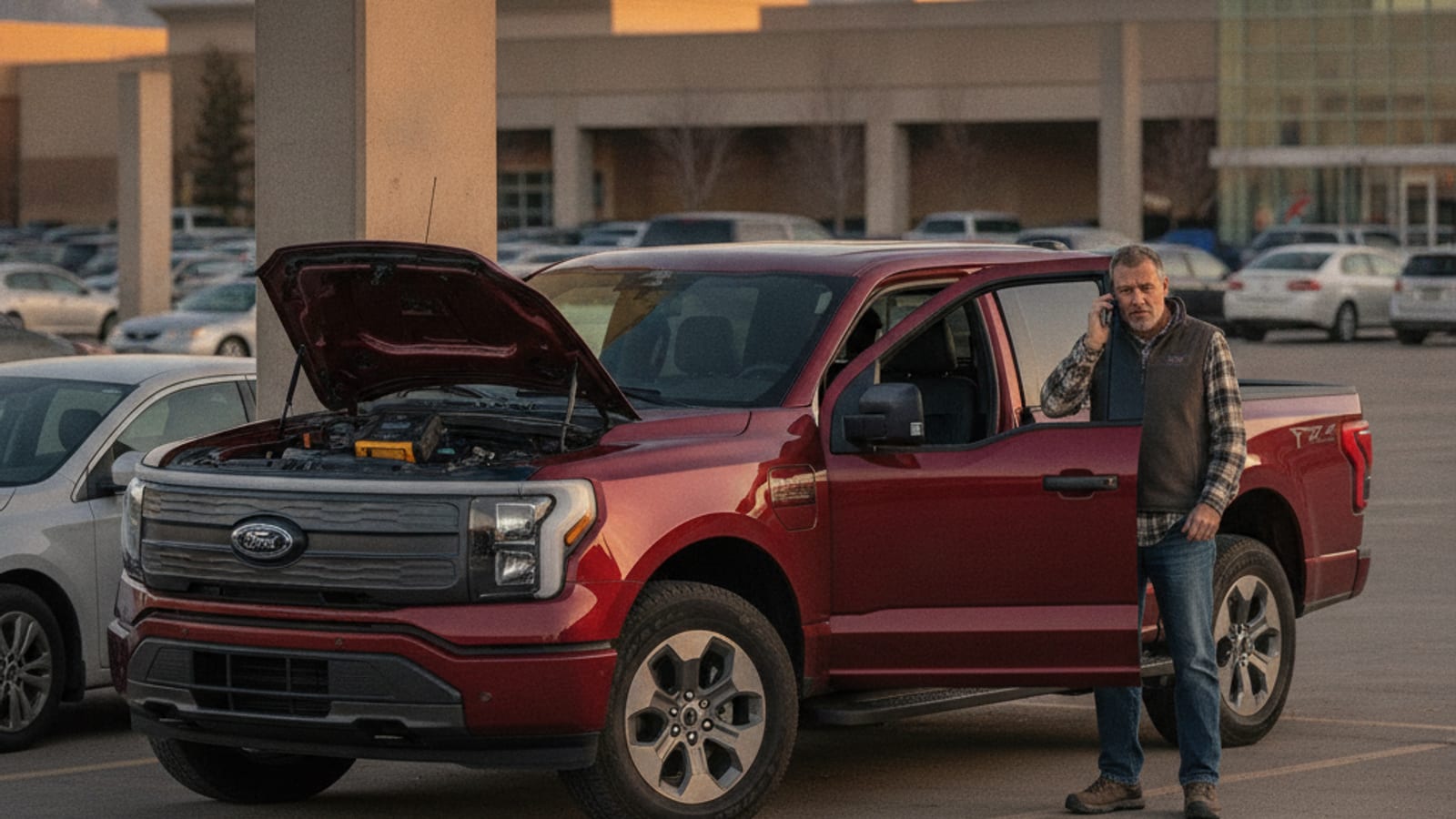
Mobile EV charging at Park Meadows starts with a phone call to (720) 738-6950. You parked a working EV at the mall, walked in for what you thought would be a couple of hours, and came back to a car that will not wake. The dash stays dark. The doors stay locked. The screen stays blank. That is almost always a 12-volt problem, not an empty pack. The traction pack still has range. The small battery that powers the computers, the contactors, and the door locks is dead. It sat through a cold Lone Tree garage while you shopped, and the cold finished it.
The Lone Tree pattern is home charging plus long dwell
Lone Tree sits on the south end of the metro along I-25 and C-470. Under 1 percent of Lone Tree’s housing predates 1980, the newest stock in the whole metro. That means nearly everyone charges at home on a 240-volt outlet or a wall connector. The call mix here is not the no-plug kind. It is the dead-after-a-long-dwell kind. Park Meadows is the largest mall in the region, and cars sit in its garage for hours. Sky Ridge Medical Center holds cars all day and into the night. The RidgeGate and Heritage Hills driveways add the overnight cold-soak no-wake pattern.
CORE Electric Cooperative, not Xcel, serves this whole corridor. CORE’s residential COREV Charge program is at capacity and closed to new applicants. None of that matters when your Tesla will not wake up at level two of the Park Meadows garage at 9 p.m. on a Saturday. What matters is that you can call one number, and a local operator comes to your car with a 12-volt jumper and a Level 2 source.
Why a long sit in the cold drains a weak 12-volt
The traction pack and the 12-volt are separate systems. The pack moves the car. The 12-volt wakes the car. It runs the computers that talk to the key fob, the contactors that close when you press the brake, the screen that turns on, and the locks that let you in. When the 12-volt battery is marginal, the car looks finished even though the pack still holds plenty of range.
Cold speeds up the loss. A 12-volt sitting in a cold Park Meadows garage overnight loses charge faster than one in a heated garage. January’s normal low around Denver sits near 18 degrees, and the Park Meadows garage is climate-controlled but not heated to the same level as a residential garage. After a few hours at those temperatures, a 12-volt that was already weak will drop below the voltage the car needs to wake. Add the small phantom drain that every EV pulls to run thermal management and to watch for the key fob, and a 12-volt that looked fine in the morning is dead by dinner.
The Tesla at level two of the garage, the Lucid that was plugged in at the Tesla Supercharger three hours ago, the Hyundai that came in with 60 percent on the dash, they all hit the same wall when the 12-volt fades. The pack is fine. The car is not.
What actually fails, and what does not
The traction pack does not lose meaningful charge sitting in a Park Meadows garage for an afternoon. It is sealed, large, and built to hold state. If the gauge showed real range when you parked, the gauge should show real range when you came back, minus a small phantom loss. A pack that drops from 60 percent to nothing in three hours is a different problem, one that points at a thermal runaway or a coolant leak, and that is a flatbed, not a mobile charge.
The 12-volt, by contrast, is a small flooded or AGM battery, and it loses capacity in cold the same way a gasoline car’s starter battery does. The EV uses more of it, on purpose, to run a low-power state while you shop. The math stops working when the battery is old, when the temperature drops, and when the dwell stretches past a few hours.
The empty-pack side of the same call
A different Park Meadows call comes in with the opposite cause. A driver came to the mall with 20 miles of range left. They meant to plug into the Tesla Supercharger at Park Meadows (10 stalls per the current inventory) and ran inside first. Three hours later, the pack is at 0 percent and the car will not shift into drive. This is an empty pack, not a 12-volt. The operator brings a 240-volt Level 2 source with a NACS, CCS, or J1772 adapter and adds 10 to 20 miles of range in 15 to 30 minutes of charging. The clock starts when charging starts. That is enough to clear the lot and reach the Supercharger, or to drive home.
Charge time depends on state of charge, pack size, the car’s onboard charging capacity, equipment output, and temperature. A cold pack charges slower than a warm one, and the operator confirms what the cable can add before they start.
What an operator can do in the Park Meadows lot
The mobile EV charge job in a Park Meadows garage has three flavors. First, the operator jumps the 12-volt and the car wakes. The driver drives home. Second, the 12-volt is too weak to hold a charge, and the operator replaces it on site with a fresh unit. Third, the pack was already low, and the operator adds Level 2 range so the car can roll.
Operators carry a 240-volt Level 2 source on the truck. For Tesla drivers, the lead ends in a native NACS plug. For other EVs, the operator brings a CCS or J1772 adapter. The operator quotes you before any cable goes in. They bill you directly. You do not pay Charge Pro DEN, and we do not set the price.
Charge Pro DEN is a referral line. We are the match between you and an independent local operator. The brand performs no work, owns no trucks, employs nobody, sets no price, and promises no arrival time. We do not publish hours or a license number, because we are not the operator. The operator is licensed, and the operator confirms the work in writing.
Cold weather on the I-25 and C-470 commute
The Park Meadows lot is one place the 12-volt fails. The Lone Tree commute is another. Drivers on I-25 and C-470 in January hit stop-and-go traffic with the cabin heater running. Recurrent Auto studied more than 30,000 U.S. EVs in winter. At 32 degrees, the average car kept about 78 percent of its max range. At 20 degrees, that fell to about 70 percent. The best heat-pump cars held more. The worst cars held less. Cold plus grade plus heater is exactly what pulls range out of a pack faster than the trip meter predicts.
A weak 12-volt plus a cold morning plus a long sit is the formula for the dead-at-Park-Meadows call. The car was fine when you parked it. The car was not fine by the time you came back. The cold found the weak battery first.
What to try before you call
If the car will not wake but the screen flickers, the 12-volt is not fully dead. It is below the voltage the car wants. Lock and unlock the car a few times with the fob. Some cars will wake after the third or fourth cycle. If the fob does nothing, the 12-volt is below the fob’s threshold. Move on to the call.
If the car will not shift into drive but the screen wakes, the pack may be empty or the contactors may not have closed. Read the dash for an actual state-of-charge number. Anything over 5 percent means the pack is fine. The 12-volt or a contactor issue is the cause.
If the car is dark and the doors will not open, the 12-volt is fully discharged. Tesla drivers can power the frunk or the doors from an external jump point under the nose. Other EVs have their own jump points. Check the manual. If you do not have a portable jumper or a friend with one, the operator brings both.
What to tell the operator when you call
Pull together four pieces of information before you call. First, the year, make, and model. Second, whether the car is dark and locked or dark and unlocked. Third, whether the dash shows a pack percentage or reads zero. Fourth, the level and aisle of the Park Meadows garage, or the closest cross streets outside it. The operator uses this to bring the right adapter and the right battery.
What Charge Pro DEN is and is not
Charge Pro DEN matches stranded drivers with independent local operators in the Denver metro. We serve the nine regions across the Front Range, from the plains to the foothills. We do not own trucks. We do not employ technicians. We do not set prices for the work, and we do not promise a specific arrival time. The operator we refer quotes you before work starts. You pay them directly for the work they do.
If your EV died at Park Meadows after a long sit, call (720) 738-6950. The operator will ask what you drive and where you are parked. They will quote you before any cable goes in. They will jump the 12-volt or add a Level 2 charge to the pack, depending on what your car actually needs.
Frequently asked questions
Is Park Meadows the only place in Lone Tree where this happens?
No. Sky Ridge Medical Center produces the same dead-battery-after-a-long-dwell call. The RTD lots at Lone Tree City Center and RidgeGate Parkway do the same. Any Lone Tree lot where a car sits for hours in the cold is a candidate. The mall is just the busiest one.
How can I tell whether my car lost pack charge or lost the 12-volt?
Look at the dashboard state-of-charge gauge before you walked away, then compare to now. If the pack gauge reads roughly where it did and the car is dark, the 12-volt is the cause. If the gauge reads near zero or the car threw a low-charge warning before you parked, the pack is the cause. The two problems need different fixes.
Can a Tesla Supercharger at Park Meadows help me if my car is dead?
No. A Supercharger requires the car to be awake and the contactors to be closed before the cable will handshake. A car with a dead 12-volt cannot start the charge session. The 12-volt has to be jumped first. Then you can drive to the Supercharger or to a Level 2 stall.
Will the cold in a Park Meadows garage always kill a 12-volt?
No. A healthy, fully charged 12-volt can sit in a cold garage for a few hours and still wake the car. The trouble starts with a 12-volt already on the way out. Cold is the trigger, not the underlying cause. A battery test in a shop tells you whether your 12-volt is still good or needs to be replaced before the next cold spell.
How long does a mobile EV charge at Park Meadows take?
For an empty pack, plan on 15 to 30 minutes of charging to add 10 to 20 miles of range. That is enough to reach the Park Meadows Supercharger and top off there, or to drive home to a wall connector. For a dead 12-volt, the jump itself takes a few minutes. A 12-volt replacement on site takes longer, and the operator confirms the timing before work starts.