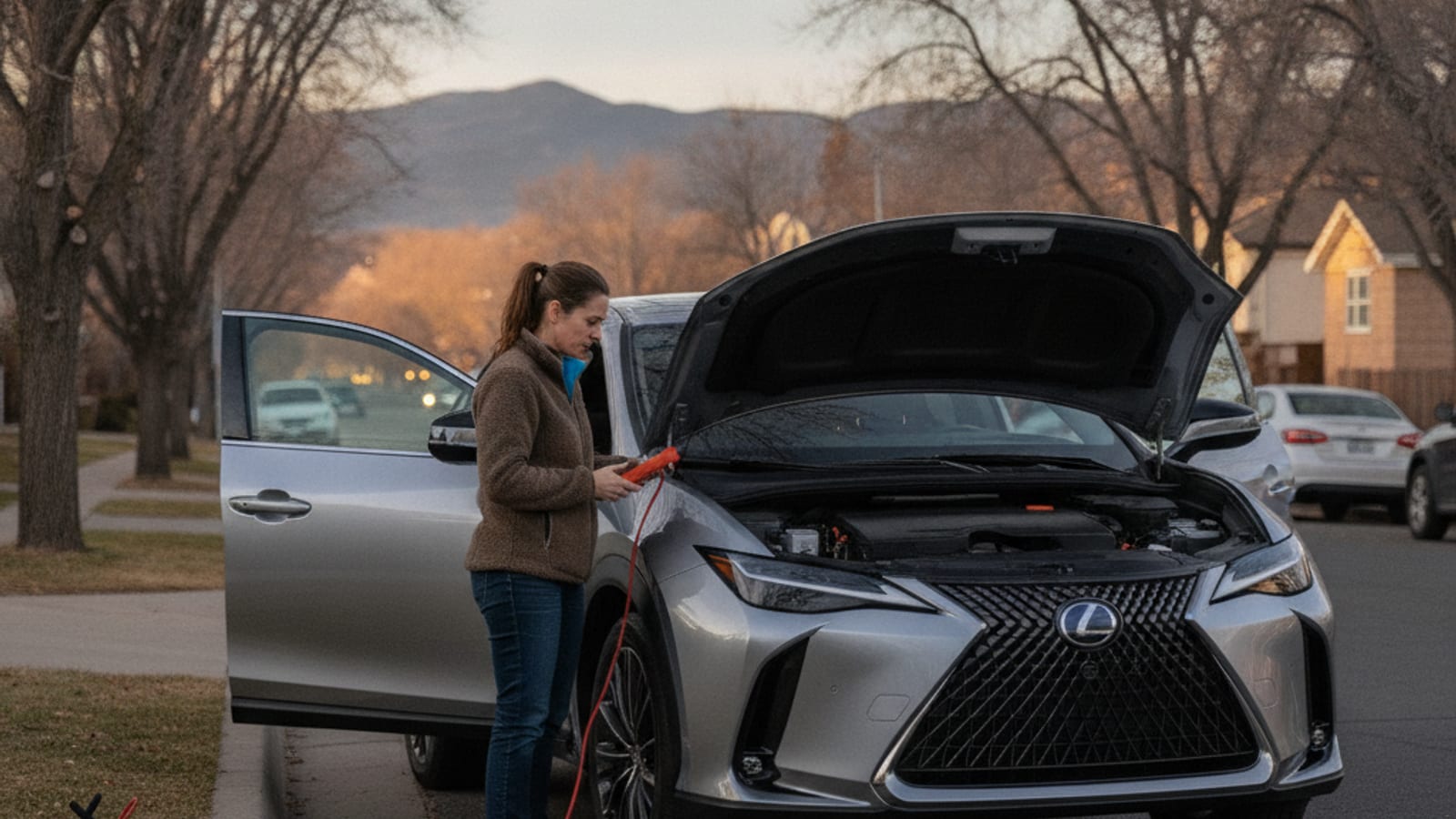
A Lexus RZ that won’t start on a cold Denver morning usually has a dead 12-volt battery, not an empty traction pack. The traction pack is the big unit under the floor. The 12-volt is the small one that wakes the computers, the contactors, and the door locks. When the 12-volt is gone, the whole car looks dead. Pull the right cover, hook the right posts, and most RZs wake right up. For a mobile jump or an on-site 12-volt replacement in the Denver metro, call (720) 738-6950 and an independent operator we refer will quote the work before any cable goes in.
The 12-volt decides whether an RZ wakes up
Every EV has two batteries. The traction pack drives the wheels. The 12-volt runs the computers that close the contactors, light the dash, unlock the doors, and put the car in park. None of that happens without the 12-volt, even when the traction pack is full.
Lexus fits the RZ with a small lithium 12-volt in some model years and a small lead-acid in others. Both die in the cold for the same reason the battery in a gas car’s key fob dies in the cold. Cold slows the chemistry. A battery that was marginal in October is dead in January.
When the 12-volt fails, the car does not crank like a gas car. It simply looks finished. The door handles may not present. The touchscreen may stay black. A double press of the brake produces nothing. That presentation is different from a true traction-pack empty, where the car still wakes up and just shows zero miles of range on the dash.
Recurrent Auto studied more than 30,000 U.S. EVs in winter. At 32 degrees, EVs kept about 78 percent of max range on average. At 20 degrees, they kept about 70 percent. Cold hurts the traction pack too, but it is the 12-volt that decides whether the car wakes at all.
What “won’t start” looks like on an RZ
A driver who says my Lexus RZ won’t start usually means one of three things on a Front Range morning. The first is a dark dash. The door handles don’t present and the screen never lights. The second is a click without a Ready light. The driver presses the brake, pushes the start button, and nothing lights up behind the steering column. The third is a Ready light that flashes and then disappears, with a long list of warnings on the screen.
A driver who says my RZ won’t charge is having a different problem. The pack may be fine and the 12-volt may be fine, but the charge port, the locking pin, or the public stall is the problem. That is a separate topic.
A good test: if the dash stayed dark through the night, treat the car as a 12-volt problem. If the dash was fine yesterday and the pack shows low range today, treat it as an out-of-charge pack. The first is a jump. The second is a mobile Level 2 charge. Operators we refer handle both, but they show up with different tools.
Where the 12-volt lives and how to jump an RZ
The RZ hides its 12-volt under a plastic cover in the front compartment, on the passenger side near the firewall. The exact location and the procedure for lifting the cover vary by model year. The owner’s manual for that year is the only source that gets this exactly right. Two jump posts sit under a separate flap closer to the radiator. The posts are marked plus and minus. Both are reachable without tools.
A jump uses a standard 12-volt booster pack or another running 12-volt source. The order is the same as on a gas car. Red to plus. Black to a known ground, not the minus post if the manual says otherwise. Then wake the car with the brake and the start button. The dash should light, the Ready indicator should appear within a few seconds, and the traction pack should accept a charge on the cable.
A few things not to do. Do not try to charge the traction pack through the 12-volt posts. A 12-volt booster does not move the pack gauge from 0 to 100. Do not swap the polarity. Red to plus and black to ground, every time. Do not try to push-start an RZ. EVs do not push-start. They need the contactors closed by a working 12-volt first.
If the dash lights but the car shows a long list of warnings and refuses to drive, the 12-volt was deep enough that the modules need to relearn. That takes a drive, not another jump.
Front Range cold and what it does to the 12-volt
Denver’s January normal low sits around 18 degrees. On an arctic morning, the metro drops well below zero. A 12-volt battery under the hood sees that air directly. When the battery’s voltage drops below what the car’s modules need to run, the contactors won’t close. The car looks dead even though the traction pack still has plenty of energy left.
The second Denver pattern is a cold-soak dwell. A driver leaves an RZ at Denver International for a week in January. The battery management system wakes periodically to run thermal management on the traction pack. That wake eats the 12-volt. By the time the driver returns to the lot, the 12-volt is gone and the car looks dead, even though the pack still shows a usable state of charge. The same pattern shows up in long airport-adjacent lots from Aurora up to the city line, and we covered it on the mobile EV charging page.
A third pattern is short-trip street parking. Older parts of Denver and Wheat Ridge have a large share of pre-1980 housing and few dedicated home plugs. An RZ parked outside runs phantom drain to keep the pack warm. The same cold that froze the morning also killed the 12-volt.
What CDOT Safety Patrol will do for free
CDOT Safety Patrol covers listed metro segments for free, and a jump-start is on the list. The published Front Range metro coverage includes I-25 South from 120th Avenue to Arapahoe Road, I-70 East from Wadsworth to Airport Boulevard, and portions of US-6, C-470, and I-225. The I-70 Mountain Corridor is also covered from Morrison to Vail. The published hours are 6:00 to 9:30 a.m. and 2:30 to 7:00 p.m. on weekdays, and 10:00 a.m. to 7:00 p.m. on weekends. On the mountain corridor the hours run 6:00 a.m. to 7:00 p.m. Friday through Sunday and during significant weather.
A Safety Patrol driver will jump a 12-volt on a covered segment during a published window. They will not charge an empty traction pack, and they will not come to a parking lot in an apartment building or to a side street in Lakewood. The free program is for the listed highways during the listed hours.
Peña Boulevard, the only road into Denver International, is city-maintained. CDOT’s published list does not include it. A stranding on Peña is a different call. On E-470, the toll loop’s own roadside line is *470 for a jump and a tire. The state-patrol non-emergency line is *CSP or *277.
When a mobile jump is faster than a tow
A tow to a dealership or a shop is a real option when the car cannot move under its own power. It is not always the fastest option. A mobile operator who brings a 12-volt booster and a fresh 12-volt for common RZ model years can usually wake the car on the spot. The RZ then drives away at low speed, and the operator follows the driver to a public stall for a Level 2 charge if needed.
Operators we refer serve the whole metro from the high plains at 5,280 feet to the foothills at 7,000 feet and above. Aurora drivers see the same calls. Highlands Ranch drivers see the same calls. Cold and short-hop driving do not stop at a city line. The traction law that activates on I-70 in storms does not affect a metro-side jump.
The typical mobile jump adds no range, but it doesn’t need to. The traction pack still has the miles the driver charged the night before. The 12-volt is the only thing that had to come back. For the broader pattern of when to ask for a roadside Level 2 charge instead of a jump, see out-of-charge recovery.
When a tow is still the right call
A mobile jump is the right tool when the traction pack still has charge and the 12-volt is the only thing dead. A tow is the right tool when the car cannot roll, when there is body damage, when a module has gone into a fault that won’t clear, or when the driver wants the car at a specific shop.
CRS 42-4-1202 lets a disabled vehicle sit on a highway shoulder if the car could not be moved further. Hazard lights must be on under CRS 42-4-230. The Colorado Towing Bill of Rights (HB22-1314) sets the rules for nonconsensual tows, including a 24-hour written notice rule for most private-property tows. Drivers should read the law before any nonconsensual tow.
If the RZ cannot roll under its own power after a jump, the operator explains the tow option and quotes it separately. That quote is between the driver and the operator.
How to reach a local mobile operator
Charge Pro DEN is a referral line for stranded EV drivers across the Denver metro. We do not own trucks, and we do not employ technicians. We don’t set prices for the visit. We match a driver with an independent local operator. That operator quotes the work before any cable goes in. They bill the driver directly for the work they do.
Operators we refer bring a 12-volt booster, a fresh 12-volt for common RZ years, and a 240-volt Level 2 source for the traction pack. Typical charging time, when a charge is the right tool, adds about 10 to 20 miles of range in 15 to 30 minutes. That is a range estimate for charging time, not an arrival time, and we do not promise one.
The service covers all nine regions in the metro. Westminster, Lakewood, and the foothills towns up to Evergreen all sit on the same Xcel Energy grid, but the service area is not the same thing as our service area. We serve the whole metro. If the RZ is stranded at a DTC garage with a dead 12-volt, or on a shoulder near the Citadel with a dark dash, call (720) 738-6950 and an operator will reach out to quote the work. Treat the number as a referral line, not a rolling promise.
Frequently asked questions
Is the Lexus RZ reliable in winter?
The RZ is a modern EV with a heat pump on most model years. Recurrent Auto’s winter study showed heat-pump vehicles hold about 10 points more range at 32 degrees than vehicles without heat pumps. The drive system holds up well in Denver cold. The 12-volt does not always do the same. The most common winter no-start on any modern EV is the 12-volt, not the traction pack or the heat pump.
Where is the 12-volt in a Lexus RZ?
The RZ hides its 12-volt under a plastic cover in the front compartment on the passenger side. The cover is plastic and lifts without tools. Two jump posts sit under a separate flap closer to the radiator. The owner’s manual for that model year is the only source that gets the cover and posts exactly right.
Can a 12-volt battery be jumped on an RZ?
Yes. A standard 12-volt booster or a running 12-volt source can wake the modules, close the contactors, and let the car go Ready. Red to plus, black to a known ground. The procedure is in the manual for that year. A jump will not move the traction pack gauge. The pack has its own range and the 12-volt has its own cycle.
What if a jump doesn’t wake the car?
If the dash lights after a jump but the car still shows a long list of warnings and will not drive, the 12-volt was deep enough that the modules need to relearn. Drive, not another jump. If the dashboard never lights at all, the 12-volt is gone or the booster is wrong. Operators we refer know the difference. They tell the driver on the phone before they roll a truck.
When does an RZ need a tow instead?
When the car cannot roll, when there is body damage, when a module shows a fault that a jump will not clear, or when the driver wants the car at a specific dealership or shop. A tow is a separate quote. The operator and the driver work that out directly.