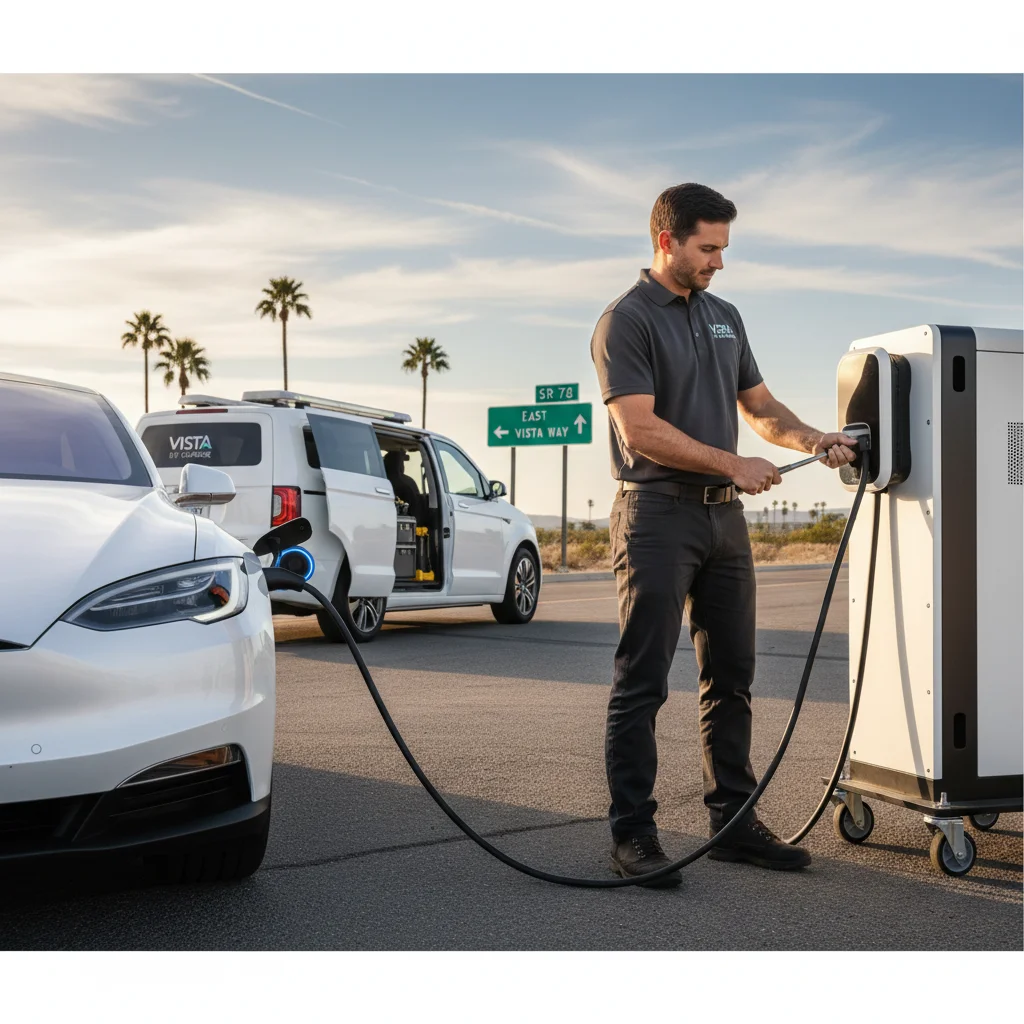
If your EV dies in Northglenn, you need help at the car. That help is a charge or a 12-volt jump. Charge Pro DEN is a referral line, not a shop. We match stranded drivers with independent local operators. The operator quotes you before any work starts, then bills you directly. Confirm your utility by address too. Northglenn splits Xcel Energy and United Power street by street.
Confirm who serves your Northglenn street
Northglenn sits in Adams County, with a Weld County slice, across about 7.36 square miles. The Census 2024 estimate is 38,287 people in a dense, older north-metro grid. About 59.1% of housing was built before 1980. That’s the highest pre-1980 share in the immediate north metro.
Xcel Energy serves the urban core, and United Power serves the Weld County portion. The line isn’t the city limit. It can change from one side of a street to the other. Thornton, Westminster, Broomfield, and Erie split the same way. A program on your neighbor’s bill may not apply on yours.
If you charge at home, read the utility name on the statement. Use each utility’s address lookup when the bill isn’t in your hand. Don’t assume Xcel because you’re in the Denver metro. United Power is the north and northeast co-op. Northglenn is the mixed case, block by block.
United Power publishes United EV for a home charger on a monthly service agreement. It also lists the EV Make-Ready Wiring Rebate. The EV Home Charge Panel Upgrade Rebate is on that list too. The RTD1 time-of-use rate uses Simple Saver scheduling. Xcel publishes EV Accelerate At Home and the EV Home Wiring Rebate. Other Xcel names are Optimize Your Charge, Charging Perks, and the RE-TOU residential time-of-use rate. Xcel also lists the Residential EV Rebate and the Public Charging Acceleration Network. Rebate amounts weren’t confirmed on United Power’s or Xcel’s published EV pages. Ask the utility that actually serves the address.
The local hub is the Northglenn charging page. For the metro-wide billing question, see who bills a Tesla charge in the Denver metro.
A home charger that never woke is a utility and panel problem first. An empty pack on I-25 is a roadside rescue, so don’t mix those two calls.
I-25, 104th, and 120th: where the car stops
I-25 is the commute spine through town. Washington Street and Huron Street carry the north-south grid. 104th Avenue and 120th Avenue are the east-west cuts. The RTD N Line Thornton/Northglenn station sits on that same pattern. Drivers stall on the freeway shoulder. They stall in a lot after errands. They stall in an older driveway on a cold morning.
CDOT built the I-25 North Express Lanes with a breakdown shoulder. The published design uses a minimum 8-foot outside shoulder. If you stall in those lanes, move to the right, outside shoulder. Stay out of the travel lane. CRS 42-4-1202 is the disabled-vehicle rule. Outside a business or residential district, you may not stop on the paved travel lanes. The exception is a vehicle so disabled it can’t be moved. Put the hazards on: that’s a lawful stop, not a parking choice.
CDOT Safety Patrol covers I-25 from 120th Avenue south to Arapahoe Road. Northglenn sits on that northern edge. Published Front Range weekday hours are 6:00 to 9:30 a.m. Afternoon coverage runs 2:30 to 7:00 p.m. Weekends run 10:00 a.m. to 7:00 p.m. The patrol can jump a 12-volt, change a tire, and clear debris. CDOT’s Safety Patrol pages mention nothing about EV charging. The free state truck won’t fill a traction pack.
You might already be on that I-25 shoulder. Read what to do on I-25 through the north metro. Thornton is the next city in that pattern. See EV roadside assistance in Thornton.
January’s normal low is about 18 degrees. Recurrent Auto’s winter study found EVs keep about 78% of max range at 32 degrees. At 20 degrees they keep about 70% on average. Heat-pump models held about 10 points more at 32 degrees. That’s why a northbound commute can burn the buffer before 120th.
NREL’s 2026 pull lists Tesla Superchargers in Northglenn, Thornton, and Westminster. You can still stall short of the stall you planned to use. A queue or a failed session can stop you before you plug in. A cold 12-volt can do the same. That’s a car-side problem, not a map problem.
Older streets, apartments, and a dark 12-volt
Original Northglenn, Stonehocker, Fox Run, Hillcrest, and the Webster Lake area aren’t new subdivisions. They don’t all have a 240-volt wall unit in every garage. Nearly six in ten homes predate 1980. Panel space is tight, and many drivers have no driveway plug. They finish a shift, sit through errands, then find the car won’t ready.
A long sit in the cold often kills the 12-volt, not the traction pack. Doors won’t unlock, and the screens stay dark. The pack may still have miles. That’s a jump or an on-site 12-volt replacement. It’s not a flatbed to a shop. The same pattern shows up after a walk around Webster Lake. It also shows up at E.B. Rains Jr. Memorial Park and Croke Reservoir.
The Northglenn Marketplace is a mid-errand dwell, not a freeway call. You ran in for groceries, and the car sat in the freeze. Then it won’t wake. Start with the 12-volt before you assume the pack is empty.
Apartment drivers and older-home drivers also call when overnight charging never started. The cause might be a tripped breaker. It might be a program or panel limit. It might be the car. Confirm the utility for that exact address first. Then decide if the car needs a boost.
Federal Heights and Westminster sit on the same north-metro edge. If you rolled west or south, the job is the same. You still need a charge in place or a 12-volt wake-up.
What the operator brings to the car
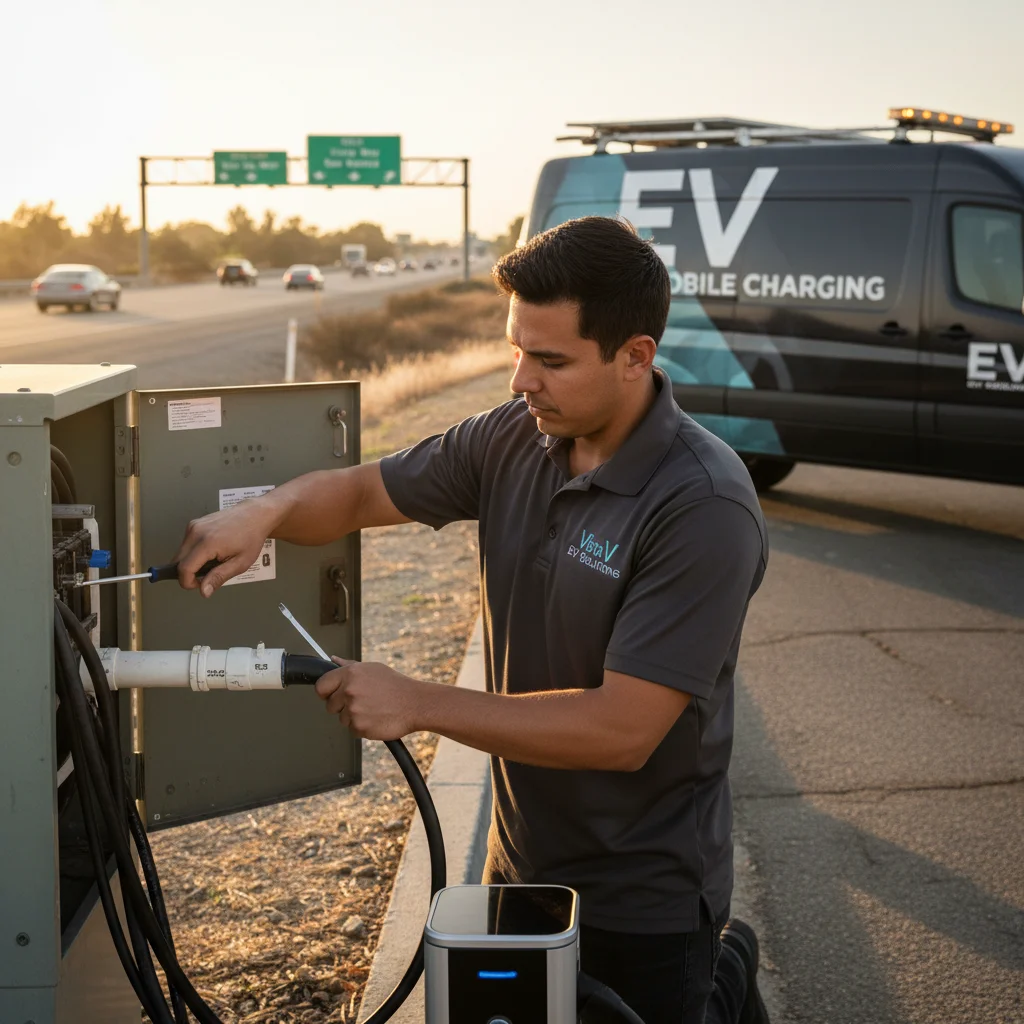
Charge Pro DEN doesn’t own trucks. We don’t employ technicians, and we don’t set a price. Independent operators do the work, bill you directly, and quote before they start.
What those operators typically bring:
- A 240-volt Level 2 source at the car
- A native NACS plug for Tesla
- A CCS or J1772 adapter for non-Tesla EVs
- About 10 to 20 miles of range in 15 to 30 minutes of charging time
- A 12-volt jump, or a 12-volt replacement on site
That 15 to 30 minutes is time on the plug. It’s not a promise of when someone arrives. We don’t publish an arrival window.
If the pack is empty, a mobile EV charge is the usual fix. If the car is dark, start with the 12-volt. Tesla and every major EV brand are in scope. For the broader rescue page, use EV roadside assistance.
Price moves with distance, time of day, and how much range you need. A short boost off I-25 is one kind of job. A long sit in a lot is another. The operator quotes you before they plug in. If the car won’t accept charge, they should say so on site. A charge-port lock, a structural fault, or a battery-management error isn’t a fill-and-go call.
A tow is still right when the car can’t take a charge. It’s also right when you need a shop. Colorado has no EV-specific breakdown statute. A stranded EV follows the same disabled-vehicle rules as any car. Abandoned-vehicle law under CRS 42-4-1803 uses officer discretion. It doesn’t set a fixed clock. For the charge-versus-tow decision, read charge in place or tow.
When this is the right call
Call when the pack is empty on I-25, 104th, or 120th. Call when the car won’t ready in an older driveway. Call after a Marketplace or park lot sit leaves you with a dark 12-volt. Those are rescue jobs, not repair-shop jobs.
Keep the hazards on, and stay out of the travel lane. You might be on a covered I-25 segment during patrol hours. Safety Patrol can still help with a 12-volt jump or a tire. They won’t bring a Level 2 charge.
Charge Pro DEN covers Northglenn with the rest of the Denver metro. We connect you with a local operator. That operator quotes the job and does the work. Call (720) 738-6950 when you need that match.