Your EV won’t ready on an Erie street. The first instinct is to blame the pack. That’s the wrong first move in this town. Erie splits Xcel Energy and United Power by address. Western streets sit on Xcel, while most of town sits on United Power. The town also straddles Boulder County and Weld County, so a neighbor’s bill isn’t your proof. A plug that seemed dead overnight might be the wrong utility. It might be a 12-volt that never woke. It might be a pack that actually ran out on SH-7. Roadside help in Erie starts with that utility check. Then you match with an independent operator for a charge or a jump on site.
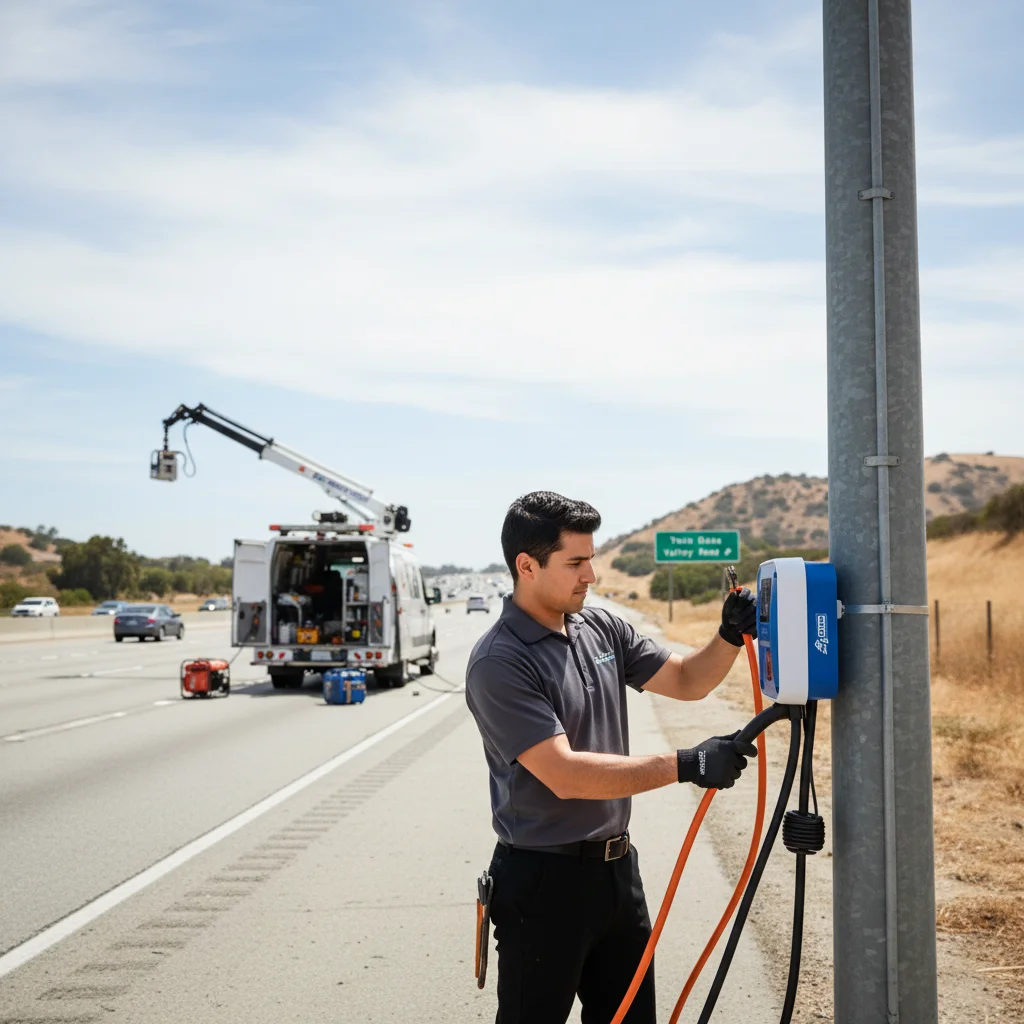
Confirm Xcel or United Power before you blame the car
Erie is the sharpest utility split in the Denver metro. Xcel Energy, the Public Service Company of Colorado, covers the western portion. United Power covers the rest. Confirm the account by address on each utility’s lookup. Don’t guess the utility from a ZIP code. 80026, 80504, and 80516 all appear in town. None of them names the electric company.
The same street-by-street pattern shows up in several north-metro cities. Thornton, Northglenn, Westminster, Arvada, Broomfield, and Commerce City all split too. Erie’s version is harder because two counties are in play. You can live on the Boulder side and still sit on United Power. You can live on the Weld side and still sit on Xcel. The lookup is the only clean answer.
Home programs follow that line. Xcel lists EV Accelerate At Home and the EV Home Wiring Rebate. It also lists Optimize Your Charge and Charging Perks. Xcel publishes the RE-TOU time-of-use rate. It also publishes the Residential EV Rebate. The Public Charging Acceleration Network is on that list too. United Power lists United EV, a ChargePoint Home Flex on a monthly service agreement. It also lists the EV Make-Ready Wiring Rebate. There’s an EV Home Charge Panel Upgrade Rebate. United Power publishes the RTD1 time-of-use rate with Simple Saver scheduling. Dollar amounts for those rebates aren’t confirmed here. Read them on the utility that actually serves the house. Who bills a Tesla charge in the Denver metro walks the same map. Thornton’s backup-power split is the closest cousin. Read it when you’re not sure who owns the wire.
Home charging is common, and the calls start on the road
Only about 6.3% of Erie’s housing was built before 1980. The 2024 Census population estimate is 38,594. Income in town runs high, and newer subdivisions are built around a garage plug. Vista Ridge, Colliers Hill, Erie Highlands, Kenosha Farm, and Flatiron Meadows fit that pattern. Old Town Erie has a tighter grid, but the stock still skews new. Home charging is the norm in those subdivisions. When a car dies here, it’s usually a commute that ran thin.
This is a fast-growing high-plains town on the Boulder and Weld line. It’s fully exposed to wind and cold. Commutes run SH-7, signed as Arapahoe, plus US-287 to the west. I-25 sits to the east, and SH-52 crosses the north side. Erie Parkway and County Line Road connect the neighborhoods. A cold morning plus a highway cruise can come up short of the garage.
Recurrent Auto studied winter range loss across more than 30,000 U.S. EVs. EVs keep about 78% of max range at 32 degrees. They keep about 70% at 20 degrees, on average. Denver’s January normal low is around 18 degrees. The January 2024 arctic blast hit the Front Range hard. Denver dropped from 47 to minus 19 in about 48 hours. Erie sits on that same exposed Front Range. Plan as if the wind is part of the math.
If you need to describe where you are, use real place names. Old Town Erie, the Erie Community Center, and Erie Municipal Airport all read clearly. So do the Colorado National Golf Club and Thomas Reservoir. They’re landmarks for a local operator. They’re not a promise of a stall.
SH-7, SH-52, and I-25 when the car stops
A stalled EV on SH-7 or SH-52 is a disabled vehicle under Colorado law. CRS 42-4-1202 covers a disabled vehicle on the shoulder. You may stay off the paved travel lanes when the car truly can’t move further. Keep hazard lights on, as CRS 42-4-230 requires. A violation is a class B traffic infraction. No Colorado statute carves out a special rule for a dead EV. The shoulder rules are the same as any other car.
I-25 sits east of town. The I-25 North Express Lanes were built with a minimum 8-foot outside shoulder. If you stop in those lanes, move to the right, outside shoulder. CDOT Safety Patrol can jump a 12-volt and change a tire on some covered freeway segments. Published hours are weekday mornings and afternoons, plus weekend windows. Front Range metro hours are 6:00-9:30 a.m. and 2:30-7:00 p.m. weekdays. Weekend hours are 10:00 a.m. to 7:00 p.m. Those are patrol hours, not a promise that an EV charge will arrive. CDOT’s own pages mention nothing about charging an EV. Don’t wait on that truck for a pack top-off.
Lafayette sits west on SH-7. Longmont sits north, and Broomfield sits south. Dacono and Frederick sit toward Weld County. The commute keeps going as services thin. EV roadside assistance is the call when you need a charge at the bumper. It’s also the call for a 12-volt jump where you sit.
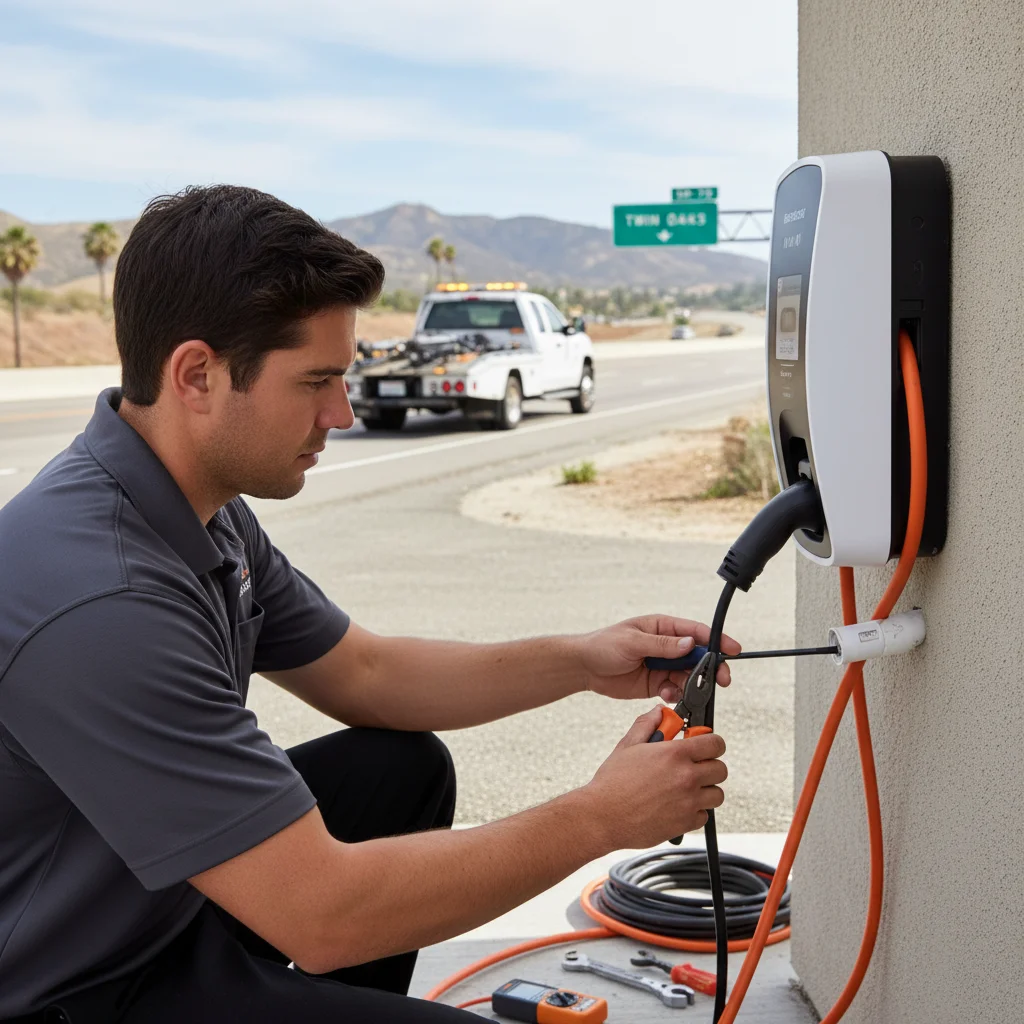
Empty pack versus a 12-volt that never woke
If the car is dark and the doors won’t unlatch, start with the 12-volt. A blank screen is the same clue. That small battery runs the computers and contactors. Cold overnight parking on an open high-plains driveway is a classic way to kill it. The traction pack can still hold miles. You need a jump or an on-site 12-volt replacement. You don’t need a tow to a charger for that.
If you watched the range fall on SH-7 or I-25, that’s an empty pack. You need electrons at the bumper. Operators we connect you with bring a 240-volt Level 2 source. Teslas take a native NACS plug. Other EVs take a CCS or J1772 adapter. They handle Tesla and every major EV brand. Typical charging time adds about 10 to 20 miles of range. That window is 15 to 30 minutes at the car. That’s charging time, not an arrival time. Charge Pro DEN doesn’t promise when someone shows up.
The Tesla 12-volt jump is the right first ask. Use it when the car is fully dark. The operator quotes you before they start, and they bill you directly. The referral line doesn’t set that price.
Charge in place, or actually tow it
An empty pack or a dead 12-volt doesn’t need a flatbed. Tow when the car is damaged or the tire is gone. Tow if you can’t legally stay. Many EVs shouldn’t be flat-towed. A flatbed is the usual mechanical move. Exact tow fees aren’t confirmed here, so ask the carrier before you sign.
Nonconsensual tows fall under the Colorado Towing Bill of Rights, HB22-1314. The Colorado Public Utilities Commission regulates towing carriers. Abandoned-vehicle rules in CRS 42-4-1803 run on officer discretion. The statute sets no published hour clock. Don’t count on a set number of hours on a shoulder.
Charge in place or tow is the decision to make while hazards are on. Mobile EV charging is the charge-in-place option. The operators we send don’t work for Xcel, United Power, or CDOT.
After the car will move, fix the house side
Once you have miles, confirm the utility on the actual bill. Then use that utility’s EV pages, not a neighbor’s screenshot. Xcel tools won’t enroll a United Power house. United EV won’t enroll an Xcel house. Longmont Power and Communications is municipal if your commute ends there. Don’t treat Longmont like Xcel. Broomfield is its own city and county, carved out in 2001. It still splits Xcel and United Power by street.
The garage plug is still the daily plan in this town. The roadside call is the exception. It’s for a thin commute or a dark 12-volt. It’s also for a stall on SH-7 or SH-52. Erie Parkway and the I-25 side count too.
When to call Charge Pro DEN
Call the referral line when the pack is empty. Call if you can’t make the next stop. Call when the car is dark and you suspect the 12-volt. Call when you’re on an Erie shoulder. Ask for a charge brought to the bumper. Charge Pro DEN serves every city in the Denver metro, including Erie. The pros we connect you with are licensed and insured. The brand holds no trade license, owns no trucks, and performs no work.
Call (720) 738-6950. The operator who takes the job quotes you first, then bills you directly.